Home
Class 12
BIOLOGY
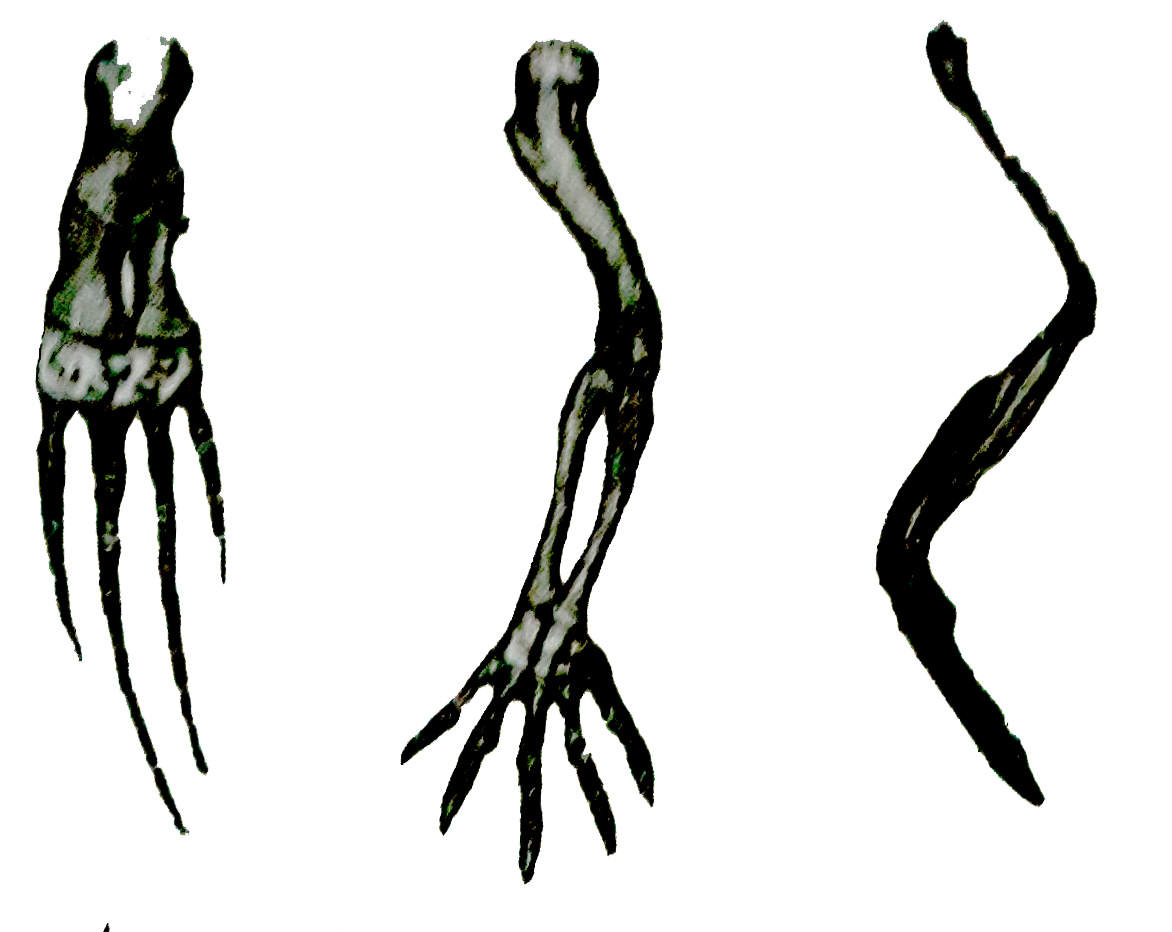
What can you infer about the structures ...

What can you infer about the structures shown in figure?

A

They are homologous structures.

B

They are vestigial structures.

C

They are analogous structures.

D

They have nothing to do with each other.

Text Solution

Verified by Experts

The correct Answer is:

A

Given figures represent the forelimbs of different verbrates, which possess the same basic structural plant. i.e., in each case, the forelimb consists of humerus, radio-ulna, carpais, metacarpals and digits. Thus. The skeletal parts of these forelimbs are similar in structure and arrangement, but have differnt shapes and functions it depicts the example of homologous structures.
Promotional Banner

Topper's Solved these Questions

  • ENVIRONMENTAL ISSUES

    NCERT FINGERTIPS|Exercise Environmental Issues|142 Videos
  • HUMAN HEALTH AND DISEASE

    NCERT FINGERTIPS|Exercise Human Health And Disease|177 Videos

Similar Questions

Explore conceptually related problems

What can you say about the area of two congruent figures?

Two persons are applying forces on two opposite sides of a moving cart. The cart still moves with the same speed in the same direction. What do you infer about the magnitudes and direction of the forces applied.

Which of the following options correctly identifies the structural formulae shown in figure ?

Find the angular momentum of a disc about the axis shown in figure in the following situations.

Some equi-potential surfaces are shown in figure. What can you say about the magnitude and the direction of the electric field ?

Some equipotential surfaces are shown in figure. What can you say about the magnitude and the direction of the electric field ?

NCERT FINGERTIPS-EVOLUTION-Evolution
  1. Which of the following statements is related to karl Ernst von Baer?

    Text Solution

    |

  2. The presence of gill slits, in the mbryos of all vertebrates, supports...

    Text Solution

    |

  3. What can you infer about the structures shown in figure?

    Text Solution

    |

  4. Which one of the following correctly describes the homologous structur...

    Text Solution

    |

  5. The given figure shows an example of

    Text Solution

    |

  6. Which of the following statements is true?

    Text Solution

    |

  7. Which one of the following options gives one correct example each of c...

    Text Solution

    |

  8. Evolutionary convergence is characterised by

    Text Solution

    |

  9. In evolution, the studies can be made at molecular level. For example,...

    Text Solution

    |

  10. Industrial melanism as observed in peppered moth proves that

    Text Solution

    |

  11. Replacement of the lighter-coloured variety of peppered moth (Biston b...

    Text Solution

    |

  12. Phenomenon of industrial melanism demonstrates

    Text Solution

    |

  13. Which one of the following phenomena supports Darwin's concept of natu...

    Text Solution

    |

  14. Which is not a vestigial organ in man?

    Text Solution

    |

  15. Which one is not a vestigial organ?

    Text Solution

    |

  16. Refer to the given figure what does it represent?

    Text Solution

    |

  17. Following diagram provides and example of

    Text Solution

    |

  18. Refer to the given figure The organisms in the given figure repre...

    Text Solution

    |

  19. The diversity in the type of beaks of finches adapted to different fee...

    Text Solution

    |

  20. Consider the following three statements and select the correct option...

    Text Solution

    |
