

Home
Class 12
PHYSICS
Two identical blocks are attached by a m...

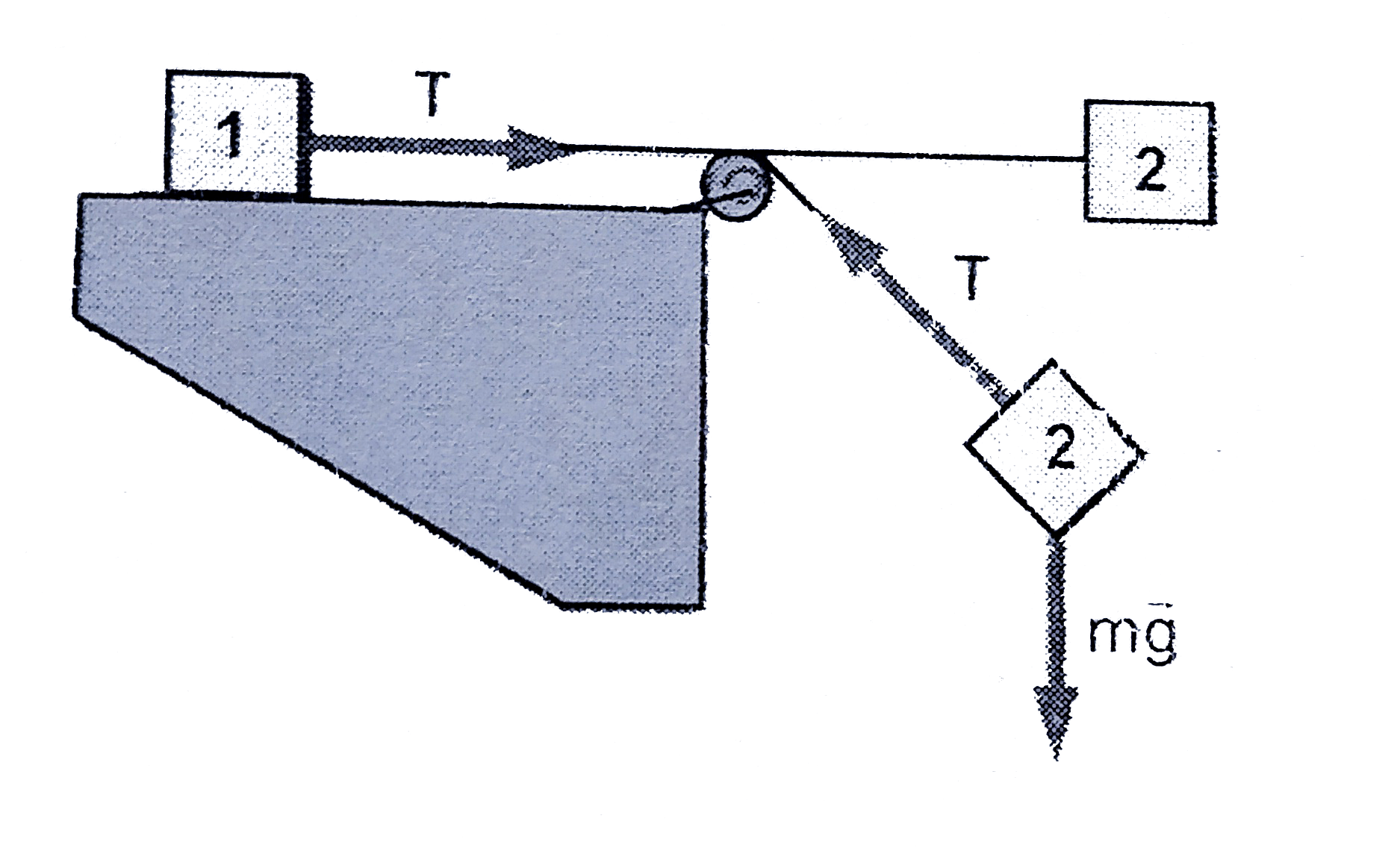
Two identical blocks are attached by a massless string running over a pulley as shown in figure. The rope initially runs over the pulley at its (the rope's) midpoint, and the surface that block 1 rests on is frictionless. Blocks 1 and 2 are initially at rest when block 2 is released with the string taut and horizontal. Assume that the initial distance from block 1 to the pulley is the same as the initial distance from block 2 to the wall.

Promotional Banner

Similar Questions

Explore conceptually related problems

Two identical masses are attached by a light string that passes over a small pulley, as shown . The table and the pulley are frictionless. The hanging block is moving

Two identical masses are attached by a light string that passes over a small pulley, as shown . The table and the pulley are frictionless. The hanging block is moving

Two blocks are connected by a long inextensible string passing over an ideal pulley as shown in the figure. If the system is released from rest then the common speed of blocks when block m_2 moves a distance I will be

Two blocks A and B , each of mass 10 kg , are connected by a light string passing over a smooth pulley as shown in the figure. Block A will remain at rest if the friction on it is

Two blocks A & B are connected by the massless string & pulley. As the blocks are left to move, the force by the pulley on the clamp is

Two blocks of masses of 40 kg and 30 kg are connected by a weightless string passing over a frictionless pulley as shown in the figure.

Two blocks of masses of 40 kg and 30 kg are connected by a weightless string passing over a frictionless pulley as shown in the figure.

In the following arrangement, the system is initially at rest. The 5-kg block is now released. Assuming the pulley and string to be massless and smooth, the acceleration of block C will be

In the following arrangement, the system is initially at rest. The 5-kg block is now released. Assuming the pulley and string to be massless and smooth, the acceleration of block C will be

A block of mass m is attached with a massless spring of force constant k . The block is placed over a fixed rought inclined surface for which the coefficient of friction is mu=(3)/(4) . The block of mass m is initially at rest . The block is mass M is released from rest with spring in unstretched state. The minimum value of M required to move the block up the plane is ( neglect mass of string and pulley and friction in pulley )