Home
Class 12
MATHS
If z(1), z(2), z(3), z(4) are complex nu...

If `z_(1), z_(2), z_(3), z_(4)` are complex numbers in an Argand plane satisfying `z_(1)+z_(3)=z_(2)+z_(4)`. A compex number `'z'` lies on the line joining `z_(1)` and `z_(4)` such that `Arg((z-z_(2))/(z_(1)-z_(2)))=Arg((z_(3)-z_(2))/(z-z_(2)))`. It is given that `|z-z_(4)|=5,|z-z_(2)|=|z-z_(3)|=6` then

A

area of triangle formed by `z,z_(1),z_(2)` is `3sqrt(7)` sq units

B

area of the triangle formed by `z, z_(3), z_(4)` is `(15sqrt(7))/3` sq. units

C

area of the quadrilateral formed by the points `z_(1),z_(2),z_(3),z_(4)` taken in orders is `(27sqrt(7))` sq. units

D

area of the quadrilateral formed by the points `z_(1),z_(2),z_(3),z_(4)` taken in order is `(27sqrt(7))/4` sq. units

Text Solution

Verified by Experts

The correct Answer is:
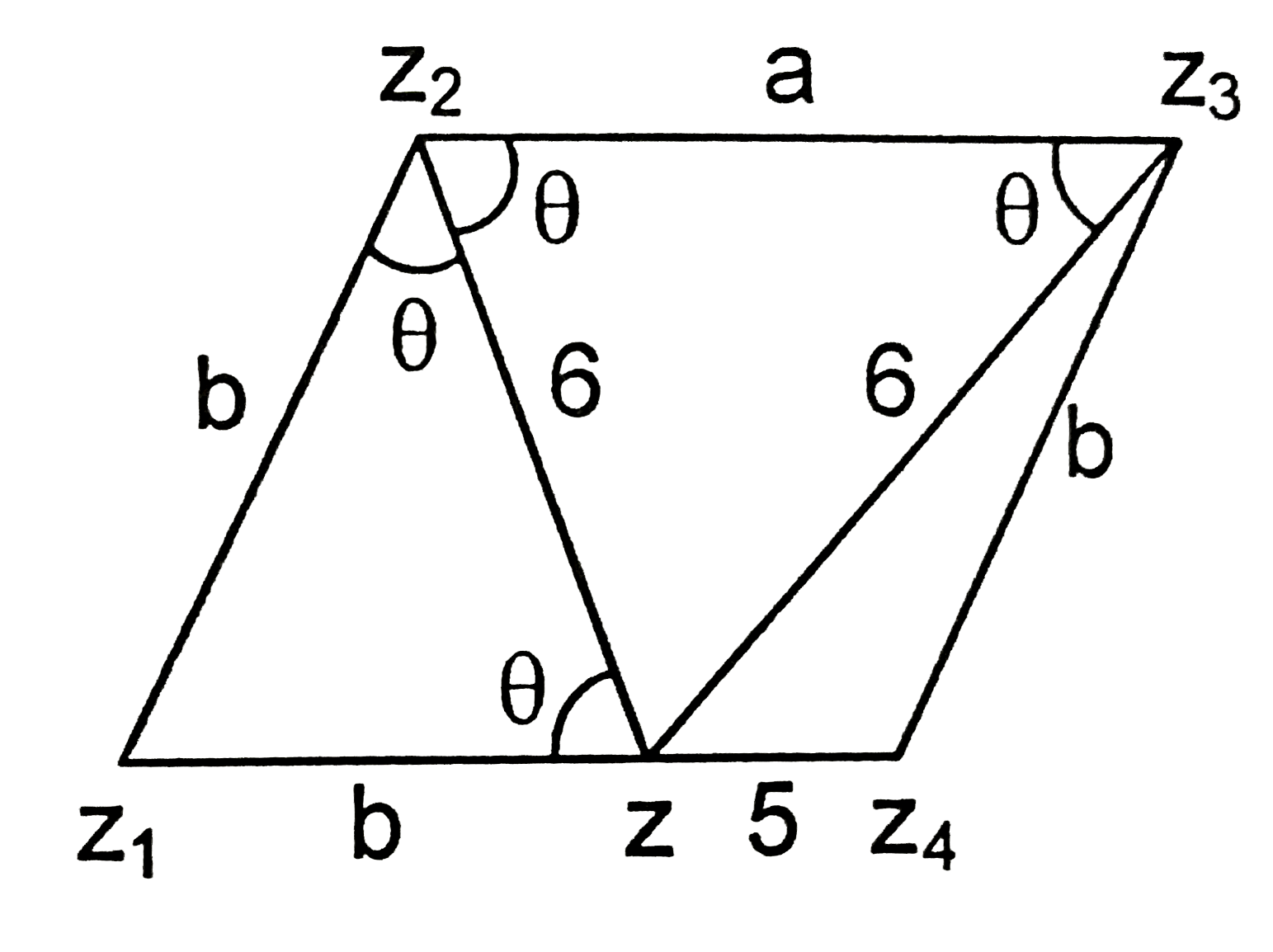
A, B, C

`a=b+5`
and `b/6=6/a`
`implies ab=36`
`b^(2)+5b-36=0`
`implies b=4`
Promotional Banner

Topper's Solved these Questions

  • STRAIGHT LINE

    FIITJEE|Exercise NUMERICAL BASED|4 Videos
  • TIPS

    FIITJEE|Exercise NUERICAL DECIMAL BASED QUATIONS|20 Videos

Similar Questions

Explore conceptually related problems

If z_(1),z_(2),z_(3),z_(4) are two pairs of conjugate complex numbers, then arg(z_(1)/z_(3)) + arg(z_(2)/z_(4)) is

Let z_(1),z_(2),z_(3),z_(4) are distinct complex numbers satisfying |z|=1 and 4z_(3) = 3(z_(1) + z_(2)) , then |z_(1) - z_(2)| is equal to

If z_(1),z_(2) and z_(3),z_(4) are two pairs of conjugate complex numbers then arg((z_(1))/(z_(4)))+arg((z_(2))/(z_(3)))=

If z_(1),z_(2) and z_(3),z_(4) are two pairs of conjugate complex numbers then arg ((z_(1))/(z_(4)))+arg((z_(2))/(z_(3))) equals

If z_(1), z_(2) and z_(3) are the vertices of a triangle in the argand plane such that |z_(1)-z_(2)|=|z_(1)-z_(3)| , then |arg((2z_(1)-z_(2)-z_(3))/(z_(3)-z_(2)))| is

If z_(1),z_(2) and z_(3),z_(4) are two pairs of conjugate complex numbers,hen find the value of arg(z_(1)/z_(4))+arg(z_(2)/z_(3))*a

If z_(1)-z_(2) are two complex numbers such that |(z_(1))/(z_(2))|=1 and arg (z_(1)z_(2))=0, then

If z_(1),z_(2) and z_(3),z_(4) are two pairs of conjugate complex numbers,prove that arg ((z_(1))/(z_(4)))+arg((z_(2))/(z_(3)))=0

FIITJEE-TEST PAPERS-MATHEMATICS
  1. x(1), x(2), x(3) are three real numbers satisfying the system of equat...

    Text Solution

    |

  2. a(1), a(2), a(3),…………. are distinct terms of an A.P. We cal (p,q,r) an...

    Text Solution

    |

  3. If z(1), z(2), z(3), z(4) are complex numbers in an Argand plane satis...

    Text Solution

    |

  4. Which of the following is/are true?

    Text Solution

    |

  5. Which of the following is/are correct?

    Text Solution

    |

  6. The vertices of a triangle ABC are A-=(2,0,2), B(-1,1,1) and C-=(1,-2,...

    Text Solution

    |

  7. Find the direction cosines of the lines, connected by the relations...

    Text Solution

    |

  8. Let the equation of a straight line L in complex form be abarz+baraz+b...

    Text Solution

    |

  9. Match the following Column I- with Column-II

    Text Solution

    |

  10. Match the following Column I- with Column-II

    Text Solution

    |

  11. If alpha(1),alpha(2),alpha(3), alpha(4) are the roos of x^(4)+2x^(3)+b...

    Text Solution

    |

  12. A chess match between two players A and B is won by whoever first wins...

    Text Solution

    |

  13. If k(1) and k(2) (k(1) gt k(2)) are two non-zero integral values of k ...

    Text Solution

    |

  14. Let ak = .^nCk for 0 lt= k lt= n and Ak = [(a(k-1),0), (0,ak)] for 1 l...

    Text Solution

    |

  15. If sum(r=0)^(203)((r^(2)+2)(r+1)!+2r(r+1)!)=a!-2(b) (where a,b in N), ...

    Text Solution

    |

  16. If a=1+x^3/(3!)+x^6/(6!)+.....oo, b=x+x^4/(4!)+x^7/(7!)+.....oo , c=...

    Text Solution

    |

  17. Let A=[(l,m,n),(p,q,r),(1,1,1)] and B=A^(2). If (l-m)^(2)+(p-q)^(2)=9,...

    Text Solution

    |

  18. If the number of ordered pairs (a,b) where a,b in R such that (a+ib)^(...

    Text Solution

    |

  19. A is a matrix of 3xx3 and a(ij) is its elements of i^(th) row and j^(t...

    Text Solution

    |

  20. If x and y satisfy te equation xy-2x^(2)-9x+3y-16=0 then

    Text Solution

    |

