Home
Class 12
MATHS
Let A(z(1)), B(z(2)), C(z(3) and D(z(4))...

Let `A(z_(1)), B(z_(2)), C(z_(3)` and `D(z_(4))` be the vertices of a trepezium in an Argand plane such that `AB||CD` Let `|z_(1)-z_(2)|=4, |z_(3),z_(4)|=10` and the diagonals `AC` and `BD` intersects at `P`. It is given that `Arg((z_(4)-z_(2))/(z_(3)-z_(1)))=(pi)/2` and `Arg((z_(3)-z_(2))/(z_(4)-z_(1)))=(pi)/4`
Which of the following option(s) is/are correct?

A

Area of trepezium `ABCD` is equla to `140/3` sq. units

B

Area of the trapezium `ABCD` is equal to `70/3` sq. units

C

Area of the triangle `BCP` is equal, to `100/21` sq. units

D

Area of the triangle `BCP` is equal to `200/42` sq. units

Text Solution

Verified by Experts

The correct Answer is:
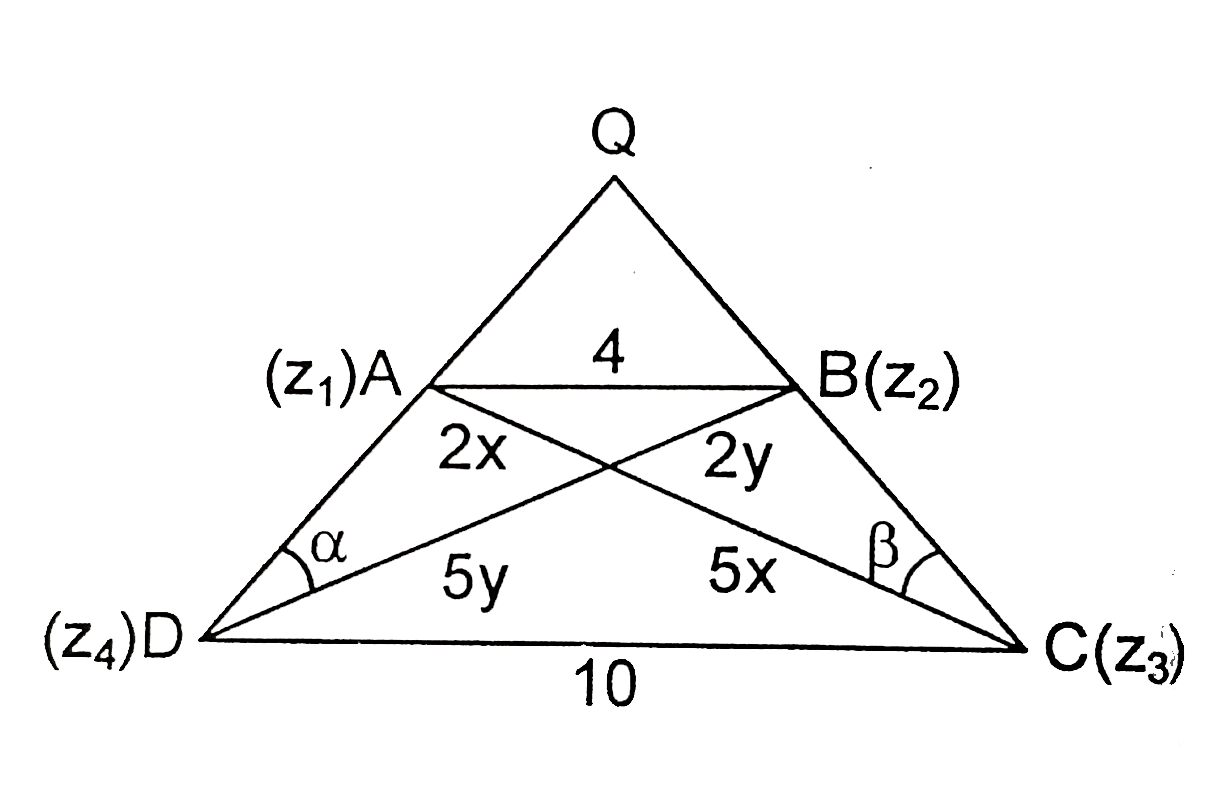
A

`DeltaABP` and `DeltaCDP` are similar if `AP=2x`
`BP=2y` then `CP=5x, DP=5y`
Area of trapezium `ABCD=49/2xy`
`tan alpha=(2x)/(5y), tan beta =(2y)/(2x)` also `alpha+beta=45^(@)`
`impliesxy=10/21(x^(2)+y^(2))`
Also `AB^(2)=AP^(2)+BP^(2)impliesx^(2)+y^(2)=4impliesxy=40/21`
`Ar(DeltaPCD)=5xy`
Promotional Banner

Topper's Solved these Questions

  • STRAIGHT LINE

    FIITJEE|Exercise NUMERICAL BASED|4 Videos
  • TIPS

    FIITJEE|Exercise NUERICAL DECIMAL BASED QUATIONS|20 Videos

Similar Questions

Explore conceptually related problems

Let A(z_(1)),B(z_(2)),C(z_(3)) be the vertices of an equilateral triangle ABC in the Argand plane, then the number (z_(2)-z_(3))/(2z_(1)-z_(2)-z_(3)) , is

If z_(1), z_(2) and z_(3) are the vertices of a triangle in the argand plane such that |z_(1)-z_(2)|=|z_(1)-z_(3)| , then |arg((2z_(1)-z_(2)-z_(3))/(z_(3)-z_(2)))| is

If A(z_(1)),B(z_(2)), C(z_(3)) are the vertices of an equilateral triangle ABC, then arg (2z_(1)-z_(2)-z_(3))/(z_(3)_z_(2))=

|z_(1)|=|z_(2)| and arg((z_(1))/(z_(2)))=pi, then z_(1)+z_(2) is equal to

If |z_(1)+z_(2)|>|z_(1)-z_(2) then prove that -(pi)/(2)

Let z_(1),z_(2) and z_(3) represent the vertices A,B, and C of the triangle ABC , respectively,in the Argand plane,such that |z_(1)|=|z_(2)|=|z_(3)|=5. Prove that z_(1)sin2A+z_(2)sin2B+z_(3)sin2C=0

If z_(1),z_(2),z_(3),z_(4) are the four complex numbers represented by the vertices of a quadrilateral taken in order such that z_(1)-z_(4)=z_(2)-z_(3) and amp backslash(z_(4)-z_(1))/(z_(2)-z_(1))=(pi)/(2) then the quadrilateral is a

FIITJEE-TEST PAPERS-MATHEMATICS
  1. A is a matrix of 3xx3 and a(ij) is its elements of i^(th) row and j^(t...

    Text Solution

    |

  2. If x and y satisfy te equation xy-2x^(2)-9x+3y-16=0 then

    Text Solution

    |

  3. Let p, q be integers and let alpha,beta be the roots of the equation ...

    Text Solution

    |

  4. For any two positive integers x and y f(x,y)=1/((x+1)!)+1/((x+2)!)+1/(...

    Text Solution

    |

  5. Let agt0, bgt0, cgt0 and a+b+c=6 then ((ab+1)^(2))/(b^(2))+((bc+1)^(2)...

    Text Solution

    |

  6. A and B play a game in which they alternately call out positive intege...

    Text Solution

    |

  7. Which of the following is/are correct?

    Text Solution

    |

  8. Consider all 10 digit numbers formed by using all the digits 0, 1, 2, ...

    Text Solution

    |

  9. Let A(z(1)), B(z(2)), C(z(3) and D(z(4)) be the vertices of a trepeziu...

    Text Solution

    |

  10. Let A(z(1)), B(z(2)), C(z(3) and D(z(4)) be the vertices of a trepeziu...

    Text Solution

    |

  11. In the equation A+B+C+D+E=FG. Where FG is the two digit number whose v...

    Text Solution

    |

  12. In the equation A+B+C+D+E=FG. Where FG is the two digit number whose v...

    Text Solution

    |

  13. If a,b,c are three positive real numbers then the minimum value of (a+...

    Text Solution

    |

  14. If the quadratic equation a(1)x^(2)-a-(2)x+a(3)=0 where a(1),a(2),a(3)...

    Text Solution

    |

  15. Let a(1),a(2),a(3),a(4),a(5) be a five term geometric sequence satisfi...

    Text Solution

    |

  16. If the coefficient of x^((n^(2)+n-18)/2) in (x-1)(x^(2)-2)(x^(3)-3)(x^...

    Text Solution

    |

  17. If a,b,c are three positive numbers then the minimum value of (a^(4)+b...

    Text Solution

    |

  18. Let alpha^(k) when k=0, 1, 2, 3, 4….253 are 254^(th) roots of unity th...

    Text Solution

    |

  19. Let A=[a(ij)](3xx3) be a matrix such that A.A^(T)=4I and a(ij)+2c(ij)=...

    Text Solution

    |

  20. If x^(3)+ax^(2)+bx+c=0 has the roots alpha^(2)+beta^(3)+gamma^(4),beta...

    Text Solution

    |

