Home
Class 12
PHYSICS
Four identical coherent sourc e emiting ...

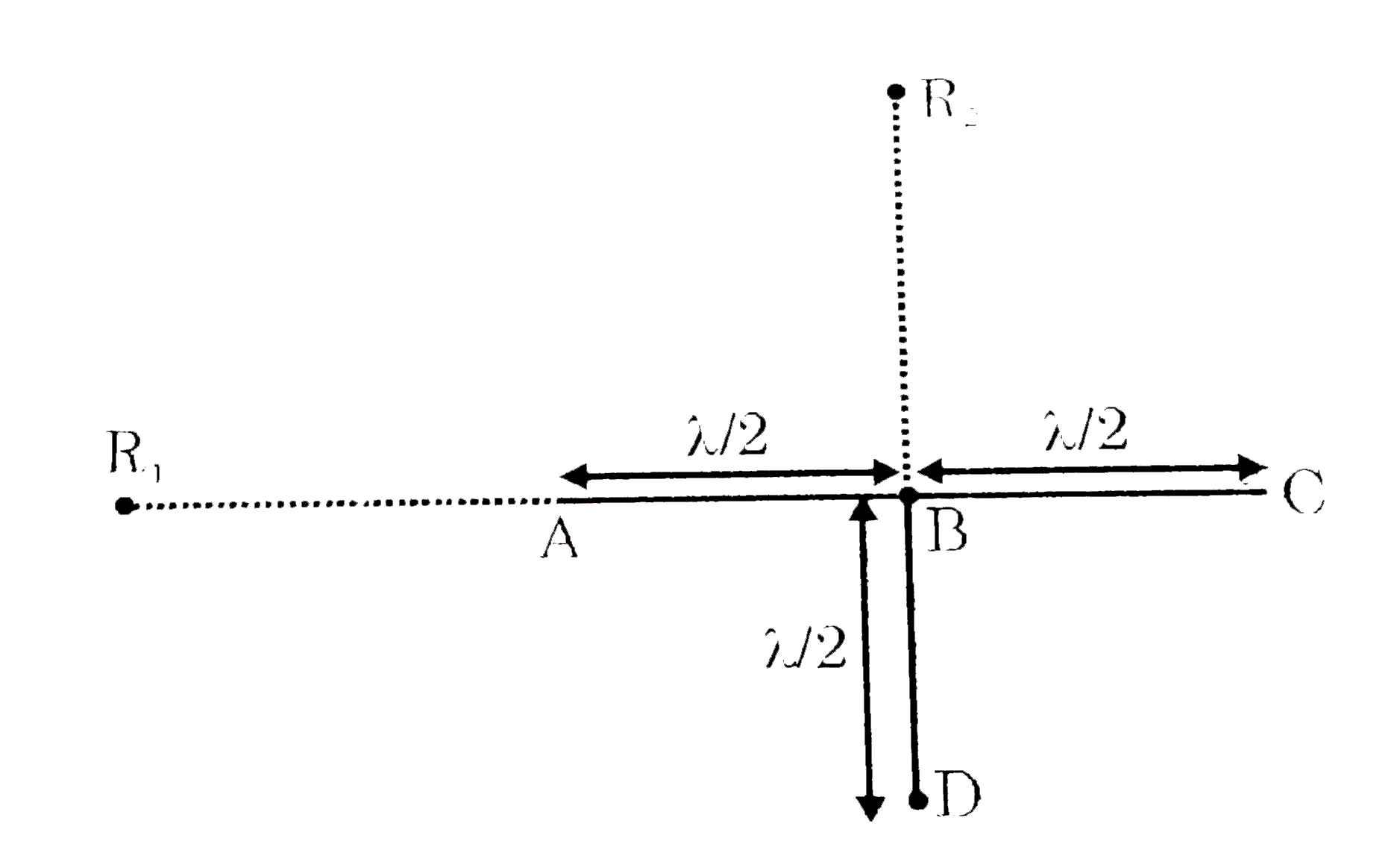
Four identical coherent sourc e emiting monochromatic light if same wavelength lambda are placed at `A,B,C` and `D` as shown. Two receivers `R_(1)` and `R_(2)` are at but equal distance from B. The path difference between signals reaching from A&D at `R_(1)` is `(lambda)/(2)` and between signals reaching from A & B at `R_(2) is ~= 0`. Also assume that intensities of waves emitted by A,B,C &D reaching at `R_(1)` and `R_(2)` is same.

A

`R_(1) `records greater intensity if all the sources are on.

B

`R_(1)`and`R_(2)` records same intensity if B is switched of, and other sources are on.

C

`R_(2)` records greater intensityif D switched off, and other sources are on.

D

It is possible to know, whether B is switch off or D is switched off by recording intensities at `R_(1)` and `R_(2)`

Text Solution

Verified by Experts

The correct Answer is:

B, C, D

At ` R_(2)`
`Delta Q_(BA) = Q _(BC)=0`
`Delta Q_(BD) = pi`
`At R_(1) `
`DeltaQ_(BA)=pi`
`Q_(AD)=pi`
`Delta Q_(BC)=pi`
`(A)` When all sources are on at `R_(1)`
`I=0`
at `R_(2)`,
`I prop 4a^(2)`
(where a is amptitude of individual waves reaching at `R_(1)` &`R^(2))`
`(B)` When only `B` is switched off
`I_(R_(1)) prop a^(2)`
`I_(R_(2))`
When only `D` is switched off
`I_(R_(1)) prop a^(2)`
`I_(R_(2)) prop 9a^(2)`
`(D)` By measuring intensities it is possible to know, which source out of `B & D` is switched off.
Promotional Banner

Topper's Solved these Questions

  • TEST PAPERS

    ALLEN|Exercise part-2 physics|63 Videos
  • TEST PAPERS

    ALLEN|Exercise part-2 physic|48 Videos
  • TEST PAPERS

    ALLEN|Exercise PAPER 3|100 Videos
  • TEST PAPER 4

    ALLEN|Exercise PHYSICS|45 Videos
  • UNIT & DIMENSIONS, BASIC MATHS AND VECTOR

    ALLEN|Exercise Exercise (J-A)|7 Videos

Similar Questions

Explore conceptually related problems

Four identical monochromatic source A, B, C, D as shown in figure produce waves of the same wavelength lambda and are coherent. Two receivers R_(1) and R_(2) are at great but equal distance from B. The choose the correct statements.

Four identical monochromatic sources A,B,C,D as shown in the (figure) produce waves of the same wavelength lambda and are coherent. Two receiver R_(1) and R_(2) are at great but equal distances from B. (i) Which of the two receivers picks up the larger signal when B is turned off? (iii) Which of the two receivers picks up the larger singnal when D is turned off ? (iv) Which of the two receivers can distinguish which of the sources B or D has been turned off ?

Six resistances each of v ale r= 6Omega are connected between points A,B and C as shown in the figure if R_(1),R_(2) and R_(3) are the net resistances between A and B, between B and C and between A and C respectively, the R_(1):R_(2):R_(3) will be equal to

Six resistance each of value r=5 Omega are connected between points A, B and C as shown in figure. If R_(1), R_(2) and R_(3) are the net resistance between A and B, between B and C and between A and C respectively, then R_(1):R_(2):R_(3) will be equal to

Four identical resistances are joined as shown in the figure. The equivalent resistance between points A and B is R_(1) and that between A anc C is R_(2) then ratio R_(1)//R_(2) is

Four identical resistance are joined as shown in fig. the equivalent resistance between points A and B is R_(1) and that between A and C is R_(2) . Then ratio of (R_(1))/(R_(2)) is

Two coherent point source S_(1) and S_(2) vibrating in phase emit light of wavelength lambda . The separation between them is 2 lambda as shown in figure. The first bright fringe is formed at 'P' due to interference on a screen placed at distance 'D' from S_(1)(Dgtgtlambda) , then OP is 1) sqrt(3)D , 2) 1.5D , 3) sqrt(2)D , 4) 2D

Among the two interfering monochromatic sources A and B, A is ahead of B in phase by 66^@ . If the observation be taken from point P, such that PB-PA=lambda//4 . Then the phase difference between the waves from A and B reaching P is

In the circuit as shown in figure, E_(1)=2V , E_(2)=2V, E_(3)=1V, and R=r_(1)=r_(2)=r_(3)Omega . The potential difference between points A and B will be

Identify A, B, C, D, E, R and R^(1) in the following:
