Home
Class 12
PHYSICS
A small marble of mass m moves in a circ...

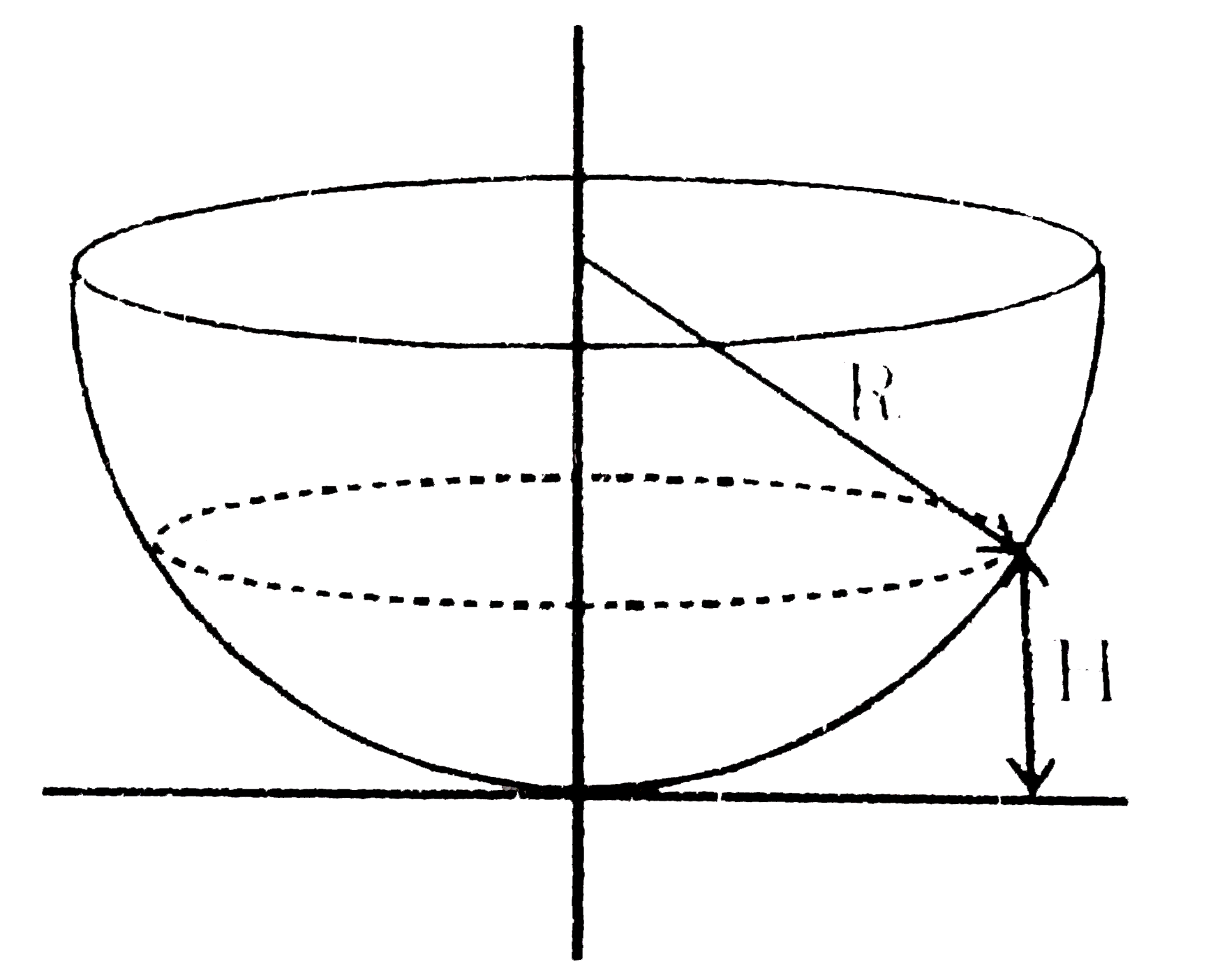
A small marble of mass m moves in a circular orbit very close to the bottom of a circular bowl. Assume that the marble can only move in orbits whose angular momentum is `L = (nh)/(2pi)` where h is plank constant.

A

The allowed radius of the circular orbit is proportionsl to `n(3//2)`

B

The allowed speed is proportional to `n(1//2)`

C

Taking gravitional potential energy at bottom to be zero, the allowed energy is given by `(nh)/(2pi) sqrt((g)/(R )`

D

Gravotational potential energy and kinetic energy in any allowed state are equal (taking reference at bottom.)

Text Solution

Verified by Experts

The correct Answer is:
B, C, D

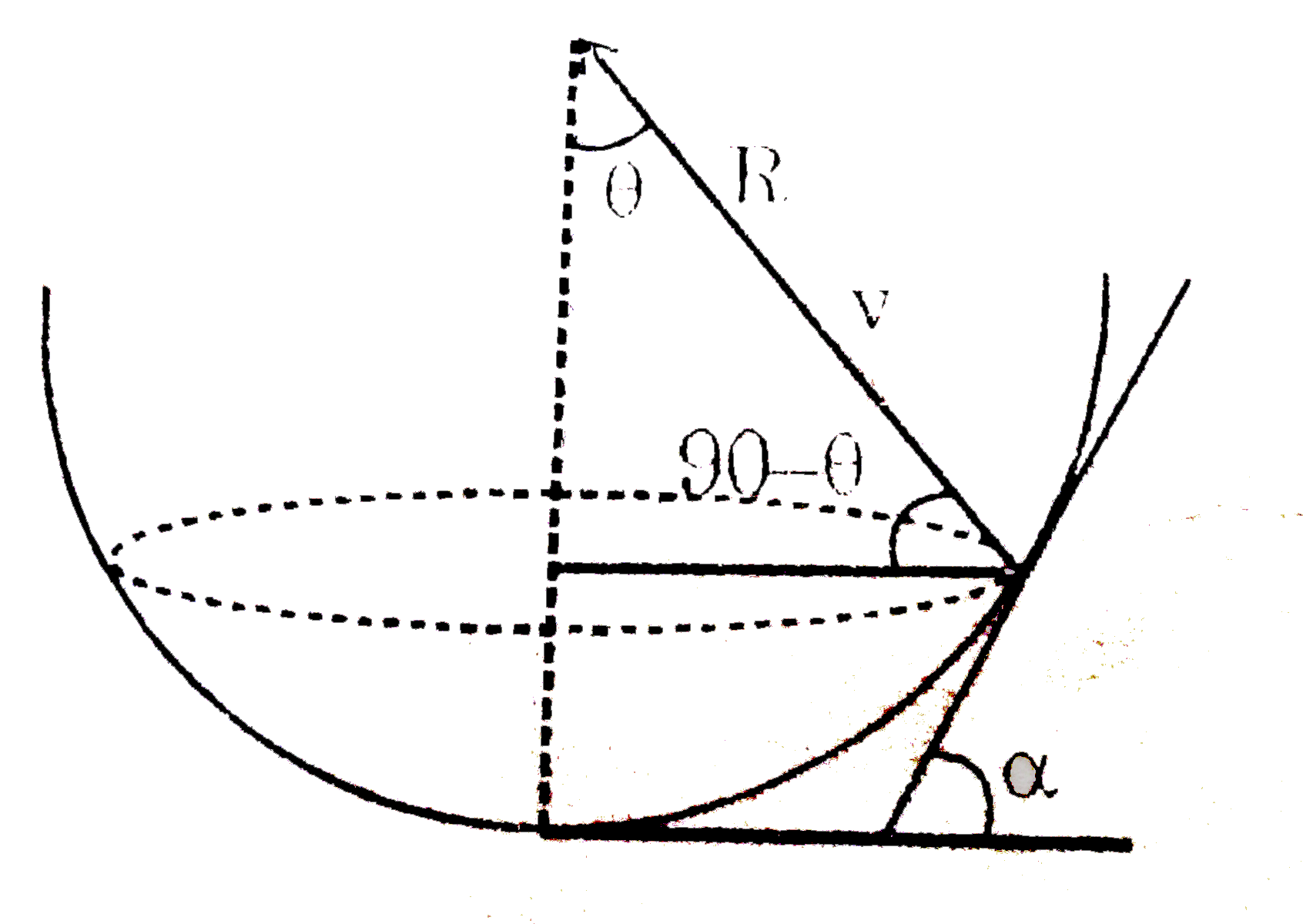
`Ncostheta = mg`
`N sin theta = (mv^(2))/(x)`

` tan theta=(v^(2))/(gx)=(v^(2))/(gR sin theta)`
`mvx = (nh)/(2pi)`
`mvxx R sin theta = (nh)/(2pi)`
`m sqrt((gR sin ^(2) theta)/(cos theta)) R sin theta = (nh)/(2pi)`
`m sqrt(gR^(3)) (sin^(2)theta)/sqrt(costheta) = (nh)/(2pi)`
`cos theta ~~1`
`m sqrt(gR^(3))xx(x^(2))/(R^(2))=(nh)/(2pi)`
`x=sqrt((nh)/(2pim)sqrt((R )/(g)))`
`v prop sqrt(n)`
`v = sqrt(nh)/(sqrt(2pisqrt(m)))xxsqrt((nh)/(2pim)sqrt((R)/(g)))=sqrt((nh)/(2pim)sqrt((g)/(R)))`
`E = mgh + (1)/(2) mv^(2)`
`mg (R-Rcos theta) + (1)/(2) mxx (nh)/(2pim)sqrt((g)/(R))`
` (1)/(2) mgRxx x^(2)/R^(2)+ (1)/(2) (nh)/(4pi) sqrt((g)/(R))`
`(mg)/(2R)xx(nh)/(2pim)sqrt((R)/(g))+(nh)/(4pi)sqrt((g)/(R))`
` E = (nh)/(2pi) sqrt((g)/(R))`
Promotional Banner

Topper's Solved these Questions

  • TEST PAPERS

    ALLEN|Exercise part-2 physics|63 Videos
  • TEST PAPERS

    ALLEN|Exercise part-2 physic|48 Videos
  • TEST PAPERS

    ALLEN|Exercise PAPER 3|100 Videos
  • TEST PAPER 4

    ALLEN|Exercise PHYSICS|45 Videos
  • UNIT & DIMENSIONS, BASIC MATHS AND VECTOR

    ALLEN|Exercise Exercise (J-A)|7 Videos

Similar Questions

Explore conceptually related problems

A satellite of mass m moves around the Earth in a circular orbit with speed v. The potential energy of the satellite is

A particle of charge 'q' and mass 'm' move in a circular orbit of radius 'r' with frequency 'v' the ratio of the magnetic moment to angular momentum is:

A body of mass m moves in a circular path with uniform angular velocity. The motion of the body has constant

A particle of charge q and mass m moves in a circular orbit or radius r with angular speed omega . The ratio of the magnitude of its magnetic moment to that of its angular momentum depends on

A satellite of mass M revolving in a circular orbit of radius r_(s) around the earth of mass M has a total energy E. then, its angular momentum will be

A particle of the charged q and mass m moves in a circular orbit of radius r with angular speed omega . The ratio of the magnitude of its magnetic moment to that of its angular momentum depends on

A particle of charge q and mass m moves in a circular orbit of radius r with angular speed omega . The ratio of the magnitude of its magnetic moment to that of its angular momentum depends on

The satellite of mass m revolving in a circular orbit of radius r around the earth has kinetic energy E. then, its angular momentum will be

A particle of charge -q and mass m moves in a circular orbits of radius r about a fixed charge +Q .The relation between the radius of the orbit r and the time period T is

