Home
Class 12
PHYSICS
Consider a non conduting ring of radius ...

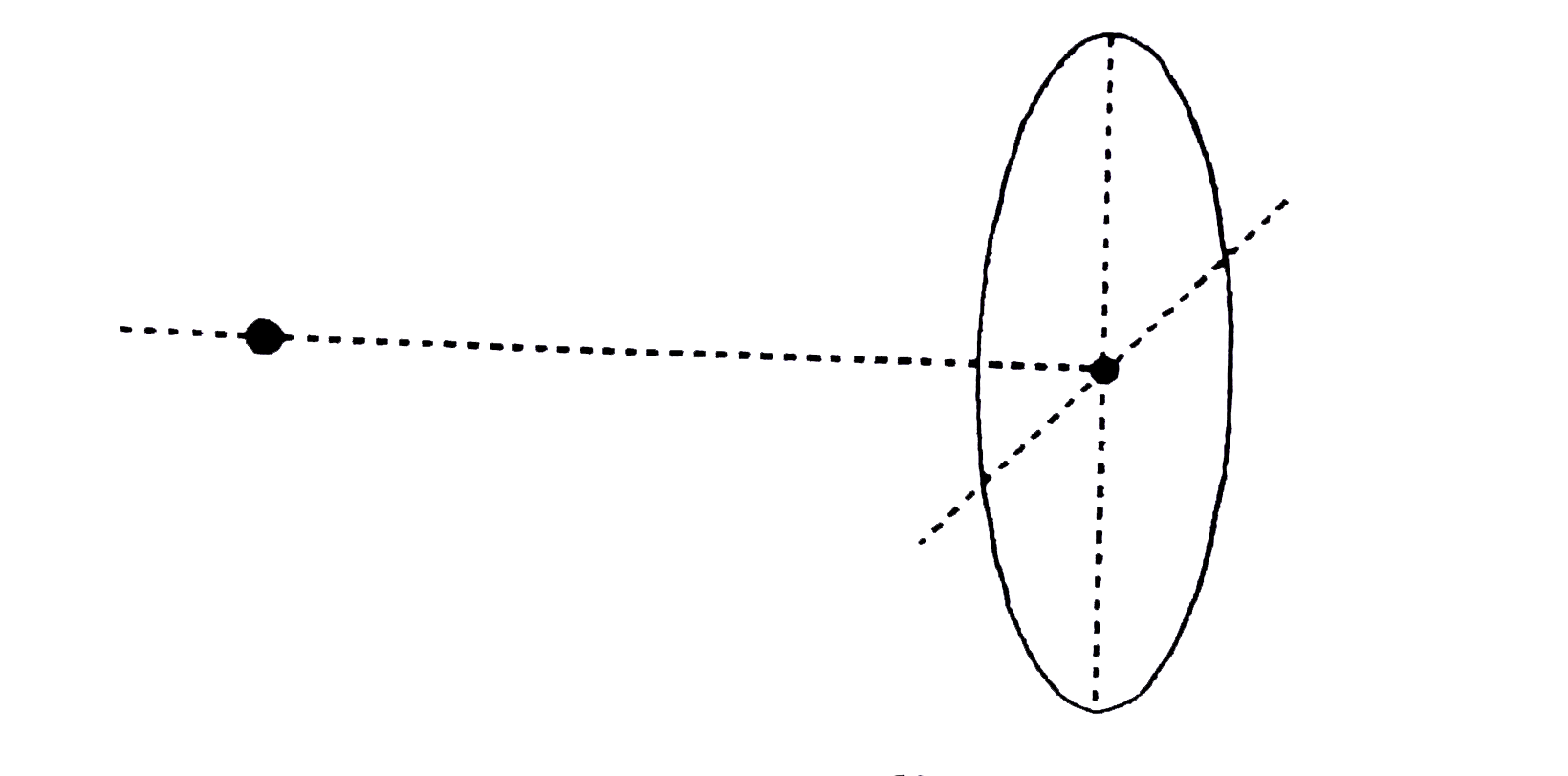
Consider a non conduting ring of radius r and mass m and a particle of same mass, both at rest in free space. The particle is on the axis of the ring and far away from the ring. An amount Q of positive charge is uniformly distributed on the ring and the particle is given a positive charge q. The particle is imparted a velocity v towards the centre of the ring. Consider the consequences given in the columns and answer the following question

`{:(,"Column-I",,"Column-II",,"Column-III"),((I),"Maximum speed of the ring is v",(i),"Minimum speed of the particle is"v//2,(P),"Final speed of the ring and particle is v and zero respectively".),((II),"Maximum speed of the ring is" v//2,(ii),"Minimum speed of the particle is zero",(Q),"Final speed of the ring and particle is zero and v respectively".),((III),"Maximum speed of the ring is"(v)/(2)[1+sqrt(1-(Qq)/(pi epsilon_(0)mrv^(2)))],(iii),"Minimum speed of the particle is"(v)/(2)[1+sqrt(1-(Qq)/(pi epsilon_(0)mrv^(2)))],(R ),"Final speed of the ring and particle is v/4 and3v/4 respectively".),((IV),"Maximum speed of the ring is" (v)/(2)[1-sqrt(1-(Qq)/(pi epsilon_(0)mrv^(2)))],(iv),"Minimum speed of the particle is" (v)/(2)[1-sqrt(1-(Qq)/(pi epsilon_(0)mrv^(2)))],(S),"Final speed of the ring and particle is v/2 for both".):}`
Which of following options is the correct is the representation if`v=sqrt((Qq)/(2piepsilon_(0)mr)`

A

`(II)(i)S`

B

`(I)(ii)P`

C

`(III)(iv)R`

D

`(IV)(iii)Q`

Text Solution

Verified by Experts

The correct Answer is:
B

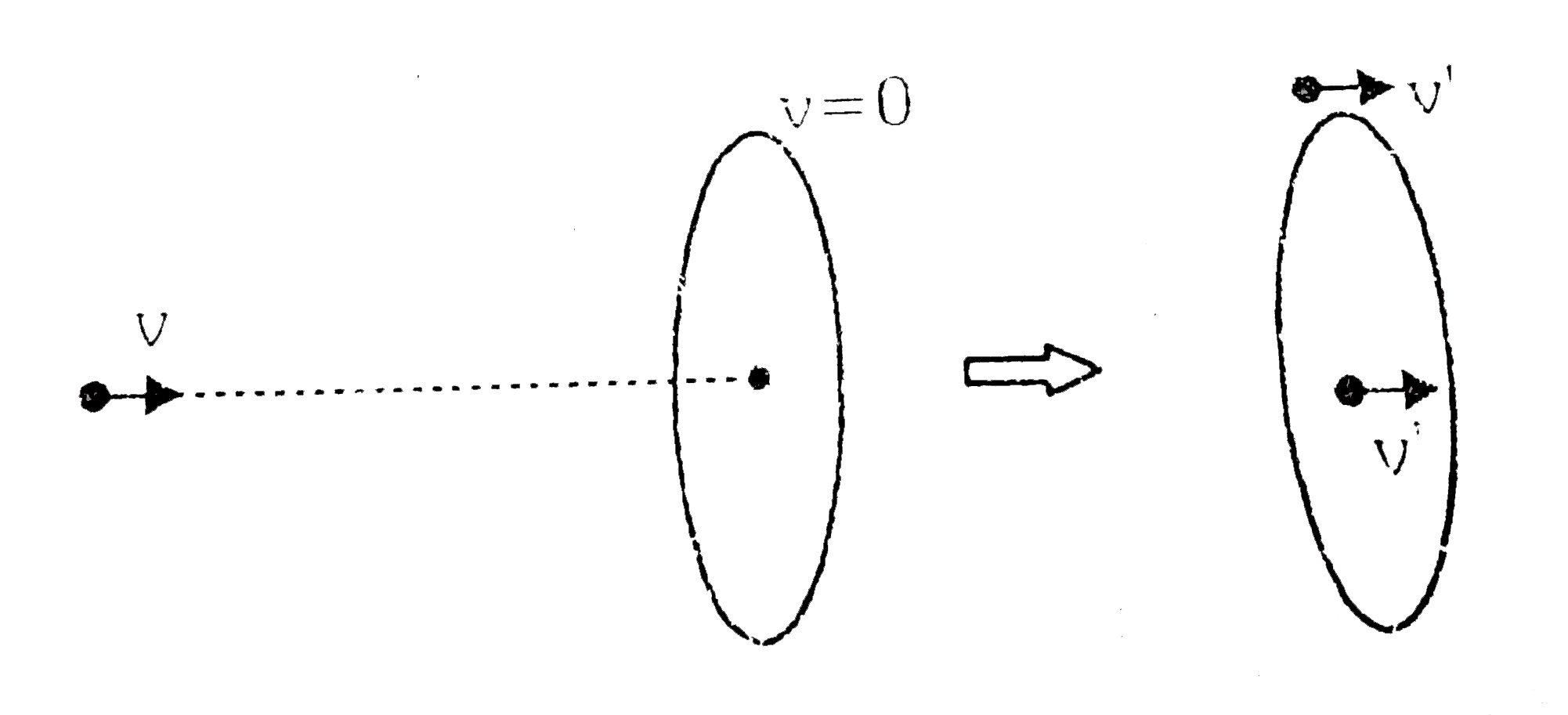
Let v be the velocity of particle for which both moves together finally

`p_(i)=p_(f)`
`mv=2mv' implies v'=(v)/(2)" "….(i)`
`E_(i)=E_(f)`
`(1)/(2)mv^(2)((1)/(2)mv^('2))xx2-(kQq)/(r).....(ii)`
`v=sqrt((Qq)/(piepsilon_(0)mr))`
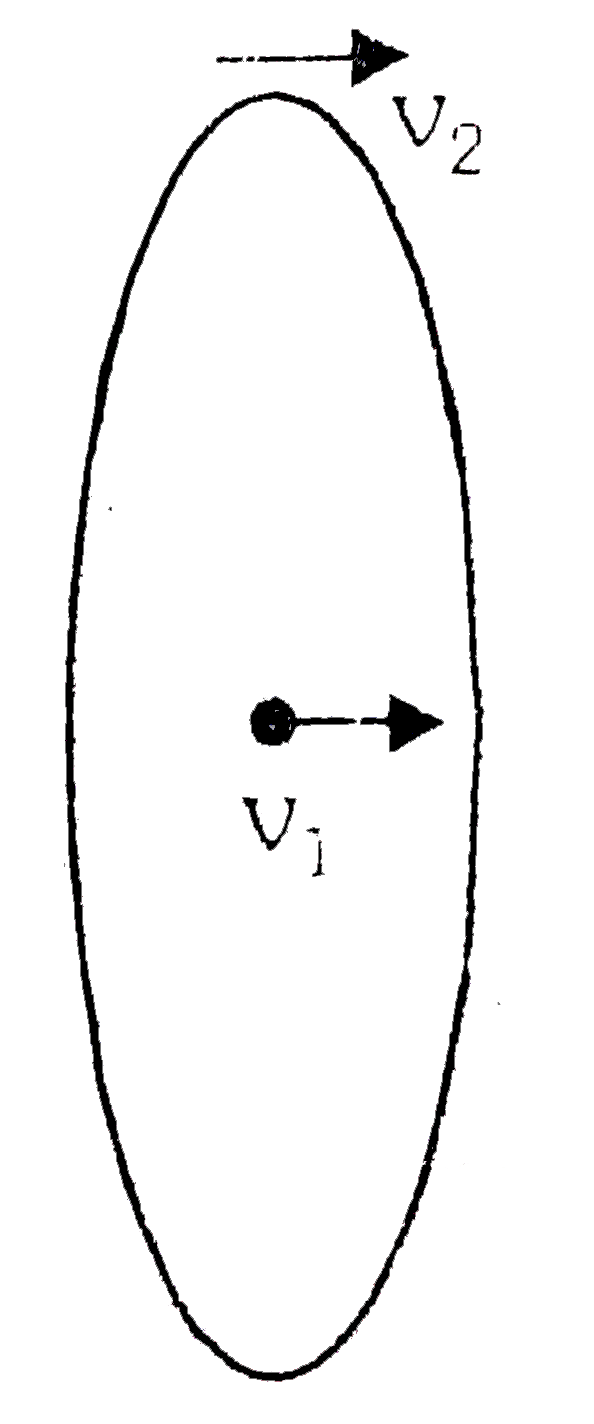
If `vltsqrt((Qq)/(piepsilon_(0)mr))` then velocity of particle continously decrease and that of ring continously increase. Final velocity of particle becomes zero and that of ring becomes v
If `vgtsqrt(Qq)/(piepsilon_(0)mr)` then particle crosses the ring and again it's velocity start increasing and finally becomes v and that of ring becomes zero.
`p_(i)=p_(f)impliesmv=mv_(1)+mv_(2)....(i)`
`(1)/(2)mv^(2)=(1)/(2)mv_(1)^(2)+(1)/(2)mv_(2)^(2)+(kQq)/(r)....(ii)`
Minimum speed of particle
`v_(1)=(v)/(2)[1+sqrt(1-(Qq)/(piepsilon_(0)mrv^(2))]]`

Maximum speed of ring
`v_(2)=(v)/(2)[1-sqrt(1-(Qq)/(piepsilon_(0)mrv^(2))]]`
Promotional Banner

Topper's Solved these Questions

  • TEST PAPERS

    ALLEN|Exercise part-2 physic|48 Videos
  • TEST PAPERS

    ALLEN|Exercise PHYSICS|18 Videos
  • TEST PAPERS

    ALLEN|Exercise Part-1 Physics|15 Videos
  • TEST PAPER 4

    ALLEN|Exercise PHYSICS|45 Videos
  • UNIT & DIMENSIONS, BASIC MATHS AND VECTOR

    ALLEN|Exercise Exercise (J-A)|7 Videos

Similar Questions

Explore conceptually related problems

Consider a non conduting ring of radius r and mass m and a particle of same mass, both at rest in free space. The particle is on the axis of the ring and far away from the ring. An amount Q of positive charge is uniformly distributed on the ring and the particle is given a positive charge q. The particle is imparted a velocity v towards the centre of the ring. Consider the consequences given in the columns and answer the following question {:(,"Column-I",,"Column-II",,"Column-III"),((I),"Maximum speed of the ring is v",(i),"Minimum speed of the particle is"v//2,(P),"Final speed of the ring and particle is v and zero respectively".),((II),"Maximum speed of the ring is" v//2,(ii),"Minimum speed of the particle is zero",(Q),"Final speed of the ring and particle is zero and v respectively".),((III),"Maximum speed of the ring is"(v)/(2)[1+sqrt(1-(Qq)/(pi epsilon_(0)mrv^(2)))],(iii),"Minimum speed of the particle is"(v)/(2)[1+sqrt(1-(Qq)/(pi epsilon_(0)mrv^(2)))],(R ),"Final speed of the ring and particle is v/4 and3v/4 respectively".),((IV),"Maximum speed of the ring is" (v)/(2)[1-sqrt(1-(Qq)/(pi epsilon_(0)mrv^(2)))],(iv),"Minimum speed of the particle is" (v)/(2)[1-sqrt(1-(Qq)/(pi epsilon_(0)mrv^(2)))],(S),"Final speed of the ring and particle is v/2 for both".):} Which of following options is the correct representation if v =sqrt((2Qq)/(piepsilon_(0)mr))

Charges q is uniformly distributed over a thin half ring of radius R . The electric field at the centre of the ring is

Calculate potential on the axis of a ring due to charge Q uniformly distributed along the ring of readius R.

A positive charge Q is uniformly distrubuted along a circular ring of radius R .a small test chage q is placed at the centre of the ring .The

A charge Q is uniformly distributed only on the fourths portion of a ring of radius R . The elctric potential at centre of ring is

A fixed ring of radius R is given a charge q. A charge q_0 is brought slowly from infinity to the centre of the ring. The wrong statement is-

ALLEN-TEST PAPERS-part-2 physics
  1. A block is released on the slant face of a wedge of equal mass placed ...

    Text Solution

    |

  2. A block is released on the slant face of a wedge of equal mass placed ...

    Text Solution

    |

  3. Consider a non conduting ring of radius r and mass m and a particle of...

    Text Solution

    |

  4. Consider a non conduting ring of radius r and mass m and a particle of...

    Text Solution

    |

  5. Consider a non conduting ring of radius r and mass m and a particle of...

    Text Solution

    |

  6. A commander fires a shell at certain angle of projection from A which...

    Text Solution

    |

  7. A trinary star system which is a system of three orbiting around centr...

    Text Solution

    |

  8. A planet is made of two materials of density p(1) and p(2) as shown in...

    Text Solution

    |

  9. Two identical small elastic conducting balls of mass m and radius r ha...

    Text Solution

    |

  10. A long thin pliable carpet is laid on the floor. One end of the carpet...

    Text Solution

    |

  11. A regular tetrahedron frame is made up of homogeneous resitance wire o...

    Text Solution

    |

  12. A long straight wire of negligible resistance is bent into V shape, it...

    Text Solution

    |

  13. A solid cube is floating (completely submerged) in a container filled ...

    Text Solution

    |

  14. The arms of a U shaped tube are vertical. The arm on right side is clo...

    Text Solution

    |

  15. A cup contains some mercury in it. Now a narrow glass tube is lowered ...

    Text Solution

    |

  16. From a water tap, liquid comes out in from of cylinder. As water moves...

    Text Solution

    |

  17. A small ball of mass m and charge q is attached to the bottom end of a...

    Text Solution

    |

  18. A small ball of mass m and charge q is attached to the bottom end of a...

    Text Solution

    |

  19. A small ball of mass m and charge q is attached to the bottom end of a...

    Text Solution

    |

  20. A cylindrical capacitor with external radius R, internal radius R-d(dl...

    Text Solution

    |