Home
Class 12
PHYSICS
In the diagram shown below, the rod is u...

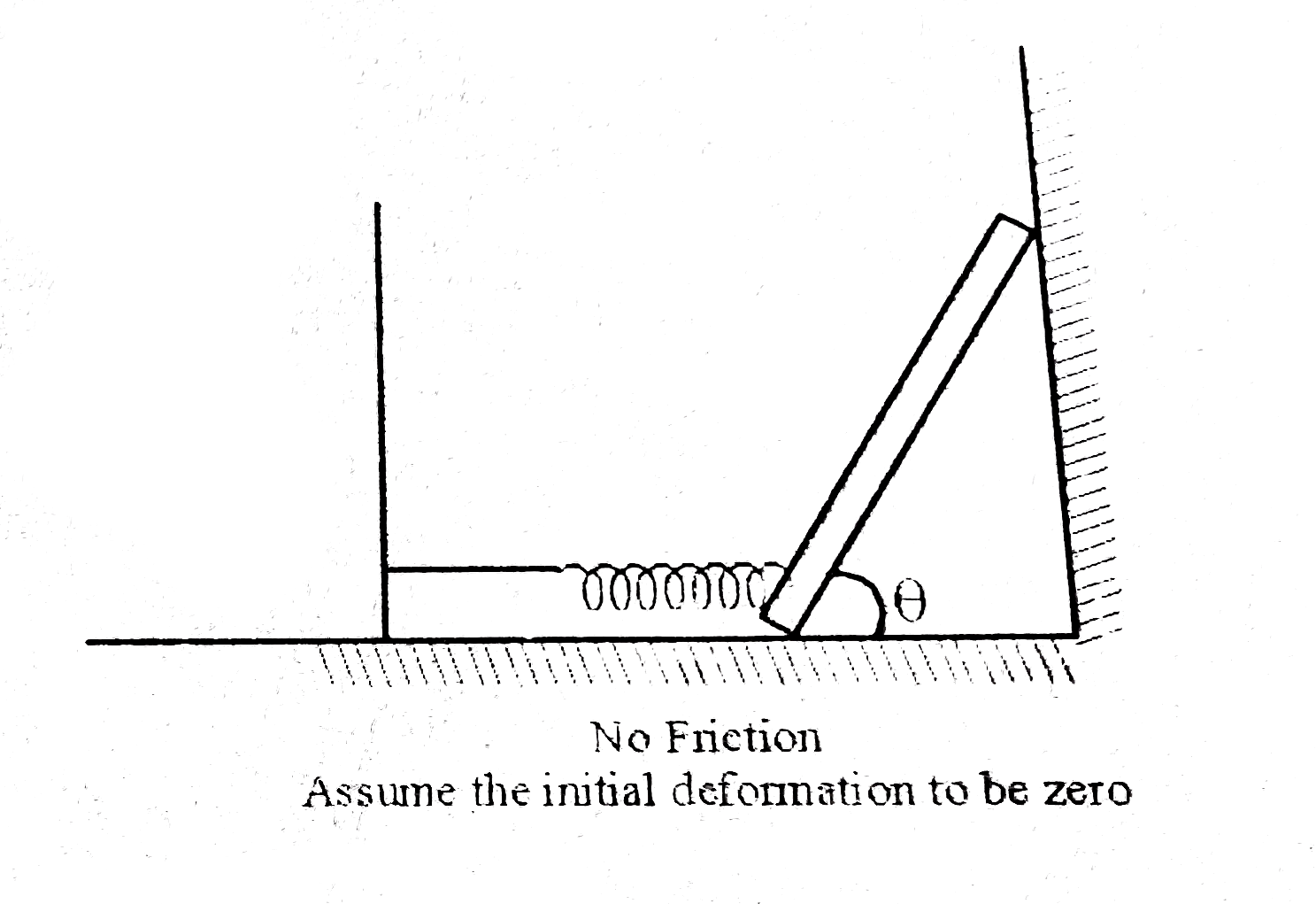
In the diagram shown below, the rod is uniform having mass M and length L. When it is making an angle `theta=60^(0)`, the rod is released from the state of rest (and spring in its natural length). The rod comes to state of rest when the angle theta reduces to `30^(@)`. What should be the initial compression in the spring`(when theta = 60^(@))` so that the whole system can remain in the state of rest? (there is no friction between any surfaces)

A

`((sqrt(3)-1))/(2sqrt(3))l`

B

`(3(sqrt(3)-1))/(2)l`

C

`((sqrt(3)-1))/(4sqrt(3))l`

D

`(2(sqrt(3)-1))/(sqrt(3))l`

Text Solution

Verified by Experts

Promotional Banner

Similar Questions

Explore conceptually related problems

In the diagram shown below, the rod is uniform having mas M and length L. When it is making an angle = 60^(@) the rod is released from the state of rest (and spring in its natural lenth) The rod comes to state of rest when the angle theta reduces to 30^(@) . What should be the initial compression in the spring (when theta = 60^(@)) so that the whole system can remain in the state of rest? (there is no friction between any surfaces)

Find the maximum tension in the spring if initially spring at its natural length when block is released from rest.

A uniform rod of mass M and length L is hinged at its end. The rod is released from its vertical position by slightly pushing it. What is the reaction at the hinge when the rod becomes horizontal, again vertical.

The block shown in figure is released from rest and initially the spring is at its natural length. Write down the energy conservation equation. When the spring is compressed by l_(1) ?

A uniform rod of mas m and length l is made to stand at an angle of 60^(@) with the vertical. What is the potential energy of the rod in this position?

In the adjoining diagram the ball A is released from rest when the spring is at its natural length (neither stretched nor compressed) For the block B of mass M to leave contact with the ground at some time, the minimum mass of A must be:

The moment of inertia of a thin uniform rod of mass M, length L, about an axis passing through its centre and making an angle theta with the rod is

In the diagram shown, friction is present only between therod and the wall. The mass of the rod is M and tht of the wedge is 3M. What is the minimum value of the coefficient of friction between the rod and the wall so that rod remains in the state of rest?

A rod of mass m and length l is held vertically on a smooth horizontal floor. Now it is released from this position, find the speed of its centre of mass when it makes an angle theta with the vertical.

A rod of mass m and length l is hinged at 'its' end and released from rest in position shown. Find the force exerted by the hinge when the rod becomes horizontal

