

Home
Class 11
PHYSICS
A uniform disc of mass m, radius R is pl...

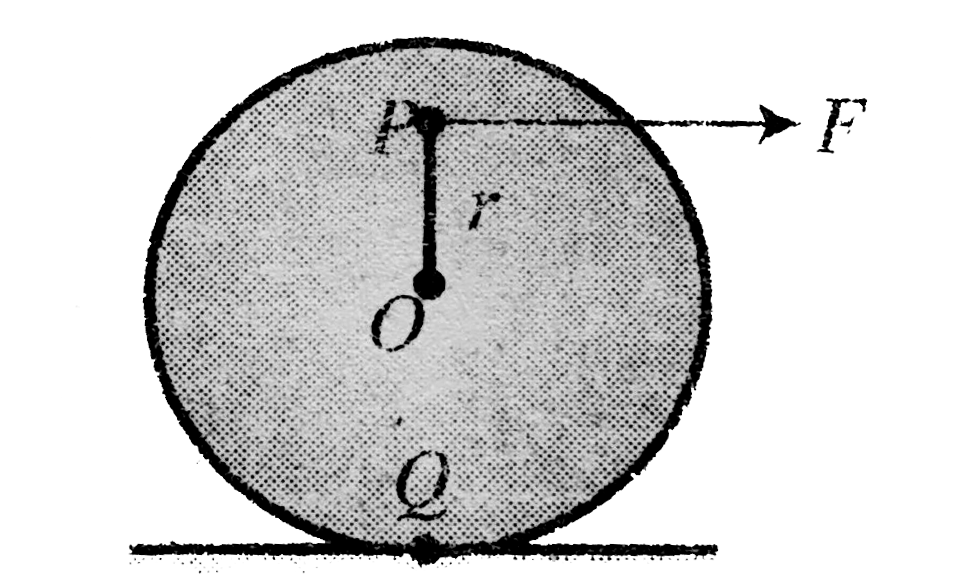
A uniform disc of mass `m`, radius `R` is placed on a smooth horizontal surface. If we apply a horizontal force `F` at `P` as shown in the figure. If `F = 4 N, m= .1 kg, R = 1 m` and `r = 1/2 m` then, find the:

angular acceleration of the disc. `(rads^(-1))`

Promotional Banner

Similar Questions

Explore conceptually related problems

A uniform disc of mass m , radius R is placed on a smooth horizontal surface. If we apply a horizontal force F at P as shown in the figure. If F = 4 N, m= .1 kg, R = 1 m and r = 1/2 m then, find the: acceleration of the CM (in ms^(2) )

A uniform disc of mass m , radius R is placed on a smooth horizontal surface. If we apply a horizontal force F at P as shown in the figure. If F = 4 N, m= .1 kg, R = 1 m and r = 1/2 m then, find the: acceleration of the CM (in ms^(2) )

Three identical cubes each of mass m are place on a smooth horizontal surface.A constant force F is applied on A as shown in the figure.The force on B applied by C is

A cotton reel of mass m , radius R and moment of inertia I is kept on a smooth horizontal surface. If the string is pulled horizontally by a force F , find the (i) acceleration of CM , (ii) angular acceleration of the cotton reel.

A uniform disc of mass M and radius R is pivoted about the horizontal axis through its centre C A point mass m is glued to the disc at its rim, as shown in figure. If the system is released from rest, find the angular velocity of the disc when m reaches the bottom point B.

A uniform disc of mass M and radius R is pivoted about the horizontal axis through its centre C A point mass m is glued to the disc at its rim, as shown in figure. If the system is released from rest, find the angular velocity of the disc when m reaches the bottom point B.

Consider a disc of mass m and radius R placed on a rough plank of mass M which is turn is place on a smooth horizontal surface. Now plank is pulled by a force F and disc starts to roll on the plank. If there is no friction any where then find (a) Fricition force acting on the disc (b) Angular acceleration of the disc

Consider a disc of mass m and radius R placed on a rough plank of mass M which is turn is place on a smooth horizontal surface. Now plank is pulled by a force F and disc starts to roll on the plank. If there is no friction any where then find (a) Fricition force acting on the disc (b) Angular acceleration of the disc

Two masses m_1 and m_2 are placed on a smooth horizontal surface and are connected by a string of negligible mass. A horizontal force F is applied on the mass m_2 as shown in the figure. The tension in the string is