

Home
Class 11
PHYSICS
Two particles of mass m(1) "and" m(2) ar...

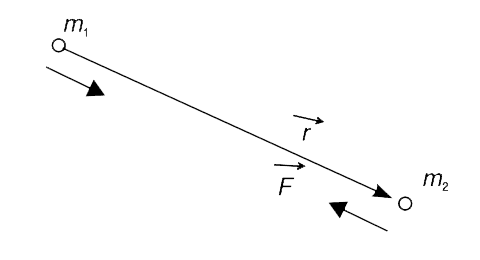
Two particles of mass `m_(1) "and" m_(2)` are in space at separation `vecr` [vector from `m(1)` to `m_(2)`]. The only force that the two particles experience is the mutual gravitational pull. The force applied by `m_(1) "on" m_(2) "is" vecF `. Prove that `mu(d^(2)vecr)/(dt^(2)) = vecF` where `mu"(m_(1)m_(2))/(m_(1) + m_(2))` is known as reduced mass for the two particle system .

Promotional Banner

Topper's Solved these Questions

  • MOMENTUM AND CENTRE OF MASS

    ARIHANT|Exercise Momentum And Center of Mass|117 Videos
  • ROTATIONAL MOTION

    ARIHANT|Exercise PHYSICS|159 Videos

Similar Questions

Explore conceptually related problems

Two particles of mass m_(1) and m_(2) , approach each other due to their mutual gravitational attraction only. Then

The reduce mass of two particles having masses m and 2 m is

Two stationary particles of masses M_(1) and M_(2) are 'd' distance apart. A third particle lying on the line joining the particles, experiences no resultant gravitational force. What is the distance of this particle from M_(1) ?

Position vector of centre of two particles of masses m_(1) and m_(2) whose position vectors r_(1) and r_(2) then r_(cm) ?

For a two body oscillator system, prove the relation, T = 2pi sqrt((mu)/(k)) where, mu = (m_(1)m_(2))/(m_(1) + (m_(2))) = reduced mass.

.Two particles of masses "m_(1)" and m_(2)(m_(1)>m_(2))" are separated by a distance ' "d" '.The shift in the centre of mass when the two particles are interchanged.

Two particles of masses m_(1) and m_(2) are moving in concentric circle of radii r_(1) and r_(2) such that their period are same. Then the ratio of their centripetal acceleration is

Two stars of mass m_(1) and m_(2) are parts of a binary star system. The radii of their orbits are r_(1) and r_(2) respectivey, measured from the centre of mass of the system. The magnitude of gravitational force m_(1) exerts on m_(2) is

If two particles of masses m_(1) and m_(2) are projected vertically upwards with speed v_(1) and v_(2) , then the acceleration of the centre of mass of the system is

ARIHANT-NEWTONS LAWS OF MOTION-All Questions
  1. A disc of mass m lies flat on a smooth horizontal table. A light strin...

    Text Solution

    |

  2. (i) A spinning disk has a hole at its centre. The surface of the disk ...

    Text Solution

    |

  3. Two particles of mass m(1) "and" m(2) are in space at separation vecr ...

    Text Solution

    |

  4. Six identical blocks – numbered 1 to 6 – have been glued in two groups...

    Text Solution

    |

  5. Two strange particles A and B in space, exert no force on each other w...

    Text Solution

    |

  6. A light string passing over a smooth pulley holds two identical bucket...

    Text Solution

    |

  7. A chain is lying on a smooth table with half its length hanging over t...

    Text Solution

    |

  8. A triangular wedge W having mass M is placed on an incline plane with ...

    Text Solution

    |

  9. In the system shown in fig, mass of the block is m(1) = 4 kg and that...

    Text Solution

    |

  10. A uniform chain of mass M = 4.8 kg hangs in vertical plane as shown in...

    Text Solution

    |

  11. Block A of mass M is placed on an incline plane, connected to a string...

    Text Solution

    |

  12. Figure shown a fixed surface inclined at an angle theta to the horizo...

    Text Solution

    |

  13. In the system shown in the figure AB and CD are identical elastic cord...

    Text Solution

    |

  14. Blocks A and B have dimensions as shown in the fig. and their masses a...

    Text Solution

    |

  15. Three identical smooth balls are placed between two vertical walls as ...

    Text Solution

    |

  16. A horizontal wooden block has a fixed rod OA standing on it. From top ...

    Text Solution

    |

  17. In the arrangement shown in the fig. the pulley, the spring and the th...

    Text Solution

    |

  18. In the arrangement shown in the fig. a monkey of mass M keeps itself a...

    Text Solution

    |

  19. An ideal spring is in its natural length (L) with two objects A and B ...

    Text Solution

    |

  20. The fig. shows an infinite tower of identical springs each having forc...

    Text Solution

    |