

Home
Class 11
PHYSICS
Block B of mass m has been placed on blo...

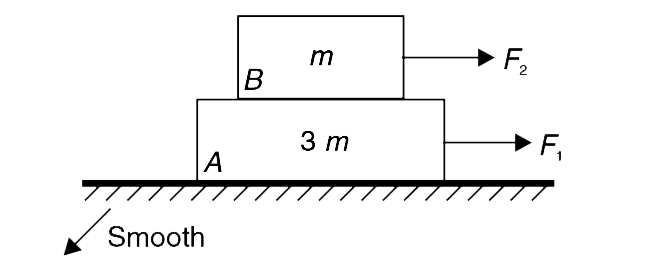
Block B of mass m has been placed on block A of mass 3 m as shown. Block A rests on a smooth horizontal table. `F_(1)` is the maximum horizontal force that can be applied on the block A such that there is no slipping between the blocks. Similarly, `F_(2)` is the maximum horizontal force that can be applied on the block B so that the two blocks move together without slipping on each other. When `F_(1) "and" F_(2)` both are applied together as shown in figure.

(a) Find the friction force acting between the blocks.
(b) Acceleration of the two blocks.
(c) If `F_(2)` is decreased a little, what will be direction of friction acting on B.

Text Solution

Verified by Experts

The correct Answer is:
(a) Zero
(b) `(F_(1))/(3m) = (F_(2))/(m)`
(c) To right
Promotional Banner

Topper's Solved these Questions

  • MOMENTUM AND CENTRE OF MASS

    ARIHANT|Exercise Momentum And Center of Mass|117 Videos
  • ROTATIONAL MOTION

    ARIHANT|Exercise PHYSICS|159 Videos

Similar Questions

Explore conceptually related problems

The coefficient of static friction between the two blocks shown in figure is mu and the table is smooth. What maximum horizontal forced F can be applied to he block of mass M so that the block move together?

A block of mass m is placed on another block of mass M lying on a smooth horizontal surface as shown in the figure. The co-efficient of friction between the blocks is mu . Find the maximum horizontal force F (in Newton) that can be applied to the block M so that the blocks together with same acceleration? (M=3kg, m=2kg, mu=0.1, g=10m//s^(2))

The coefficient of static friction between two blocks is 0.5 and the table is smooth. The maximum horizontal force that can be applied to move the blocks together is N. (take g = 10 ms^(-2) )

A 4.0 kg block is put on top of a 5.0kg block. In order to cause the top block to slip on the bottom one, a horizontal force of 12N must be applied to the top block. Assuming a friction less table the maximum horizontal force F which can be applied to the lower block so that the blocks, will move together should be

A block the of mass 4kg is placed on another block of mass 5kg and the block B rests on a smooth horizontal table for sliding the block A on B a horizontal force 12N is required to be applied force on it How much maximum horizontal force can be applied on 'B' s that both A and B move together? Also find out the accleration proudced by this force .

Two blocks of mass m_(1) and m_(2) lie on smooth horizontal table in contact with each other as shown in figure If a force F is applied to the mass m_(1) then the contact force between the block will be

Two blocks of masses M = 3 kg and m = 2 kg, are in contact on a horizontal table. A constant horizontal force F = 5 N is applied to block M as shown. There is a constant frictional force of 2 N between the table and the block m but no frictional force between the table and the first block M, then the acceleration of the two blocks is-

Two blocks of masses M = 3 kg and m = 2 kg are in contact on a horizontal table. A constant horizontal force F = 5 N is applied to block M as shown. There is a constant frictional force of 2 N between the table and the block m but no frictional force between the table and the first block M, then acceleration of the two blocks is

ARIHANT-NEWTONS LAWS OF MOTION-All Questions
  1. Block B of mass m has been placed on block A of mass 3 m as shown. Blo...

    Text Solution

    |

  2. Let vecu be the initial velocity of a particle and vecF be the resulta...

    Text Solution

    |

  3. A ball is projected vertically up from the floor of a room. The ball e...

    Text Solution

    |

  4. A small body of super dense material, whose mass is half the mass of t...

    Text Solution

    |

  5. N identical carts are connected to each other using strings of negligi...

    Text Solution

    |

  6. A toy cart has mass of 4 kg and is kept on a smooth horizontal surface...

    Text Solution

    |

  7. In the arrangement shown in the figure the system is in equilibrium. M...

    Text Solution

    |

  8. Two blocks of equal mass, M each, are connected to two ends of a massl...

    Text Solution

    |

  9. A pulley is mounted on a stand which is placed over a weighing scale. ...

    Text Solution

    |

  10. In the given arrangement, all strings and pulleys are light. When the ...

    Text Solution

    |

  11. A block slides down a frictionless plane inclined at an angle theta. F...

    Text Solution

    |

  12. A tall elevator is going up with an acceleration of a = 4 m//s^(2). A ...

    Text Solution

    |

  13. Due to air drag the falling bodies usually acquire a constant speed wh...

    Text Solution

    |

  14. A cylinder of mass M and radius r is suspended at the corner of a room...

    Text Solution

    |

  15. A rod of mass M and length L lies on an incline having inclination of ...

    Text Solution

    |

  16. A ball of mass M is in equilibrium between a vertical wall and the inc...

    Text Solution

    |

  17. A pendulum has a bob connected to a light wire. Bob ‘A’ is in equilibr...

    Text Solution

    |

  18. Two blocks of equal mass have been placed on two faces of a fixed wedg...

    Text Solution

    |

  19. In the system shown in the figure, all surfaces are smooth. Block A an...

    Text Solution

    |

  20. A particle of mass M rests on a rough inclined plane at an angle q t...

    Text Solution

    |

  21. A small body A starts sliding down from the top of a wedge (see fig) w...

    Text Solution

    |