

Home
Class 11
PHYSICS
In a compensated pendulum a triangular f...

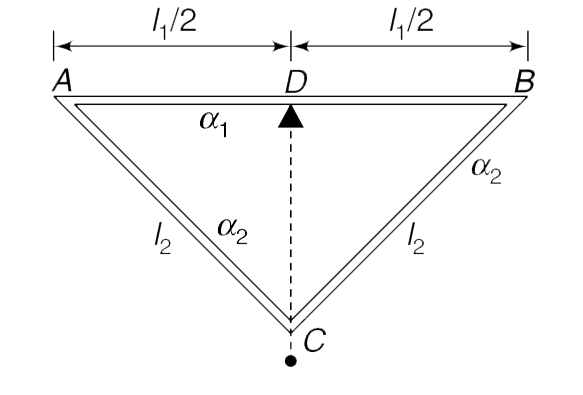
In a compensated pendulum a triangular frame ABC is made using two different metals. AB of length `l_(1)` is made using a metal having coefficient of linear expansion `alpha_(1)`. BC and AC of length `l_(2)` each have coefficient of linear expansion `alpha_(2)`. A heavy bob is attached at C. Pendulum can oscillate about the pivot D. Find `(l_(2))/(l_(1))` so that distance of bob from the pivot point D does not change with change in temperature.

Text Solution

Verified by Experts

The correct Answer is:
`1/2 sqrt((alpha_(1))/(alpha_(2)))`
Promotional Banner

Topper's Solved these Questions

Similar Questions

Explore conceptually related problems

Two metallic rods of length l and 3l have coefficient of linear expansion alpha and 3alpha respectively. The coefficient of linear expansion ofr their series combinations, is

Two rods having length l_(1) and l_(2) , made of materials with the linear coefficient of expansion alpha_(1) and alpha_(2) were welded togther. The equivalent coefficients of linear expansion for the obtained rod:-

If two rods of length L and 2L having coefficients of linear expansion alpha and 2alpha respectively are connected so that total length becomes 3L, the average coefficient of linear expansion of the composite rod equals

Two different wirese having lengths L_(1) and L_(2) and respective temperature coefficient of linear expansion alpha_(1) and alpha_(2) are joined end - to - end . Then the effective temperature coeficient of linear expansion is :

There are two rods of length l_1 l_2 and coefficient of linear expansions are alpha_1 and alpha_2 respectively. Find equivalent coefficient of thermal expansion for their combination in series.

" The relation between coefficient of linear expansion "(alpha_(1))" and coefficient of volume expansion ( "alpha_(5)" ) is "

An isosceles triangles is formed with a thin rod of length l_(1) and coefficient of linear expansion alpha_(1) , as the base and two thin rods each of length l_(2) and coefficient of linear expansion alpha_(2) as the two sides. The distance between the apex and the midpoint of the base remain unchanged as the temperature is varied. the ratio of lengths (l_(1))/(l_(2)) is

A rod of length l and coefficient of linear expansion alpha . Find increase in length when temperature changes from T to T+ DeltaT

A rod of length l and coefficient of linear expansion alpha . Find increase in length when temperature changes from T to T+ DeltaT

A cube of edge (L) and coefficient of linear expansion (alpha) is heated by 1^(0)C . Its surface area increases by