Home
Class 11
PHYSICS
A block is kept in a room which is at 20...

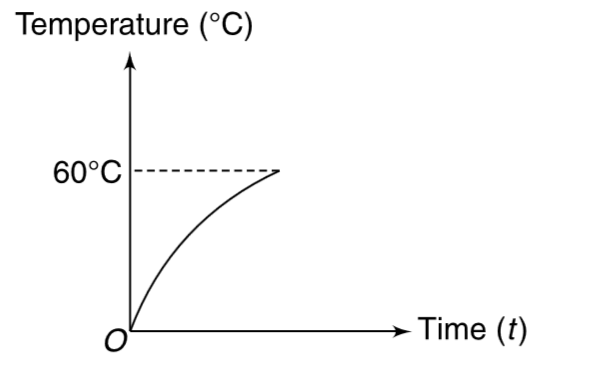
A block is kept in a room which is at `20^(@)C`. To raise the temperature of the block, heat is given to it at a constant rate of 600 watt (using an electric heater). The temperature of the block rises with time as shown in the graph. The slope of the graph at time `t = 0` is `3^(@)C s^(-1)`. Once the temperature rises to `60^(@)C`, the heater is switched off and another heater is switched on to maintain the temperature of the block at `60^(@)C`. This new heater supplies heat at a constant rate of 100 watt. Assume that heat capacity of the block remains constant for the range of temperature involved.
(a) Explain why the slope of the given graph is decreasing with time.
(b) Calculate the heat capacity of the block.
(c) If the 100 W heater is also switched off, what will be initial rate of cooling of the block?
(d) Assuming that rate of heat loss by the block to the surrounding is proportional to difference in its temperature with surrounding, calculate the heat radiated per second by the block when it was at `30^(@)C`.

Text Solution

Verified by Experts

The correct Answer is:

(b) `200J^(@)C_(-1)` (c) `0.5^(@)C^(-1)` (d) 25W
Promotional Banner

Topper's Solved these Questions

Similar Questions

Explore conceptually related problems

A metal block is placed in a room which is at 10^(@)C for long time. Now it is heated by an electric heater of power 500 W till its temperature becomes 50^(@)C . Its initial rate of rise of temperature is 2.5^(@)C//sec . The heater is switched off and now a heater of 100W is required to maintain the temperature of the block at 50^(@)C . (Assume Newtons Law of cooling to be valid) What is the heat capacity of the block?

Heat is generated continuously in an electric heater, but its temperature becomes constant after some time. Why?

A metal ball of mass 1.0 kg is kept in a room at 15^(@)C . It is heated using a heater. The heater supplies heat to the ball at a constant rate of 24 W. The temperature of the ball rises as shown in the graph. Assume that the rate of heat loss from the surface of the ball to the surrounding is proportional to the temperature difference between the ball and the surrounding. Calculate the rate of heat loss from the ball when it was at temperature of 20^(@)C .

A metal block is placed in a room which is at 10^(@)C for long time. Now it is heated by an electric heater of power 500W till its temperature becomes 50^(@)C Its initial rate of rise of temperature is 2.5^(@)C//sec The heater is switched off and now a heater of 100W is required to maintain the temperature of the block at 50^(@)C The heat radiated per second when the block was 30^(@)C is given as alpha watt. Find the value of ((alpha)/(10)) (Assume Newton's law of cooling to be valid .

A metal block is placed in a room which is at 10^(@)C for long time. Now it is heated by an electric heater of power 500 W till its temperature becomes 50^(@)C . Its initial rate of rise of temperature is 2.5^(@)C//sec . The heater is switched off and now a heater of 100W is required to maintain the temperature of the block at 50^(@)C . (Assume Newtons Law of cooling to be valid) What is the rate of cooling of block at 50^(@)C if the 100W heater is also switched off?

A metal block is placed in a room which is at 10^(@)C . It is heated by an electric heater of power 500 W till its temperature becomes 50^(@)C . Its initial rate of rise of temperature is 2.5^(@)C//sec . The heater is switched off and now a heater of 100 W is required to maintain the temperature of the block at 50^(@)C . (Assume Newtons Law of cooling to be valid) (i) What is the heat capacity of the block ? ( ii ) What is the rate of cooling of block at 50^(@)C if the 100W heater is also switched off ? (iii) What is the heat radiated per second when the block was 30^(@)C ?

1^(@) C rise in temperature is equal to a rise of

ARIHANT-HEAT TRANSFER-Heat Transfer
  1. Solar constant, I(s) is defined as intensity of solar radiation incide...

    Text Solution

    |

  2. A tapering rod of length L has cross sectional radii of a and b(lt a) ...

    Text Solution

    |

  3. A thick cylindrical shell made of material of thermal conductivity k h...

    Text Solution

    |

  4. A double pan window used for insulating a room thermally from outside ...

    Text Solution

    |

  5. The container A contains ice at O^(@)C. A conducting uniform rod PQ of...

    Text Solution

    |

  6. Two identical adiabatic containers of negligible heat capacity are con...

    Text Solution

    |

  7. A copper slab is 2 mm thick. It is protected by a 2 mm layer of stainl...

    Text Solution

    |

  8. A steel plate is 0.3 m long, 0.1m wide and 0.012 m thick. The plate is...

    Text Solution

    |

  9. A straight cylindrical wire is connected to a battery. The wire is mai...

    Text Solution

    |

  10. A spherical shell is kept in an atmosphere at temperature T(0). The wa...

    Text Solution

    |

  11. A body at a temperature of 50^(@)C cools to 49^(@)C in time Deltat whe...

    Text Solution

    |

  12. A plane surface A is at a constant temperature T(1) = 1000 K. Another ...

    Text Solution

    |

  13. A block is kept in a room which is at 20^(@)C. To raise the temperatur...

    Text Solution

    |

  14. Mass m of a liquid A is kept in a cup and it is at a temperature of 90...

    Text Solution

    |

  15. Consider the Sun to be a black body at temperature T(S) = 5780 K. Radi...

    Text Solution

    |

  16. A and B are two sphere made of same material. Radius of A is double th...

    Text Solution

    |

  17. Heat received by the Earth due to solar radiations is 1.35 KWm^(-2). I...

    Text Solution

    |

  18. A truck of mass M has 4 wheels. The surface area of the metal disc in ...

    Text Solution

    |

  19. A solid body A of mass m and specific heat capacity ‘s’ has temperatur...

    Text Solution

    |

  20. A cylindrical rod of length l, thermal conductivity k and area of cros...

    Text Solution

    |
