Home
Class 11
PHYSICS
When a negative charged rod is brought n...

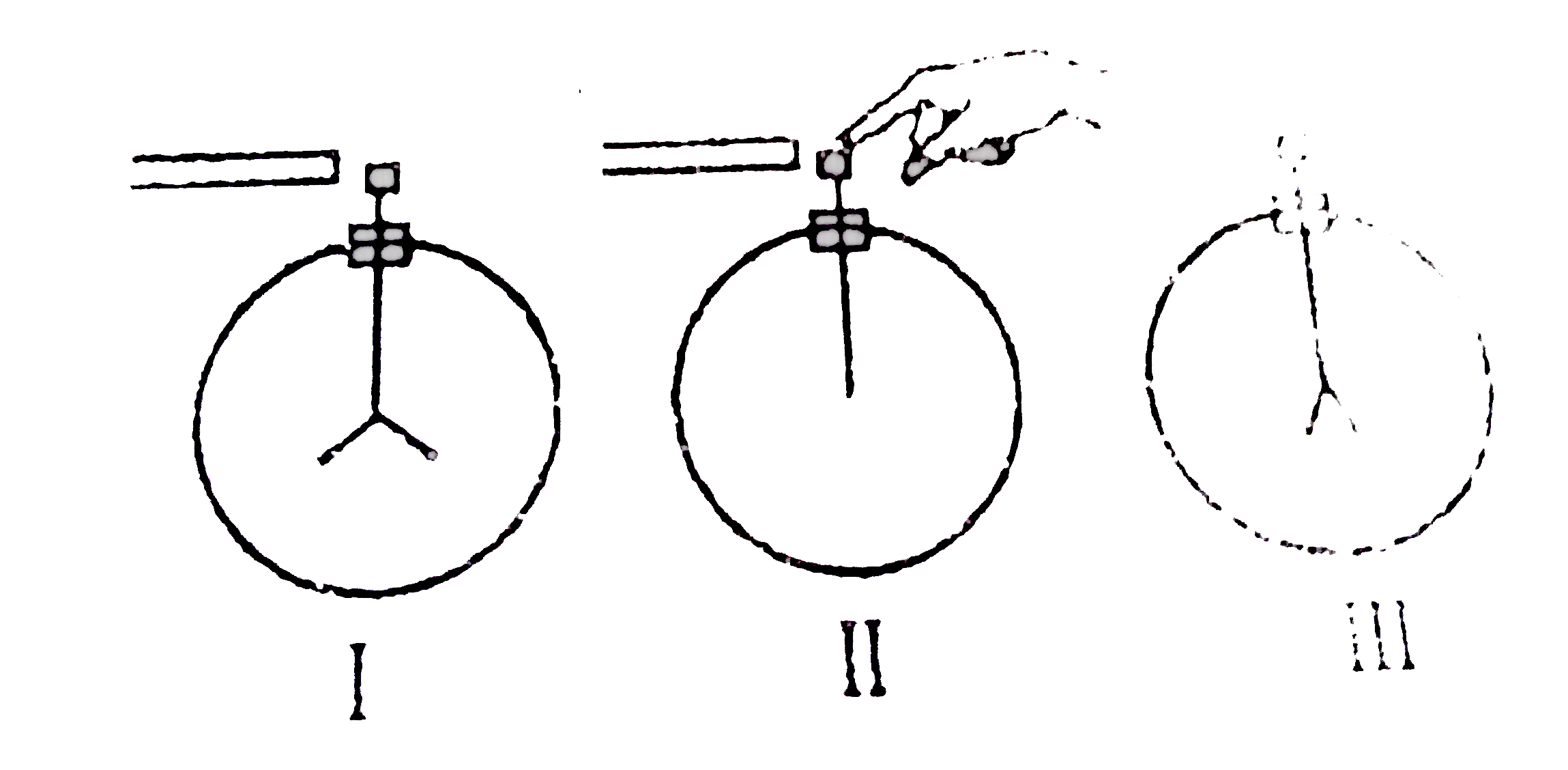
When a negative charged rod is brought near, but does not touch, the initially unchanged electroscope shown below, the leaves spring apart `(I)`. When the electroscope is then touched with a finger, the leaves collapse `(II)`. When next the finger and finally the rod are removed, the leaves spring apart a second time `(III)`. The charge on the leaves is

A

positive in both `I` and `III`

B

negative in both `I` and `III`

C

positive in `I`, negative in `III`

D

negative in `I`, positive in `III`

Text Solution

Verified by Experts

The correct Answer is:

D

Due to induced effect.
Promotional Banner

Topper's Solved these Questions

  • MISCELLANEOUS

    ALLEN|Exercise Exersice-03|7 Videos
  • MISCELLANEOUS

    ALLEN|Exercise ASSERTION-REASON|18 Videos
  • MISCELLANEOUS

    ALLEN|Exercise Part -II Example Some worked out Examples|1 Videos
  • KINEMATICS (MOTION ALONG A STRAIGHT LINE AND MOTION IN A PLANE)

    ALLEN|Exercise BEGINNER S BOX-7|8 Videos
  • PHYSICAL WORLD, UNITS AND DIMENSIONS & ERRORS IN MEASUREMENT

    ALLEN|Exercise EXERCISE-IV|8 Videos

Similar Questions

Explore conceptually related problems

When the leaves of a Mimosa pudica plant are touched with a finger, they fold up quickly. This is an example of:

What will happen to the leaves of an electroscope if a positively charged body is brought near (a) An uncharged electroscope ? (b) A positively charged electroscope ? ( c ) A negatively charged electroscope ?

An electroscope is given a positive charge, causing its foil leaves to separate. When an object is brought near the top plate of electroscope, the foils separate even further. We conclude

An electroscope is given a positive charge, causing its foil leaves to separate. When an object is brought near the top plate of the electroscope, the fiols separated even further. We conclude.

A leaf electroscope is a simple apparatus to detect any charge on a body. It consists of two metal leaves OA and OB, free to rotate about O. Initially both are very slightly separated. When a charged object is touched to the metal knob at the top of the conducting rod, charge flows knob to the leaves through the conducting rod. As the leaves are now charges similarly, they start repelling each other and get separated, (deflected by certain angle). The angle of deflection in static equilibrium is an indicator of the amount of charge on the charged body. In an electroscope, both leaves are hinged at the top point O. Each leaf has mass m, length l and gets charge q. assuming the charge to be concentrated at ends A and B only, the small angle of deviation (theta) between the leaves in static equilibrium, is equal to :

ALLEN-MISCELLANEOUS-Exercise-01
  1. The method of dimensional analysis can be used to derive which of the ...

    Text Solution

    |

  2. A particle with mass m and initial speed V(0) is a subject to a veloci...

    Text Solution

    |

  3. When a negative charged rod is brought near, but does not touch, the i...

    Text Solution

    |

  4. Two small insulating spheres are attached to silk threads. The spheres...

    Text Solution

    |

  5. Using mass (M), length (L), time (T) and current (A) as fundamental qu...

    Text Solution

    |

  6. Two point charges +9e and +e are kept 16 cm. Apart from each other. Wh...

    Text Solution

    |

  7. Four charges are arranged at the corners of a square ABCD as shown in ...

    Text Solution

    |

  8. When charge is given to a soap bubble, it shows:Two equal negative cha...

    Text Solution

    |

  9. Two equal negative charges -q are fixed at points (0, -a) and (0,a) on...

    Text Solution

    |

  10. Figure below show regular hexagons with charges at the vertices. In w...

    Text Solution

    |

  11. Two infinite linear charges are placed parallel to each other at a dis...

    Text Solution

    |

  12. An electron of mass m(e ) initially at rest moves through a certain di...

    Text Solution

    |

  13. An electron is projected as in figure with kinetic energy K, at an ang...

    Text Solution

    |

  14. A proton sists at coordinates (x,y)=(0, 0), and an electron at (d, h),...

    Text Solution

    |

  15. A positive point charge 50mu C is located in the plane xy at a point w...

    Text Solution

    |

  16. Three point charges 1C, 2C and 3C are placed at the corners of an equi...

    Text Solution

    |

  17. Rank the work required to assemble the charge distribution below from ...

    Text Solution

    |

  18. The are AB with the centre C and infinitely long wire having linear ch...

    Text Solution

    |

  19. The diagram shows the electric field lines produced by an electrostali...

    Text Solution

    |

  20. As per this diagram a point charge +q is placed at the origin O. Work ...

    Text Solution

    |
