Home
Class 11
PHYSICS
X and Y are large, parallel conducting p...

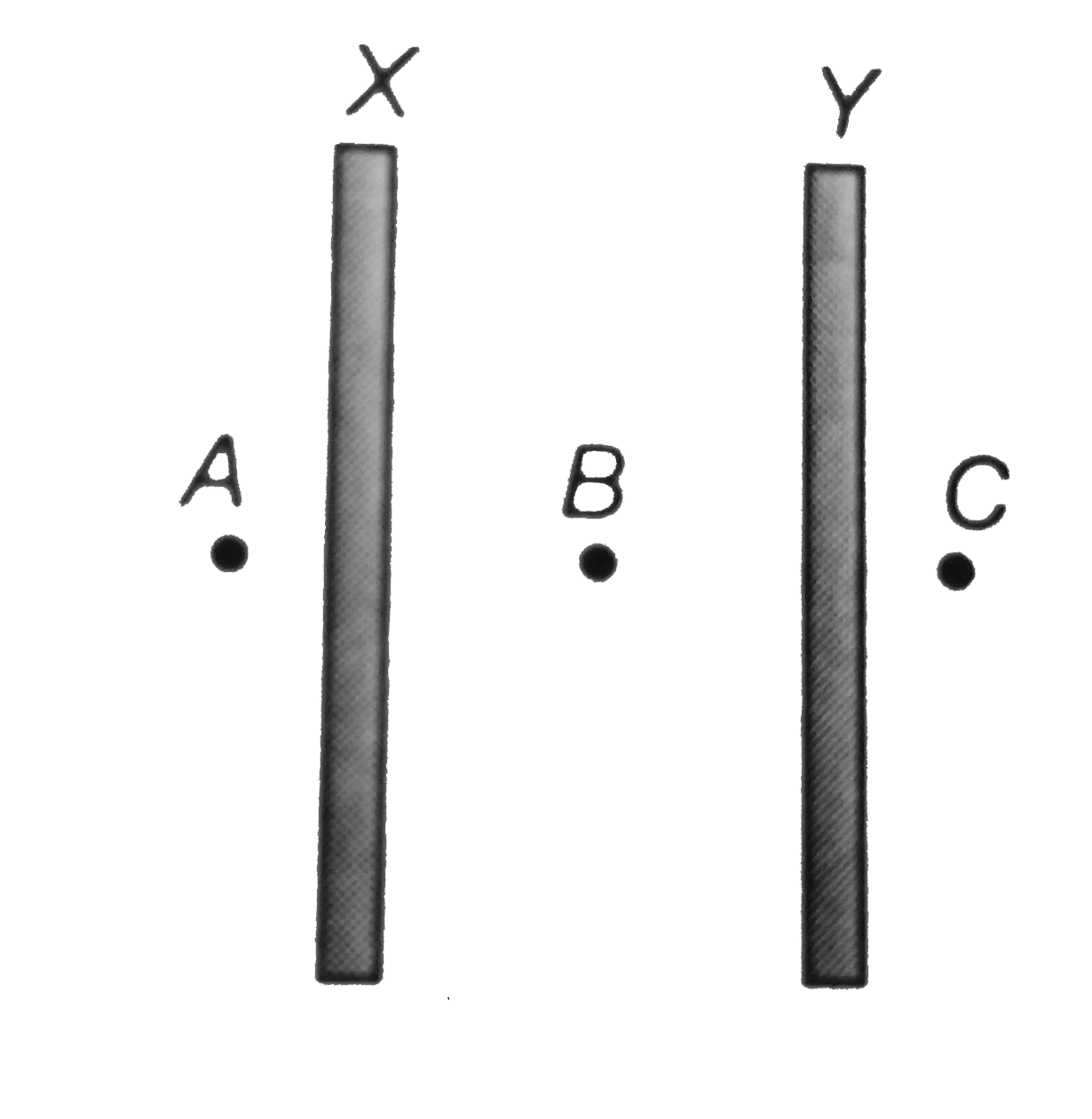
`X` and `Y` are large, parallel conducting plates close to each other. Each face has an area `A`. `X` is given a charge `Q`. `Y` is without any charge. Points `A,B` and `C` are as shown in the figure.

A

The field at B is `Q/(2epsilon_(0)A)`

B

The field at B is `Q/(epsilon_(0)A)`

C

The field at A, B and C are of the same magnitude

D

The field at a and C are of the same magnitude, but in opposite directions

Text Solution

Verified by Experts

The correct Answer is:

A, C, D

Surface charge density at inner surface of X is `sigma=Q/(2A)`
`:.` Electric field at B due to this is `sigma/(2 in_(0))=Q/(4pi in_(0))`
Toward right and in same direction of same value due to induced charged precent inside surface of plate Y.
Promotional Banner

Topper's Solved these Questions

  • MISCELLANEOUS

    ALLEN|Exercise Exercise-03|1 Videos
  • MISCELLANEOUS

    ALLEN|Exercise Exercise-04|1 Videos
  • MISCELLANEOUS

    ALLEN|Exercise Exersice -05(B)|20 Videos
  • KINEMATICS (MOTION ALONG A STRAIGHT LINE AND MOTION IN A PLANE)

    ALLEN|Exercise BEGINNER S BOX-7|8 Videos
  • PHYSICAL WORLD, UNITS AND DIMENSIONS & ERRORS IN MEASUREMENT

    ALLEN|Exercise EXERCISE-IV|8 Videos

Similar Questions

Explore conceptually related problems

A and B are two large identical thin metal plates placed parallel to each other at a small separation. Plate A is given a charge Q. (i) Find the amount of charge on each of the two faces of A and B. (ii) Another identical plate C having charge 3Q is inserted between plate A and B such that distance of C from B is twice its distance from A. Plate A and B is shorted using a conducting wire. Find charge on all six faces of plates A, B and C. (iii) In the situation described in (ii) the plate A is grounded. Now write the charge on all six faces.

Two large , parallel conducting plates X and Y , kept close to each other , are given Q_(1) and Q_(2) (Q_(1) gt Q_(2)) . The four surfaces of the plates are A,B,C and D , as shown (i) The charge on A is (1)/(2) (Q_(1) + Q_(2)) (ii) The charge on B is (1)/(2) (Q_(1) - Q_(2)) (iii) The charge on C is (1)/(2) (Q_(2) - Q_(1)) (iv) The charge on D is (1)/(2) (Q_(1) + Q_(2))

Two conducting plates A and B are placed parallel to each other. A is given a charge. Q_1 and B a charge Q_2 . Find the distribution of charges on the four surface.

Two large parallel conducting plates are placed close to each other ,the inner surface of the two plates have surface charge densities +sigma and -sigma .The outer surfaces are without charge.The electric field has a magnitude of

There are two metallic plates of a parallel plate capacitor. One plate is given a charge +q while the other is earthed as shown. Points P, P_1 and P_2 are taken as shown in adjoining figure. Then the electric intensity is not zero at :

Two conducting plates X and Y, having large surface area A (on one side), are placed parallel to each other as shown in figure. The plate X is given a charge Q whereas the other is neutral. Find : (a) The surface charge density at the inner surface of the plate X, (b) The electric field at a point to the left of the plates, (c) The electric field at a point in between the plates and (d) The electric field at a point to the right of the plates.

Three large plates A, B and C are placed parallel to each other and charges are given as shown. The charge that appears on the left surface of plate B is

Three large conducting plates with charges Q , -Q and Q are kept close to each other as shown in the figure. ( where Q = 2 uc ). Now all the three plates A, B, and C are connected by a thin conducting wire. Find the charge ( in C) on left surface of plate A at electristatic equailibrium

Two conducting plates A and B are placed parallel to each other. A is given a charge Q_1 and B a charge Q_2 . Prove that the charges on the inner surfaces are of equal magnitude and opposite sign.

ALLEN-MISCELLANEOUS-Exercise-02
  1. The dipole moment of a system of charge +q distribyted uniformly on a...

    Text Solution

    |

  2. An electric dipole is kept on the axis of a uniformly charged ring at ...

    Text Solution

    |

  3. Point P lies on the axis of a dipole . If the dipole is rotated by 90...

    Text Solution

    |

  4. Two short electric dipole are placed as shown. The energy of electric ...

    Text Solution

    |

  5. Charges Q1 and Q2 lie inside and outside, respectively, of a closed su...

    Text Solution

    |

  6. An electric dipole is placed at the centre of a sphere. Mark the corre...

    Text Solution

    |

  7. An infinite, uniformly charged sheet with surface charge density sigma...

    Text Solution

    |

  8. At a distance of 5 cm and 10 cm outward from the surface of a uniforml...

    Text Solution

    |

  9. An electric field converges at the origin whose magnitude is given by ...

    Text Solution

    |

  10. A bullet of mass m and charge q is fired towards a solid uniformly cha...

    Text Solution

    |

  11. A unit positive point charge of mass m is projected with a velocity v ...

    Text Solution

    |

  12. Three concentric conducting spherical shells have radii r, 2r, and 3r ...

    Text Solution

    |

  13. Shown in the figure a spherical shell with an inner radius 'a' and an ...

    Text Solution

    |

  14. In the previous question assume that the electrostatic potential is ze...

    Text Solution

    |

  15. There are four concentric shells A,B, C and D of radii a,2a,3a and 4a ...

    Text Solution

    |

  16. X and Y are large, parallel conducting plates close to each other. Eac...

    Text Solution

    |

  17. Plates a and B constitutes an isolated, charge parallel plate capacito...

    Text Solution

    |

  18. A wheel having mass m has charges +q and -q on diametrically opposite...

    Text Solution

    |

  19. A tiny charged pellet of mass m is suspended at rest by the electric f...

    Text Solution

    |

  20. A positive point charge is placed at P in front of an earthed metal sh...

    Text Solution

    |
