Home
Class 11
PHYSICS
A non-conducting disc of radius a and un...

A non-conducting disc of radius a and uniform positive surface charge density `sigma` is placed on the ground, with its axis vertical. A particle of mass m and positive charge q is dropped, along the axis of the disc, from a height H with zero initial velocity. The particle has `q//m=4 in_0 g//sigma`
(a) Find the value of H if the particle just reaches the disc.
(b) Sketch the potential energy of the particle as a function of its height and find its equilibrium position.

Text Solution

Verified by Experts

The correct Answer is:
(i) `H=4/3a` (ii) `H=a/sqrt(3)`

Potential at a height H on the axis of the disc V(P):
The charge dq contained in the ring shown in figure.
Potential of p due to this ring
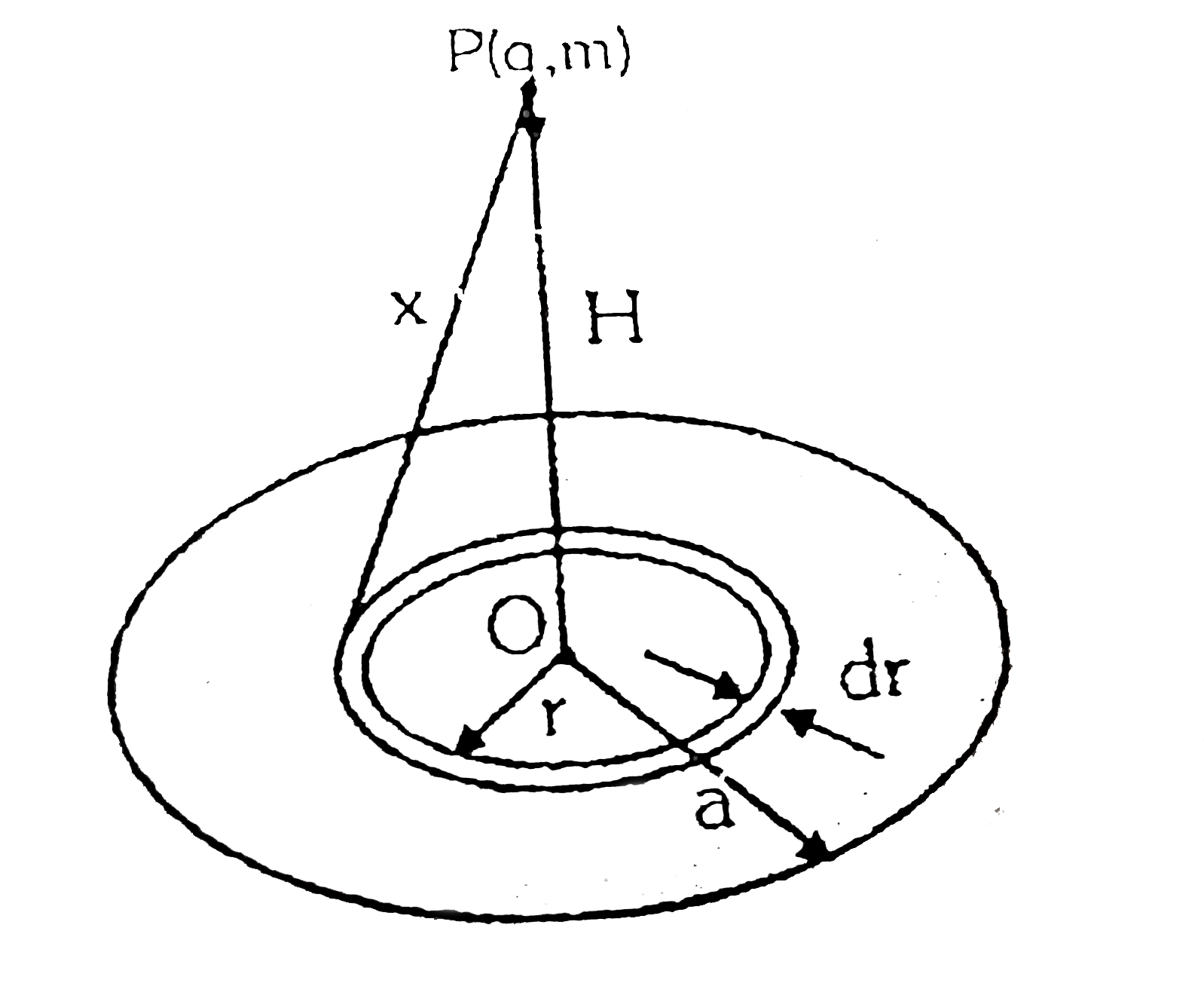
`dV=1/(4pi epsilon_(0)).(dq)/x` where `x=sqrt(H^(2)+r^(2))`
`dV=1/(4pi epsilon_(0)).((2pirdr)sigma)/sqrt(H^(2)+r^(2))=(sigma/(2epsilon_(0)))xx((rdr)/sqrt(H^(2)+r^(2)))`
`:.` Potential due to the complete disc
`V_(p)=underset(r=0)overset(r=a)(int)dV=sigma/(2epsilon_(0)) underset(r=0)overset(r=a)(int)(rdr)/sqrt(H^(2)+r^(2))`
`V_(p)=sigma/(2epsilon_(0))[sqrt(a^(2)+H^(2))-H]`
Potential at centre (O) will be `V_(O)=(sigmaa)/(2epsilon_(0)) :. H=0`
(i) Particle is released from P and just reaches point O. Therefore from conservation of mechanical energy.
Decrease in graviational potential energy
= Increase in electrostatic potential energy
`(DeltaKE=0` because `K_(1)=K_(f)=0`)
`:. mgh=q[V_(o)-V_(p)]rArr gH=(q/m)(sigma/(2epsilon_(0)))`
`[a-sqrt(a^(2)+H^(2))+H]` ...(i)
`q/m=(4epsilon_(0)g)/sigma :. (qsigma)/(2epsilon_(0)m)=2g`
Substituting in Eq. (i), we get
`gH=2g [a+H-sqrt(a^(2)+H^(2))]`
`rArr H/2=(a+H)-sqrt(a^(2)+H^(2))`
`rArr sqrt(a^(2)+H^(2))=a+H/2`
`rArr a^(2)+H^(2)=a^(2)+H^(2)/4+aHrArr 3/4 H^(2)=aH`
`rArr H=4/3a` and `H=0 :. H=(4/3)a`
(ii) Potential energy of the particle at height H=Electrostatic potential energy + gravitational potential energy
`:. U=qV+mgH`
Here V=Potential at height H
`U=(sigmaq)/(2epsilon_(0))[sqrt(a^(2)+H^(2))-H]+mgH` ...(ii)
At equilibrium position `F=(-dU)/(dH)=0`
Differentialting Eq. (ii) w.r.t H
`rArr mg+sigmaq/(2epsilon_(0))[(1/2)(2H)1/sqrt(a^(2)+H^(2))-1]=0`
`( :' (sigmaq)/(2epsilon_(0))=2mg)`
`:. mg+2mg[H/sqrt(a^(2)+H^(2))-1]=0`
`rArr 1+(2H)/sqrt(a^(2)+H^(2))-2=0rArr (2H)/sqrt(a^(2)+H^(2))=1`
`rArr H^(2)/(a^(2)+H^(2))=1/4rArr 3H^(2)=a^(@)rArr H=a/sqrt(3)`
From Eq. (ii) we can write U-H equation as
`U=mg (2sqrt(a^(2)+H^(2))-H)`
(Parabolic variation)
`U=2 mga` at `H=0`
and `U=U_("min")=sqrt(3)mga` at `H=a/sqrt(3)`
therefore, `U-H` graph will be as shown.
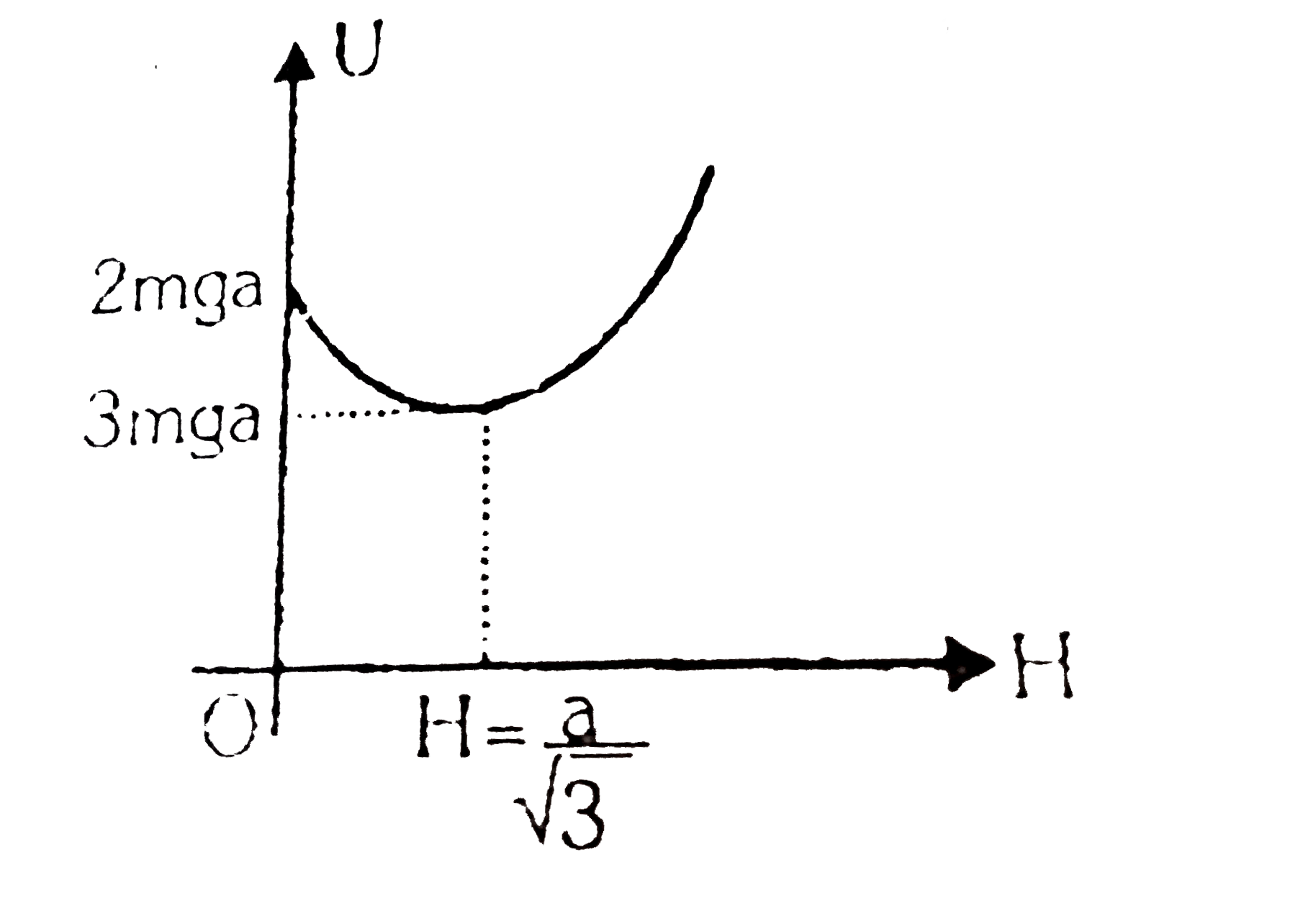
Note that at `H=a/sqrt(3)`, U is minimum.
Therefore, `H=a/sqrt(3)` is stable equilibrium position.

Promotional Banner

Topper's Solved these Questions

  • MISCELLANEOUS

    ALLEN|Exercise LINKED COMPREHENSION TYPE|3 Videos
  • KINEMATICS (MOTION ALONG A STRAIGHT LINE AND MOTION IN A PLANE)

    ALLEN|Exercise BEGINNER S BOX-7|8 Videos
  • PHYSICAL WORLD, UNITS AND DIMENSIONS & ERRORS IN MEASUREMENT

    ALLEN|Exercise EXERCISE-IV|8 Videos

Similar Questions

Explore conceptually related problems

A nonconducting disk of radius a and uniform positive surface charge density sigma is placed on the ground, with its axis vertical. A particle of mass m and positive charge q is dropped, along the axis of the disk, from a height H with zero initial velocity. The particle has q//m = 4 epsilon_(0) g// sigma . (i) Find the value of H if the particle just reaches the disk. (ii) Sketch the potential energy of the particle as a function of its height and find its equilibrium position.

A uniformly charged disc of radius R having surface charge density sigma is placed in the xy plane with its center at the origin. Find the electric field intensity along the z-axis at a distance Z from origin :

A non-conducting thin disc of radius R charged uniformly over one side with surface density s rotates about its axis with an angular velocity omega . Find (a) the magnetic induction at the centre of the disc, (b) the magnetic moment of the disc.

A non-conducting thin disc of radius R charged uniformly over one side with surface density sigma , rotates about its axis with an angular velocity omega . Find (a) the magnetic field induction at the centre of the disc (b) the magnetic moment of the disc.

A circular ring of radius R with uniform positive charge density lambda per unit length is located in the y-z plane with its centre at the origin O. A particle of mass m and positive charge q is projected from the point P (Rsqrt3, 0, 0) on the positive x-axis directly towards O, with an initial speed v. Find the smallest (non-zero) value of the speed v such that the particle does not return to P.

A non-conducting semi circular disc (as shown in figure) has a uniform surface charge density sigma . The ratio of electric field to electric potential at the centre of the disc will be

A flat disc of radius R charged uniformly on its surface at a surface charge density sigma . About its central axis of rotation it rotates at an angular speed omega . Find the magnetic moment of disc due to rotation of charges.

Positive charge Q is distributed uniformly over a circular ring of radius R. A particle having a mass m and a negative charge q, is placed on its axis at a distance x from the centre. Find the force on the particle. Assuming x ltltR, find the time period of oscillation of the particle if it is released from there.

A smooth chute is made in a dielectric sphere of radius R and uniform volume charge density. rho . A charge particle of mass m and charge -q is placed at the centre of the sphere. Find the time period of motion of the particle?
