

Home
Class 12
PHYSICS
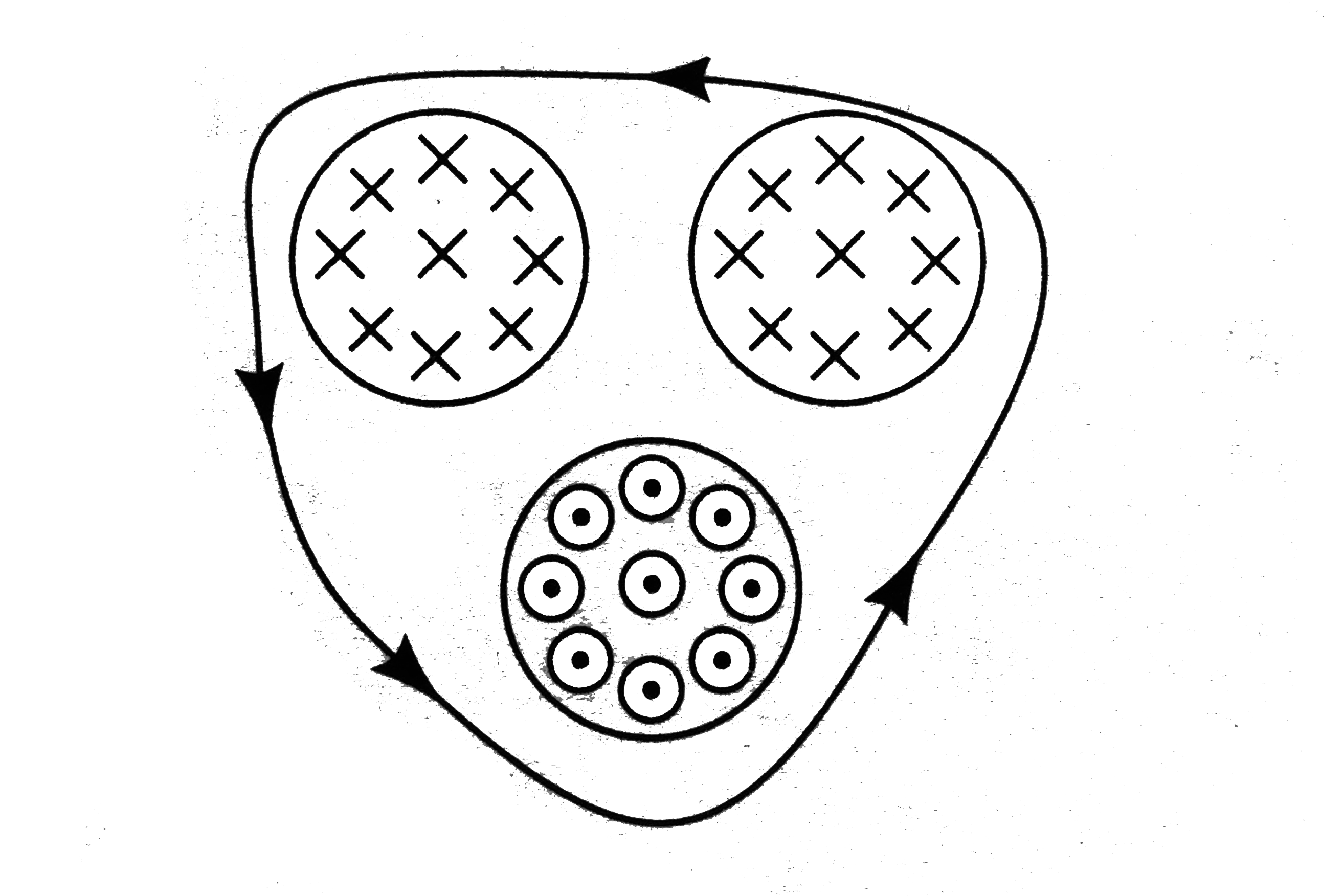
Figure. shows three rigions of magnetic ...

Figure. shows three rigions of magnetic field each of area `A`, and in each rigion, magnitude of mqagnetic field decreases rate `alpha`. If `vec(E)` is the induced electric field, then the vlue of the line `ointvec(E).dvec(r )` along the given loop is equal to

Promotional Banner

Similar Questions

Explore conceptually related problems

Figure shows a circular region of radius R in which uniform magnetic field B exists. The magnetic field is increasing at a rate (dB)/(dt) . The induced electric field at a distance r from the centre for r lt R is

(A): An emf is induced in a closed loop where magnetic flux is varied. The induced electric field is not a conservative field (R): The line integral vecE.vec(dl) around the closed loop is non-zero

Figure shows electric lines of force. If E_(x) and E_(y) are the magnitudes of electric field at points x and y respectively, then

Assertion : An emf vec(E) is induced in a closed loop where magnetic flux is varied. The induced vec(E) is not a conservative field. Reason : The line intergral vec(E).vec(dl) around the closed loop is non-zero.

Assertion : An emf vec(E) is induced in a closed loop where magnetic flux is varied. The induced vec(E) is not a conservative field. Reason : The line intergral vec(E).vec(dl) around the closed loop is non-zero.

The figure shows some of the electric field lines corresponding to an electric field. If E is the intensity of electric field and V is the potential

In fig, two particles, each of charge -q are arranged symmetrically about the y-axis, each producing an electric field at point P on the y-axis. . (a) Are the magnitudes of the fields at P equal? (b) Is each electric field directed towards or away form the charge producing it ? (c ) Is the magnitude of the net electric field at P equal to the sum of the magnitudes E of the two field vectors (is it equal to 2E)? (d) Do the x-components of those two field vectors add or cancel? (e ) Do their y-components add or cancel? (f) Is the diretion of the net field at P that of the canceling components or the adding components? (g) What is the direction of the net field?

In fig, two particles, each of charge -q are arranged symmetrically about the y-axis, each producing an electric field at point P on the y-axis. . (a) Are the magnitudes of the fields at P equal? (b) Is each electric field directed towards or away form the charge producing it ? (c ) Is the magnitude of the net electric field at P equal to the sum of the magnitudes E of the two field vectors (is it equal to 2E)? (d) Do the x-components of those two field vectors add or cancel? (e ) Do their y-components add or cancel? (f) Is the diretion of the net field at P that of the canceling components or the adding components? (g) What is the direction of the net field?