

Home
Class 12
PHYSICS
A conducting rod of length 'l'=2sqrt(5) ...

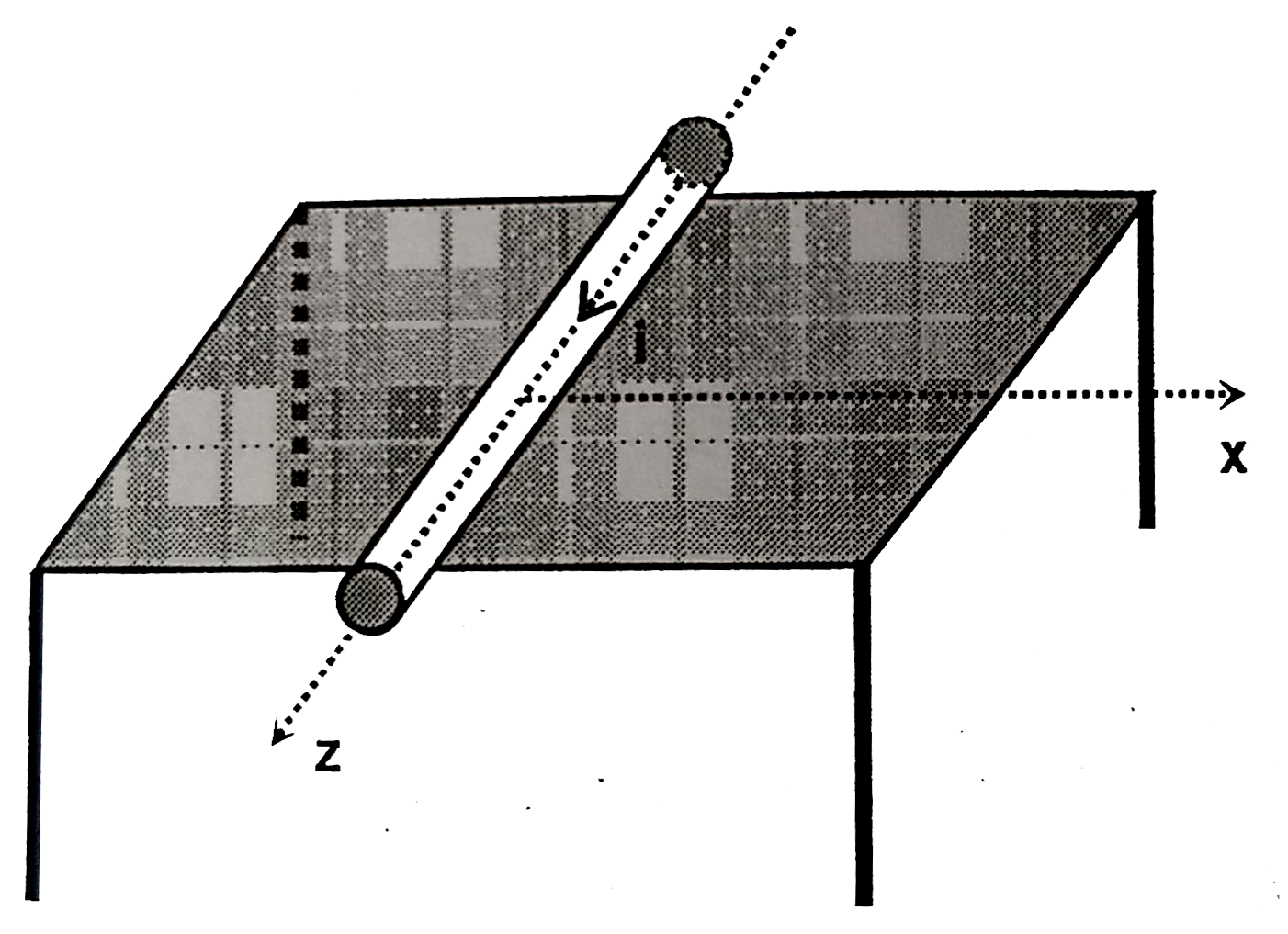
A conducting rod of length `'l'=2sqrt(5)` meter and mass `'m'=4kg` lies on the horizontal table. Coefficient of friction between the rod and the table is `'mu'=(1/2)`. If the current in the conductor si 2 ampere, then find the minimum magnitude of magnetic field strength (in Tesla) such that conducting rod just starts to translate along `x` -axis (take `g=10m//sec^(2)`) [neglect the radius of rod]

Promotional Banner

Similar Questions

Explore conceptually related problems

A conductor (rod) of mass m, length l carrying a current i is subjected to a magnetic field of induction B. If the coefficients of friction between the conducting rod and rail is mu, find the value of I if the rod starts sliding.

A conductor (rod) of mass m, length l carrying a current i is subjected to a magnetic field of induction B. If the coefficients of friction between the conducting rod and rail is mu, find the value of I if the rod starts sliding.

A rod of mass M and length L lies on an incline having inclination of theta = 37^(@) . The coefficient of friction between the rod and the incline surface is mu = 0.90 . Find the tension at the mid point of the rod.

A uniform thin rod of length 2L and mass m lies on a horizontal table. A horizontal impulse J is given to the rod at one red. There is no friction. The total kinetic energy of the rod just after the impulse will be

A uniform rod of length l and mass 2m rests on a smooth horizontal table. A point of mass m moving horizontally at right angle to the rod with velocity v collides with one end of the rod and sticks to it, then:

A uniform rod of length l and mass 2 m rests on a smooth horizontal table. A point mass m moving horizontally at right angles to the rod with velocity v collides with one end of the rod and sticks it. Then

A uniform rod of length l and mass 2 m rests on a smooth horizontal table. A point mass m moving horizontally at right angles to the rod with velocity v collides with one end of the rod and sticks it. Then

A uniform rod of length l and mass 2 m rests on a smooth horizontal table. A point mass m moving horizontally at right angles to the rod with velocity v collides with one end of the rod and sticks it. Then