

Home
Class 11
PHYSICS
A ladder of mass M and length L stays at...

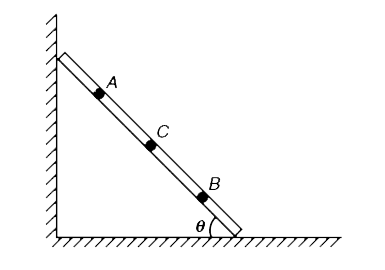
A ladder of mass M and length L stays at rest against a smooth wall. The coefficient of friction between the ground and the ladder is `mu`
(a) Let `F_("wall")`, W and `F_(g)` be the force applied by wall, weight of the ladder and force applied by ground on the ladder. Argue to show that the line of action of these three forces must intersect.
(b) Using the result obtained in (a) show that line of action of Fg makes an angle `tan^(-1) (2 tan theta)` with the horizontal ground where `theta` is the angle made by the ladder with the ground.
(c) Find the smallest angle that the ladder can make with the ground and not slip.
(d) You climb up the ladder, your presence makes the ladder more likely to slip. Where are you at A or B? C is the centre of mass of the ladder.

Text Solution

Verified by Experts

The correct Answer is:
(a) `alpha = tan^(-1) (2 tan theta)`
(c) `theta_("min") = tan^(-1) ((1)/(2 mu))`
(d) Slippage is more likely when at A
Promotional Banner

Topper's Solved these Questions

  • NEWTONS LAWS OF MOTION

    ARIHANT|Exercise All Questions|111 Videos
  • SIMPLE HARMONIC MOTION

    ARIHANT|Exercise Level 3|9 Videos

Similar Questions

Explore conceptually related problems

A ladder of length l and mass m is placed against a smooth vertical wall, but the ground is not smooth. Coefficient of friction between the ground and the ladder is mu . The angle theta at which the ladder will stay in equilibrium is

A ladder of mass 10kg is held at reat against a smooth wall on a rough ground as shown in figure. The normal reaction between the wall and the ladder is

A ladder of length 5 m is placed against a smooth wall as shown in figure. The coefficient or friction is mu between ladder and ground. What is the minimum value of mu , If the ladder is not to slip?

A ladder is resting against a wall and a person climbs up the ladder.Is the ladder more likely to slip out at the bottom as the person climbs closer to the top of the ladder? Explain.

A ladder wighing 300 N is placed against a smooth vertical wall having a coefficient of friction between it and the floor of 0.2. What is the maximum force of friction available at the point of contact between the ladder and the floor?

A ladder 15m long makes an angle of 60^(@) with the wall. Find the height of the point , where the ladder touches the wall.

A ladder rests on the floor of a room, leaning agains a wall. If the coefficient of static friction between the ladder the floor is mu_(f) and that between ladder and is mu_(w) , what is the minimum angle theta that the ladder can make with the floor if the ladder is not to slip? Assume that the mass of the ladder is distributed uniformly.

A uniform ladder of length 3.25 m and weight 250 N is placed against a smooth vertical wall with its lower end 1.25 m from the wall. If coefficient of friction between the ladder and the floor is 0.3, then, find the frictional force acting on the ladder at the point of contact between ladder and floor.

If a ladder weighting 250 N in placed a smooth vartical wall having coefficient of friction between it and floor 03, then what is the maximum force of fraction available at the point of contact between the ladder and the floor?

ARIHANT-ROTATIONAL MOTION-PHYSICS
  1. A L shaped, uniform rod has its two arms of length l and 2l. It is pla...

    Text Solution

    |

  2. A uniform meter stick AB of mass M is lying in state of rest on a roug...

    Text Solution

    |

  3. A ladder of mass M and length L stays at rest against a smooth wall. T...

    Text Solution

    |

  4. A uniform rod AB has mass M and length L. It is in equilibrium support...

    Text Solution

    |

  5. A uniform rod of length b can be balanced as shown in figure. The lowe...

    Text Solution

    |

  6. A uniform rectangular block is moving to the right on a rough horizont...

    Text Solution

    |

  7. A uniform cubical block of mass M and side length L is lying on the ed...

    Text Solution

    |

  8. A uniform rod of mass M and length L is hinged at its end to a wall so...

    Text Solution

    |

  9. A rod of mass M = 5kg and length L = 1.5 m is held vertical on a table...

    Text Solution

    |

  10. (a) In the system shown in figure 1, the uniform rod of length L and m...

    Text Solution

    |

  11. A light thread is wrapped tightly a few turns around a disc P of mass ...

    Text Solution

    |

  12. An equilateral triangle is made from three mass less rods, each of len...

    Text Solution

    |

  13. A uniform rod of mass M and length L is hinged at its end. The rod is ...

    Text Solution

    |

  14. A disc is free to rotate about an axis passing through its centre and ...

    Text Solution

    |

  15. A uniform rod of mass M and length L is hinged at its lower end on a t...

    Text Solution

    |

  16. A ring of mass M and radius R is held at rest on a rough horizontal su...

    Text Solution

    |

  17. A uniform semicircular wire is hinged at ‘A’ so that it can rotate fre...

    Text Solution

    |

  18. A uniform solid hemisphere A of mass M radius R is joined with a thin ...

    Text Solution

    |

  19. In the arrangement shown, the double pulley has a mass M and the two m...

    Text Solution

    |

  20. A thread is tightly wrapped on two pulleys as shown in figure. Both th...

    Text Solution

    |