Home
Class 11
PHYSICS
A block of mass M is placed on top of a ...

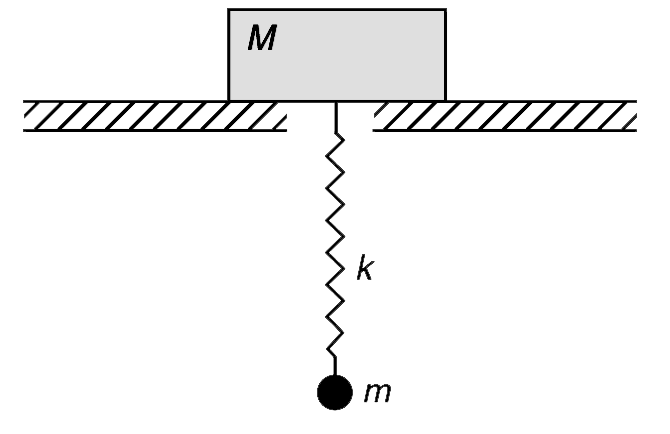
A block of mass M is placed on top of a hole in a horizontal table. A spring of force constant k is connected to the block through the hole. The other end of the massless spring has a particle of mass m connected to it. With what maximum amplitude can the particle oscillate up and down such that the block does not lose contact with the table?

Text Solution

Verified by Experts

The correct Answer is:

`(Mg)/(k)+(mg)/(k)`
Promotional Banner

Topper's Solved these Questions

  • SIMPLE HARMONIC MOTION

    ARIHANT|Exercise Level 2|33 Videos
  • SIMPLE HARMONIC MOTION

    ARIHANT|Exercise Level 3|9 Videos
  • ROTATIONAL MOTION

    ARIHANT|Exercise PHYSICS|159 Videos
  • SURFACE TENSION

    ARIHANT|Exercise Surface tension|33 Videos

Similar Questions

Explore conceptually related problems

A block of mass M is kept on a rough horizontal surface and is attached with massless spring of force constant k .The minimum constant force applied on the other end of the spring to lift the block is

A block of mass m is placed on a frictionless horizontal table. Consider a spring of spring constant K whose one end is connected to the block and the other end is connected to a fixed support in such a manner that spring remains horizontal. A positive charge q is given to the block. Suddenly an electric field of magnitude E is switched on in horizontal direction that is in the direction away from the fixed support. What will be the maximum possible elongation of the spring after electric field is switched on?

A block of mass m is connected to another .block of mass M by a massless spring of spring constant k. A constant force f starts action as shown in figure, then:

The block of mass m is released when the spring was in its natrual length. Spring constant is k. Find the maximum elongation of the spring.

A block of mass m =1 kg placed on top of another block of mass M = 5 kg is attached to a horizontal spring of force constant K = 20 N/m as shown in figure. The coefficient of friction between the blocks is µ where as the lower block slides on a frictionless surface. The amplitude of oscillation is 0.4 m. What is the minimum value of µ such that the upper block does not slip over the lower block ?

A block of mass m_(1) rests on a horizontal table. A string tied to the block is passed on a frictionless pulley fixed at the end of the table and to the other end of string is hung another block of mass m_(2) . The acceleration of the system is

A spring of force constant k is cut into two parts whose lengths are in the ratio 1:2 . The two parts are now connected in parallel and a block of mass m is suspended at the end of the combined spring. The period of oscillation of block is

A block A of mass m_(1) is placed on a horizontal frictionless table. It is connected to one end of a light spring of force constant k whose other end is fixed to a wall. A small block B of mass m_(2) is placed on block A. The coefficient of static friction between the blocks is mu . The system is displaced slightly from its equilibrium position and released. What is the maximum amplitude of the resulting simple harmonic motion of the system so that the upper block does not slip over the lower block ?
