Home
Class 11
PHYSICS
(i) In the system shown in figure, find ...

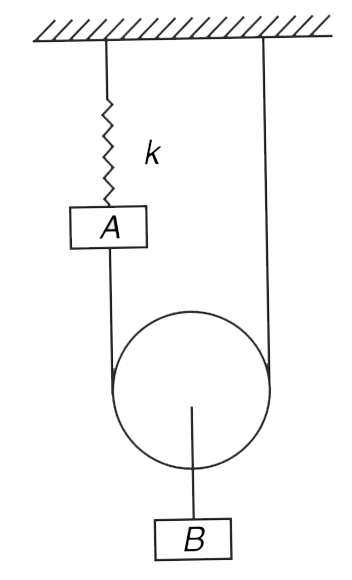
(i) In the system shown in figure, find the time period of vertical oscillations of the block A. Both the blocks A and B have equal mass of m and the force constant of the ideal spring is k. Pulley and threads are massless

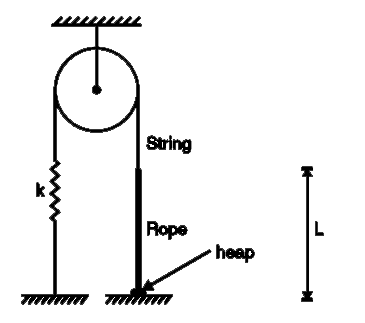
(ii) In the arrangement shown in the figure the spring, string and the pulley are mass less. The force constant of the spring is k. A rope of mass per unit length equal to `lamda (kg m^(-1))` hangs from the string as shown. In equilibrium a length L of the rope is in air and its bottom part lies in a heap on the floor. The rope is very thin and size of the heap is negligible though the heap contains a fairly long length of the rope. The rope is raised by a very small distance and released. Show that motion will be simple harmonic and calculate the time period. Assume that the hanging part of the rope does not experience any force from the heap or the floor (For example there is no impact force while the rope hits the floor while moving downward and there is no impulsive pull when the vertical part jerks a small element of heap into motion).

Text Solution

Verified by Experts

The correct Answer is:

(i) ` T=pi sqrt((5m)/(k)), (ii) T=2pi sqrt((lamda L)/(k+lmadag))`
Promotional Banner

Topper's Solved these Questions

  • SIMPLE HARMONIC MOTION

    ARIHANT|Exercise Level 3|9 Videos
  • SIMPLE HARMONIC MOTION

    ARIHANT|Exercise Level 3|9 Videos
  • ROTATIONAL MOTION

    ARIHANT|Exercise PHYSICS|159 Videos
  • SURFACE TENSION

    ARIHANT|Exercise Surface tension|33 Videos

Similar Questions

Explore conceptually related problems

In the situation as shown in figure time period of small vertical oscillation of block will be - (String, springs and pulley are ideal)

Find the time period of oscillation of block of mass m. Spring, and pulley are ideal. Spring constant is k.

The string, spring and the pulley shown in figure are light. Find the time period of the mass m .

The period of the free oscillations of the system shown here if mass m_(1) is pulled down a little and force constant of the spring is k and masses of the fixed pulleys are negligible, is

In the arrangement shown in the fig. string, springs and the pulley are mass less. Both the springs have a force constant of k and the mass of block B resting on the table is M. Ball A is released from rest when both the springs are in natural length and just taut. Find the minimum value of mass of A so that block B leaves contact with the table at some stage

The string, the spring and the pulley shown in figure are light. Find the time period of the mass m.

Both the blocks shown in figure have same mass 'm' . All the pulley and strings are massiess.

What would be the period of the free oscillations of the system shown here if mass M_(1) is pulled down a little force constant of the spring is k , mass of fixed pulley is negligible and movable pulley is smooth

Find the acceleration of the block of mass m in the arrangement shown in the following figures. The masses of the pulleys and the threads, as well as the friction are assumed to be negligible.

In the arrangement shown in figure, pulleys are light and spring are ideal. K_(1) , k_(2) , k_(3) and k_(4) are force constant of the spring. Calculate period of small vertical oscillations of block of mass m .

ARIHANT-SIMPLE HARMONIC MOTION-Level 2
  1. A circular wire frame of radius R is rotating about its fixed vertical...

    Text Solution

    |

  2. In the system shown in the figure the string, springs and pulley are l...

    Text Solution

    |

  3. (i) In the system shown in figure, find the time period of vertical o...

    Text Solution

    |

  4. A box B of mass M hangs from an ideal spring of force constant k. A sm...

    Text Solution

    |

  5. A block has a L shaped stand fixed to it. Mass of the block with the s...

    Text Solution

    |

  6. Two ideal springs of same make (the springs differ in their lengths on...

    Text Solution

    |

  7. A block of mass M connected to an ideal spring of force constant k lie...

    Text Solution

    |

  8. A block of mass M connected to an ideal spring of force constant k, is...

    Text Solution

    |

  9. A particle of mass m is constrained to move along a straight line. A a...

    Text Solution

    |

  10. An equilateral prism of mass m is kept on a smooth table between two i...

    Text Solution

    |

  11. Two blocks rest on a smooth horizontal surface. They are connected by ...

    Text Solution

    |

  12. Two blocks A (2 kg) and B (3 kg) rest on a smooth horizontal surface, ...

    Text Solution

    |

  13. A spring has force constant k = 200 N//m and its one end is fixed. The...

    Text Solution

    |

  14. Two identical simple pendulums A and B are fixed at same point. They a...

    Text Solution

    |

  15. Two spheres A and B of the same mass m and the same radius are placed ...

    Text Solution

    |

  16. Two small blocks of mass m and 4m are connected to two springs as show...

    Text Solution

    |

  17. A block of mass M = 40 kg is released on a smooth incline from point A...

    Text Solution

    |

  18. Two tunnels - T(1) " and " T(2) are dug across the earth as shown in ...

    Text Solution

    |

  19. The given figure shows the variation of the kinetic energy of a simple...

    Text Solution

    |

  20. Two identical small elastic balls have been suspended using two string...

    Text Solution

    |
