Home
Class 11
PHYSICS
A block has a L shaped stand fixed to it...

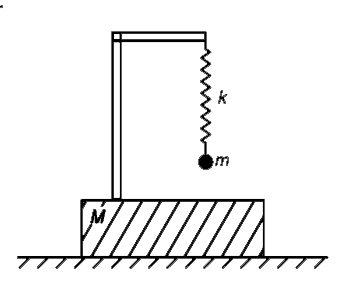
A block has a L shaped stand fixed to it. Mass of the block with the stand is M. At the free end of the stand there is a spring which carries a ball of mass m. With the spring in its natural length, the ball is released. It begins to oscillate and the stand is tall enough so that the ball does not hit the block.
(a) Find maximum value of mass (m) of the ball for which the block will not lose contact with the ground?
(b) If the stand is not tall enough and the ball makes elastic impact with the block, will your answer to part (a) change?

Text Solution

Verified by Experts

The correct Answer is:

For both (a) and (b) the block will not lose contact with the ground for any value of m.
Promotional Banner

Topper's Solved these Questions

  • SIMPLE HARMONIC MOTION

    ARIHANT|Exercise Level 3|9 Videos
  • SIMPLE HARMONIC MOTION

    ARIHANT|Exercise Level 3|9 Videos
  • ROTATIONAL MOTION

    ARIHANT|Exercise PHYSICS|159 Videos
  • SURFACE TENSION

    ARIHANT|Exercise Surface tension|33 Videos

Similar Questions

Explore conceptually related problems

Two blocks are connected to the two free ends of a spring of spring constant K . Both the blocks are moved apart to extend the psring beyond its natural length and then released . In subsequent motion

The block of mass m is released when the spring was in its natrual length. Spring constant is k. Find the maximum elongation of the spring.

A block of mass m is attached to a spring of force constant k whose other end is fixed to a horizontal surface. Initially the spring is in its natural length and the block is released from rest. The average force acting on the surface by the spring till the instant when the block has zero acceleration for the first time is

A block of mass 'm' is attached to a spring in natural length of spring constant 'k' . The other end A of the spring is moved with a constat velocity v away from the block . Find the maximum extension in the spring.

All surfaces are smooth. The ball of mass m is released from A . Find the distance travelled by the block of mass M .

In the figure shown a block of masss m is atteched at ends of two spring The other ends of the spring are fixed The mass m is released in the vertical plane when the spring are released The velocity of the block is maximum when

In the adjoining diagram the ball A is released from rest when the spring is at its natural length (neither stretched nor compressed) For the block B of mass M to leave contact with the ground at some time, the minimum mass of A must be:

A block of mass m is pushed against a spring of spring constant k fixed at one end to a wall.The block can slide on a frictionless table as shown in the figure. The natural length of the spring is L_0 and it is compressed to one fourth of natural length and the block is released.Find its velocity as a function of its distance (x) from the wall and maximum velocity of the block. The block is not attached to the spring.

In a gravity free space, man of mass M standing at a height h above the floor, throws a ball of mass m straight down with a speed u . When the ball reaches the floor, the distance of the man above the floor will be.

A ball of mass m is attached to the lower end of a light vertical spring of force constant K . The upper end of the spring is fixed. The ball is released from rest with the spring at its normal ( unstretched ) length, and comed to rest again after descending through a distance x .

ARIHANT-SIMPLE HARMONIC MOTION-Level 2
  1. (i) In the system shown in figure, find the time period of vertical o...

    Text Solution

    |

  2. A box B of mass M hangs from an ideal spring of force constant k. A sm...

    Text Solution

    |

  3. A block has a L shaped stand fixed to it. Mass of the block with the s...

    Text Solution

    |

  4. Two ideal springs of same make (the springs differ in their lengths on...

    Text Solution

    |

  5. A block of mass M connected to an ideal spring of force constant k lie...

    Text Solution

    |

  6. A block of mass M connected to an ideal spring of force constant k, is...

    Text Solution

    |

  7. A particle of mass m is constrained to move along a straight line. A a...

    Text Solution

    |

  8. An equilateral prism of mass m is kept on a smooth table between two i...

    Text Solution

    |

  9. Two blocks rest on a smooth horizontal surface. They are connected by ...

    Text Solution

    |

  10. Two blocks A (2 kg) and B (3 kg) rest on a smooth horizontal surface, ...

    Text Solution

    |

  11. A spring has force constant k = 200 N//m and its one end is fixed. The...

    Text Solution

    |

  12. Two identical simple pendulums A and B are fixed at same point. They a...

    Text Solution

    |

  13. Two spheres A and B of the same mass m and the same radius are placed ...

    Text Solution

    |

  14. Two small blocks of mass m and 4m are connected to two springs as show...

    Text Solution

    |

  15. A block of mass M = 40 kg is released on a smooth incline from point A...

    Text Solution

    |

  16. Two tunnels - T(1) " and " T(2) are dug across the earth as shown in ...

    Text Solution

    |

  17. The given figure shows the variation of the kinetic energy of a simple...

    Text Solution

    |

  18. Two identical small elastic balls have been suspended using two string...

    Text Solution

    |

  19. A simple pendulum of length L has a bob of mass m. The bob is connecte...

    Text Solution

    |

  20. A uniform rod AB of mass m and length L is tied, at its end B, to a th...

    Text Solution

    |
