

Home
Class 12
PHYSICS
In a photoelectric experiment, a monochr...

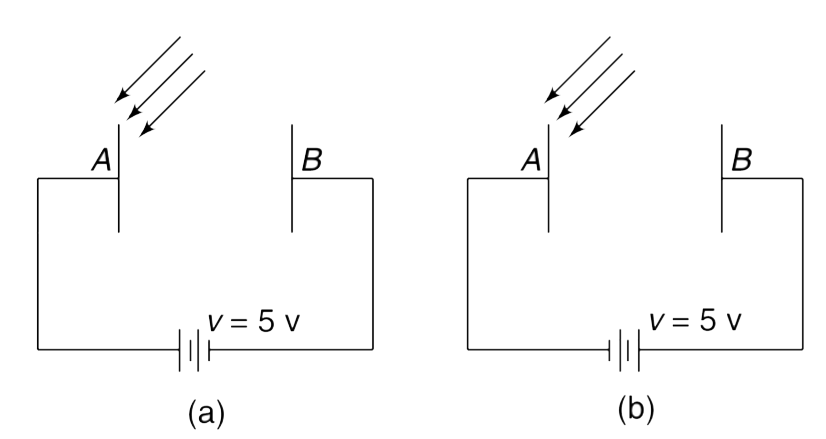
In a photoelectric experiment, a monochromatic light is incident on the metal plate A. It was observed that with `V = 5 "volt"`, the maximum kinetic energy of photoelectrons striking plate B was `1 eV`. The polarity of the applied potential difference was as shown in figure (a). With polarity of the applied potential difference reversed (as shown in figure (b)) and frequency of incident light doubled, it was observed that in saturation state, the kinetic energy of electrons striking plate B ranged between 5 eV to 20 eV. Find the work function of metal used in plate A.

Text Solution

Verified by Experts

The correct Answer is:
`phi = 3 eV`
Promotional Banner

Topper's Solved these Questions

Similar Questions

Explore conceptually related problems

The photoeletric threshold 4v is incident on the metal is v. When light of freqency 4v is incident on the metal, the maximum kinetic energy of the emitted photoelectron is

If in a photoelectric experiment, the stopping potential is 1.5 volts, what is the maximum kinetic energy of a photoelectrons?

Light of frequency 4 v_(0) is incident on the metal of the threshold frequency v_(0) . The maximum kinetic energy of the emitted photoelectrons is

The photoelectric threshold frequency of a metal is v_0. When ligth of frequency 3v_0 is incident on the metal, the maximum kinetic energy of emitted photoelectrons will be

Find the potential difference V_(a)-V_(b) in the circutis shown in figure

If the frequency of light in a photoelectric experiment is double then maximum kinetic energy of photoelectron

The photoelectric threshold frequency of a metal is v. When light of frequency 4v is incident on the metal . The maximum kinetic energy of the emitted photoelectrons is

For the photoelectric effect, the maximum kinetic energy E_(k) of the emitted photoelectrons is plotted against the frequency ν of the incident photons as shown in the figure. The slope of the curve gives

The frequency of incident light falling on a photosensitive metal plate is doubled, the KE of the emitted photoelectrons is

ARIHANT-WAVE PARTICLE DUALITY AND ATOMIC PHYSICS-All Questions
  1. In the photoelectric experiment, if we use a monochromatic light, the ...

    Text Solution

    |

  2. In a photoelectric experiment light of different wavelengths are used ...

    Text Solution

    |

  3. In a photoelectric experiment, a monochromatic light is incident on th...

    Text Solution

    |

  4. In a photoelectric experimental set-up ultraviolet light of wavelength...

    Text Solution

    |

  5. A point source is emitting 0.2 W of ultravio- let radiation at a wavel...

    Text Solution

    |

  6. In photoelectric experiment set up, the maximum kinetic energy (k("max...

    Text Solution

    |

  7. A square plate of side length L absorbs all radiation incident on it. ...

    Text Solution

    |

  8. A light photon of wavelength lambda(0) is absorbed by an atom of mass ...

    Text Solution

    |

  9. A spherical concave mirror has aperture diameter d and radius of curva...

    Text Solution

    |

  10. A point source (S) of light having power 500 W is kept at the focus of...

    Text Solution

    |

  11. An equilateral glass prism kept on a table has refractive index of mu ...

    Text Solution

    |

  12. A proton X is projected in a region of uniform electric field E with s...

    Text Solution

    |

  13. It is possible for a photon to materialize into an electron and a posi...

    Text Solution

    |

  14. The figure shows the reflection of a plane wave by two neighbouring at...

    Text Solution

    |

  15. A particle of mass m is trapped between two perfectly rigid parallel w...

    Text Solution

    |

  16. A moving H-atom makes a head on perfectly inelastic collision with a s...

    Text Solution

    |

  17. In a hypothetical hydrogen-like atom the wavelength in A° for the spec...

    Text Solution

    |

  18. Assume that structure of hydrogen atom is gov- erned by classical mech...

    Text Solution

    |

  19. When radiations of wavelength lambda(1), lambda(2) (= 0.6 lambda(1)), ...

    Text Solution

    |

  20. An electron approaches a fixed proton from a large distance with a kin...

    Text Solution

    |