

Home
Class 12
PHYSICS
The figure shows a plot of number of neu...

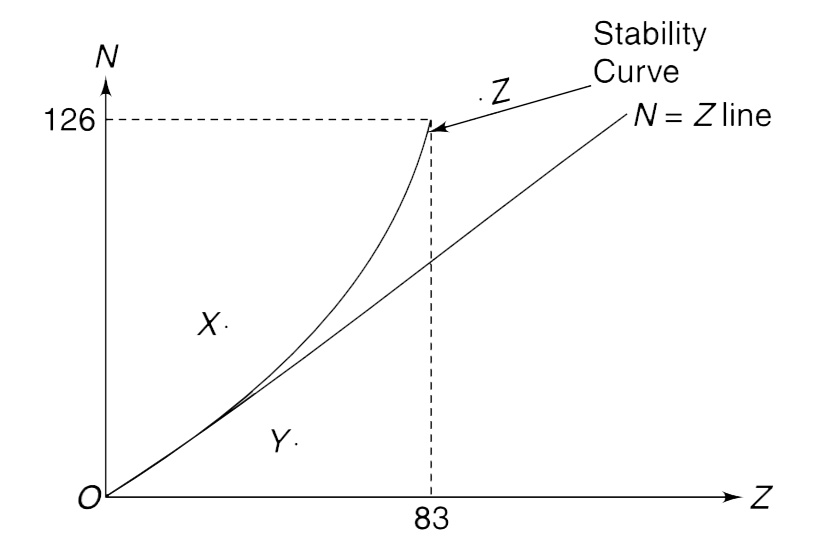
The figure shows a plot of number of neutron (N) versus number of protons (z) in all stable nuclei found in nature. What kind of decay are nuclei X,Y and Z expected to show?

Text Solution

Verified by Experts

The correct Answer is:
`Xrarr` negative `beta` decay `Yrarr` positron emission `Zrarr` alpha decay
Promotional Banner

Topper's Solved these Questions

  • MOTION OF CHARGE IN MAGNETIC FIELD

    ARIHANT|Exercise Level-3|4 Videos
  • WAVE OPTICS

    ARIHANT|Exercise All Questions|37 Videos

Similar Questions

Explore conceptually related problems

Various rules of thumb have seen proposed by the scientific community to expalin the mode of radioactive decay by various radioisotopes. One of the major rules is called the n//p ratio. If all the known isotopes of the elemnts are plotted on a graph of number of neutrons (n) versus number of protons (p), it is observed that all isotopes lying outside of a ''stable'' n//p ratio region are radioactive as shown fig. The graph exhibits straight line behaviour with unit slope up to p=25 . Above p=25 , tgose isotopes with n//p ratios lying above the stable region usually undergo beta decay. Very heavy isotopes (pgt83) are unstable because of their relativley large nuclei and they undergo alpha decay. Gamma ray emission does not involve the release of a particle. It represnts a change in an atom from a higher energy level to a lower energy level. How would the radioisotope of magnesium with atomic mass 27 undergo radioactive decay?.

A plot of the number of neutrons (n) against the number of protons (p) of stable nuclei exhibits upward deviation from linearity for atomic number, Zgt 20. For an unstable nucleus having n//p ratio less than 1, the possible mode (s) of decay is (are)

The atoms of two element A and B contain the same number of protons but different number of neutrons in their nuclei. What kind of element are A and B?

Statement : The plot of atomic number ( y -axis ) versus number of neutrons ( x -axis ) for stable nuclei shows a curvature towards x-axis fron the line of 45^@ slope as the atomic number is increased . Explanation : proton -proton electrostatic repulsions begin to overcome attracive forces involving protons and neutrons in heavier nuclides.

Staements I: Light nuclei are most stable if N =Z, while heavy nuclei are more stable if N gtZ. (N rarr number of neutrons, Z rarr number of protons) Staements II: As the number of protons increases in a nucleus, the Coulomb's repulsive forece increases, which tends to break the nucleus apart. So, to keep the nucleus apart. So, to keep the nucleus stable, more number of neutrons are needed which are neutral in nature.

ARIHANT-NUCLEAR PHYSICS-All Questions
  1. A sample contains two isotopes -one stale and the other unstable. Numb...

    Text Solution

    |

  2. In a beam of neurons the particles are having a kinetic energy of 0.03...

    Text Solution

    |

  3. The figure shows a plot of number of neutron (N) versus number of prot...

    Text Solution

    |

  4. Which of the following isotopes is more stable and why? (a) .(3)^(7)...

    Text Solution

    |

  5. Consider the position emission reaction .(z)^(A)Xrarrunderset(z-1)AY...

    Text Solution

    |

  6. Tritium (.(1)^(3)H) is a radioactive isotope of hydrogen. It has a hal...

    Text Solution

    |

  7. In the thorium decay series that begins with .^(232)Th,.^(228)Th alpha...

    Text Solution

    |

  8. Nuclei of .^(64)Cu can decay be electron capture (probability 61%) or ...

    Text Solution

    |

  9. In a sample there are two radioactive nuclide X and Y. Initially, popu...

    Text Solution

    |

  10. It is known that the ratio of .^(14)C to .^(12)C atoms in living being...

    Text Solution

    |

  11. Taking the data from last problem and assuming that 18% of our body ma...

    Text Solution

    |

  12. Consider the nuclear decay reaction. .(z)^(A)Xrarrunderset(z-1)AY+(+...

    Text Solution

    |

  13. The ratio (by weight) for U^(238) in a rock sample is 4:3. Assume that...

    Text Solution

    |

  14. A radioactive species has decay constant of lambda=10^(-2)s^(-1). Prob...

    Text Solution

    |

  15. A radioactive substance has a half life of t(0). Two particular nuclei...

    Text Solution

    |

  16. In a sample of radioactive material the probability that a particular ...

    Text Solution

    |

  17. Atomic mass of .(3)^(7)Li is 7.01600u and that of .(4)^(7)Be is 7.0169...

    Text Solution

    |

  18. .(15)P^(32) is beta active and has a short half life of 14 days. The ....

    Text Solution

    |

  19. A free neutron at rest, decays into three particles: a proton, an elec...

    Text Solution

    |

  20. A radioactive nucleus A decay to C after emitting two alpha and three ...

    Text Solution

    |