

Home
Class 12
PHYSICS
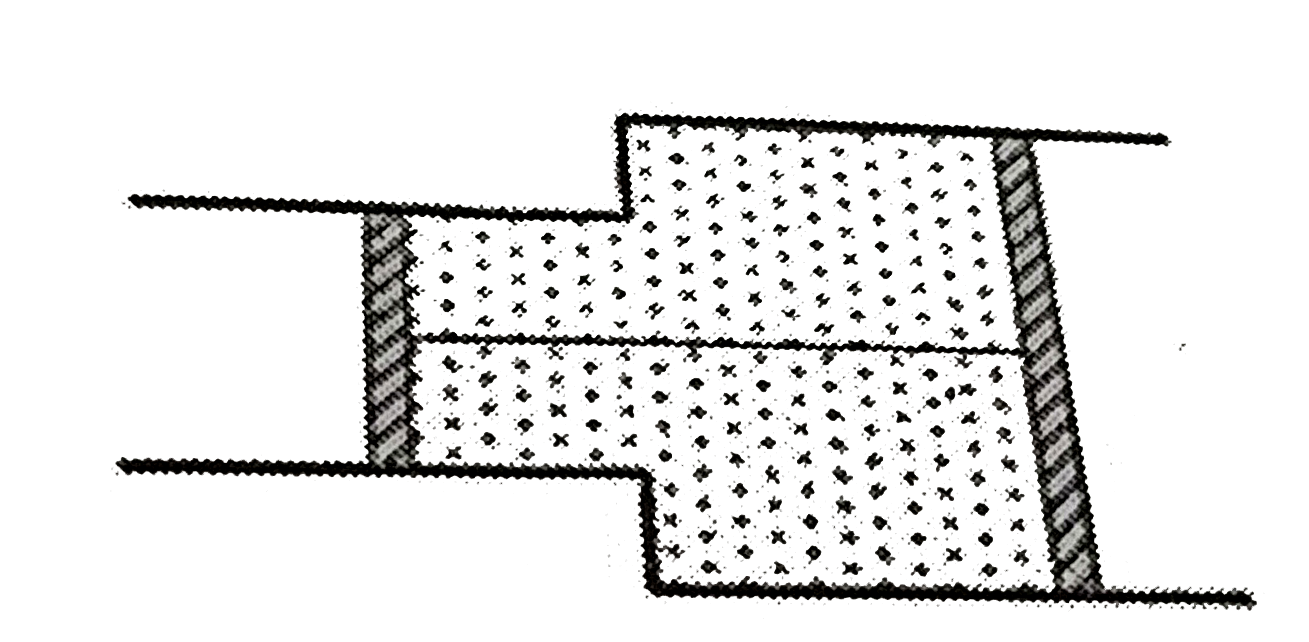
A horizontal cylinder has two sections o...

A horizontal cylinder has two sections of unequal cross - sections, in which two pistons can move freely. The pistons are joined by a string, Some gas is trapped between the pistons. If this gas is heated the pistons will

Promotional Banner

Similar Questions

Explore conceptually related problems

A horizontal cylinder has two sections of unequal cross-section, in which two pistons can move freely. The pistons are joined by a string. Some gas is trapped between the pistons . Spring is massless and in natural length. If this gas is heated, the spring will .

A gas is filled in the cylinder shown in fig. The two pistons are joined by a string. If the gas is heated, the right piston will

Consider a vertical tube open at both ends. The tube consistss of two parts, each of different cross sections and each part having a piston which can move smoothly in respective tubes. The two piston which can move smoothly in respective tube wire. The piston are joined together by an inextensible wire. The combined mass of the two piston is 5 kg and area of cross section of the upper piston is 10 cm^(2) greater than that of the lower piston. Amount of gas enclosed by the pistons is 1 mol . When the gas is heated slowly, pistons move by 50 cm . Find the rise in the temperature of the gas in the form X//R K , where R is universal gas constant. Use g = 10 m//s^(2) and outside pressure = 10^(5) N//m^(2)) .

Consider a vertical tube open at both ends. The tube consistss of two parts, each of different cross sections and each part having a piston which can move smoothly in respective tubes. The two piston which can move smoothly in respective tube wire. The piston are joined together by an inextensible wire. The combined mass of the two piston is 5 kg and area of cross section of the upper piston is 10 cm^(2) greater than that of the lower piston. Amount of gas enclosed by the pistons is 1 mol . When the gas is heated slowly, pistons move by 50 cm . Find the rise in the temperature of the gas in the form X//R K , where R is universal gas constant. Use g = 10 m//s^(2) and outside pressure = 10^(5) N//m^(2)) .

Consider a vertical tube open at both ends. The tube consistss of two parts, each of different cross sections and each part having a piston which can move smoothly in respective tubes. The two piston which can move smoothly in respective tube wire. The piston are joined together by an inextensible wire. The combined mass of the two piston is 5 kg and area of cross section of the upper piston is 10 cm^(2) greater than that of the lower piston. Amount of gas enclosed by the pistons is 1 mol . When the gas is heated slowly, pistons move by 50 cm . Find the rise in the temperature of the gas in the form X//R K , where R is universal gas constant. Use g = 10 m//s^(2) and outside pressure = 10^(5) N//m^(2)) .

A smooth vertical tube having two different cross sections is open from both the ends but closed by two sliding pistions as shown in Fig. and tied with an inextensible string. One mole of an ideal gas is enclosed between the piston The difference in cross-sectional areas of the two pistons is given Delta S . The masses of piston are m_(1) and m_(2) for larger and smaller one, respectively. Find the temperature by which tube is raised so that the pistons will be displaced by a distance l. Take atmospheric pressure equal to P_(0)

A smooth vertical tube having two different cross sections is open from both the ends but closed by two sliding pistions as shown in Fig. and tied with an inextensible string. One mole of an ideal gas is enclosed between the piston The difference in cross-sectional areas of the two pistons is given Delta S . The masses of piston are m_(1) and m_(2) for larger and smaller one, respectively. Find the temperature by which tube is raised so that the pistons will be displaced by a distance l. Take atmospheric pressure equal to P_(0)

A smooth vertical tube having two different cross sections is open from both the ends but closed by two sliding pistions as shown in Fig. and tied with an inextensible string. One mole of an ideal gas is enclosed between the piston The difference in cross-sectional areas of the two pistons is given Delta S . The masses of piston are m_(1) and m_(2) for larger and smaller one, respectively. Find the temperature by which tube is raised so that the pistons will be displaced by a distance l. Take atmospheric pressure equal to P_(0)