Home
Class 12
PHYSICS
If the resultant of two equal forces inc...

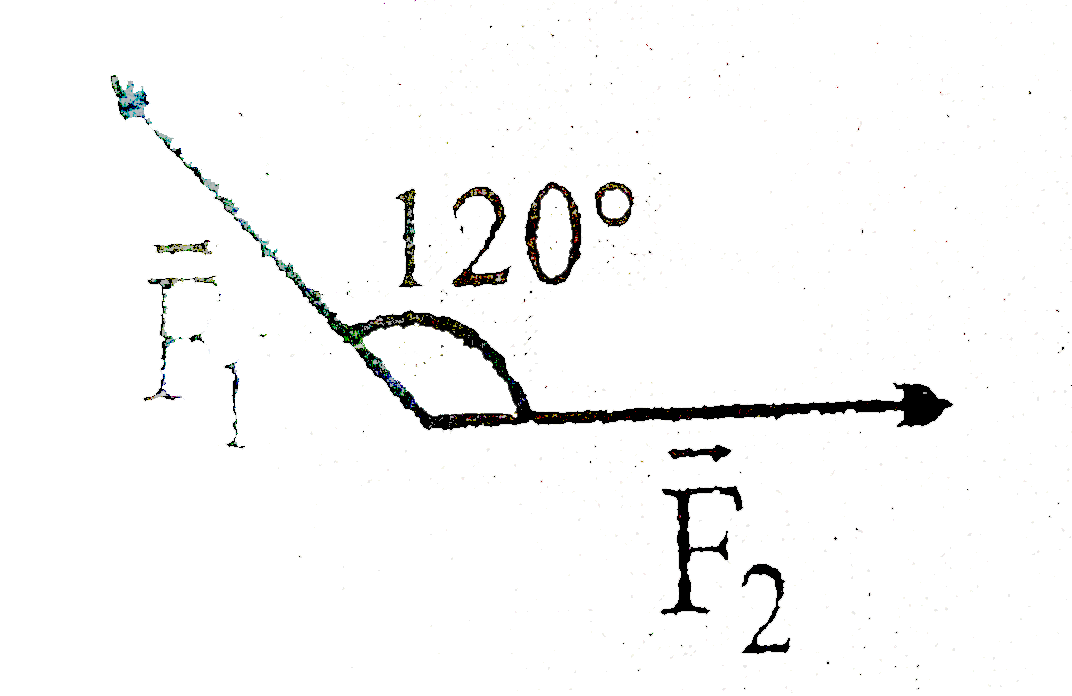
If the resultant of two equal forces inclined at `60^(@)` to each other is `sqrt(3)Q`, will be their resultant if they are inclied at `120^(@)` to each other?

A

`(sqrt(3)Q)/2`

B

`sqrt(3)Q`

C

`Q/2`

D

Q

Text Solution

Verified by Experts

The correct Answer is:
D


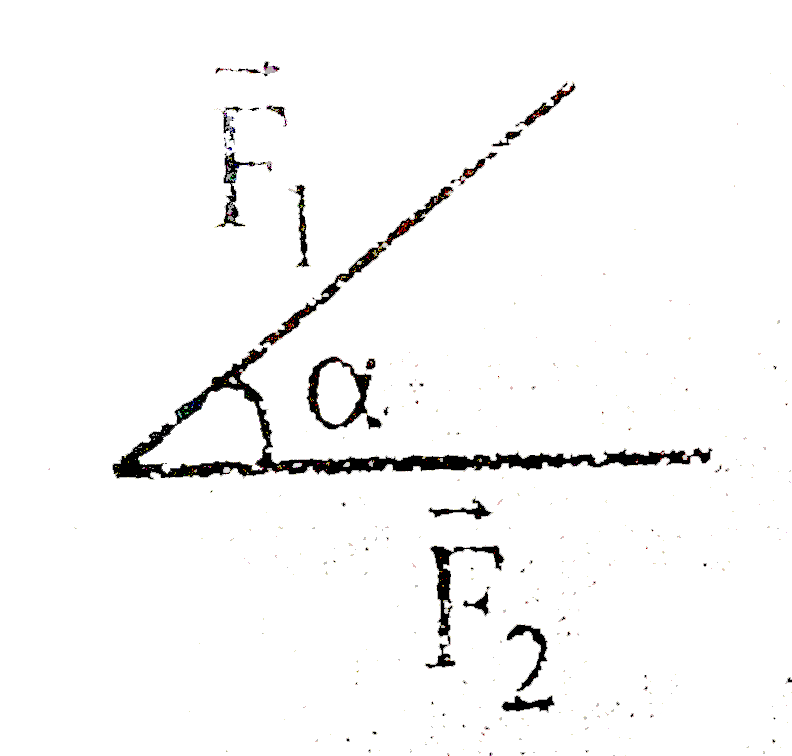
`|vec(F)_(1)|=|vec(F)_(2)|=F`
`F_(res)=2F cos alpha`
`=2F cos 30^(@) =sqrt(3) theta` (given)
`rArr F xx sqrt(3) =sqrt(3) thetarArr F =theta....(i)`

`|vec(F)_(1)|=|vec(F)_(2)|=F`
`F_(res)=2F cos a|_(2)" " alpha= 120^(@)`
=`2F cos 60^(@)`
Promotional Banner

Topper's Solved these Questions

  • TEST PAPERS

    BANSAL|Exercise PHYSICS PART (A)|32 Videos
  • TEST PAPERS

    BANSAL|Exercise PHYSICS PART (B)|3 Videos
  • TEST PAPERS

    BANSAL|Exercise PHYSICS PART- C|4 Videos
  • SEMICONDUCTORS

    BANSAL|Exercise CBSE Question|32 Videos

Similar Questions

Explore conceptually related problems

Two equal forces acting at 60^(@) to each other. Find the forces if resultant force is 300 N.

The resultant of two equal forces acting at right angles to each other is 1414 dyne. Find the magnitude of either force.

If three unit vectors are inclined at an angle of 60^@ with each other, then the magnitude of their resultant vector will be

Two forces A and B are acting at a point . The least and greatest resultants of these forces are 5 N and 10 N respectively . If each of these forces is decreased by 2 N , then what will be the resultant of these new forces acting at an angle of 30^(@) to each other ?

When two forces of magnitude P and Q are perpendicular to each other, their resultant is of magnitude R. When they are at an angle of 180^(@) to each other, their resultant is of magnitude (R )/(sqrt2) . Find the ratio of P and Q.

When two forces of magnitude P and Q are perpendicular to each other, their resultant is of magnitude R. When they are at an angle of 180^(@) to each other their resultant is of magnitude (R)/(sqrt(2)) . Find the ratio of P and Q.

The total number of images formed by two mirrors inclined at 120^(@) to each other is ______.

BANSAL-TEST PAPERS-PHYSICS
  1. A particle of mass m moving along a straight line is acted on by a ret...

    Text Solution

    |

  2. If speed of a particle is given by v=A/C sin (At+B), the dimension of ...

    Text Solution

    |

  3. If the resultant of two equal forces inclined at 60^(@) to each other ...

    Text Solution

    |

  4. The angle between the vector -hati+hatj and 2 hati+3hatj is :

    Text Solution

    |

  5. In the pulley system shown here, find the relationship between acceler...

    Text Solution

    |

  6. In the figure shown all pulleys are ideal and small. The central pulle...

    Text Solution

    |

  7. Find the acceleration of each block

    Text Solution

    |

  8. When number having uncertainties or errors are used to compute other n...

    Text Solution

    |

  9. When number having uncertainties or errors are used to compute other n...

    Text Solution

    |

  10. When number having uncertainties or errors are used to compute other n...

    Text Solution

    |

  11. Two solid sphres of density rho each and R and 2R are hung from a spri...

    Text Solution

    |

  12. In the figures shown, 1 kg block is stationary while 2 kg block is bei...

    Text Solution

    |

  13. The position of a particle moving on a straight line depends on time t...

    Text Solution

    |

  14. The angular acceleration of a fan alpha=(-3t^(2))/2. At the initial mo...

    Text Solution

    |

  15. Match the column

    Text Solution

    |

  16. Figure shows a man of mass 48 kg standing on a light weighing machine ...

    Text Solution

    |

  17. The acceleration of particle at position x is given by a=3-2x. If the ...

    Text Solution

    |

  18. The velocity vector of a body is given by vec(v)=2hati+(3-6t)hatj m//s...

    Text Solution

    |

  19. In the situation shown, the tension in the string is 22N. What is m (i...

    Text Solution

    |

  20. A trolley moving on a smooth horizontal surface in straight line unifo...

    Text Solution

    |