Home
Class 12
PHYSICS
Find the work done by tension (in J) on ...

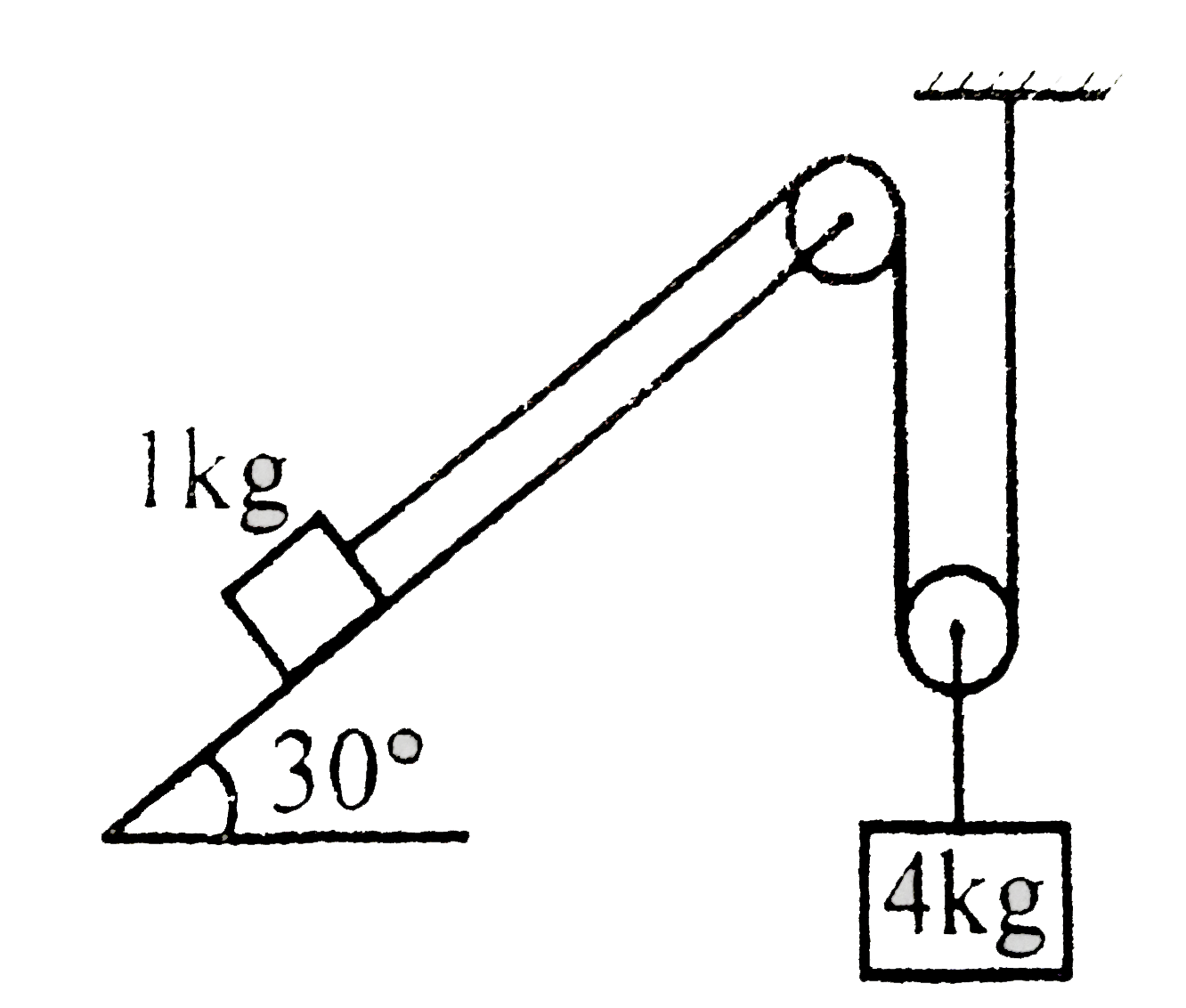
Find the work done by tension (in J) on 1 kg block when 4 kg block moves down by 20 cm after the system is released. All surfaces are frictionless

Text Solution

Verified by Experts

The correct Answer is:
5

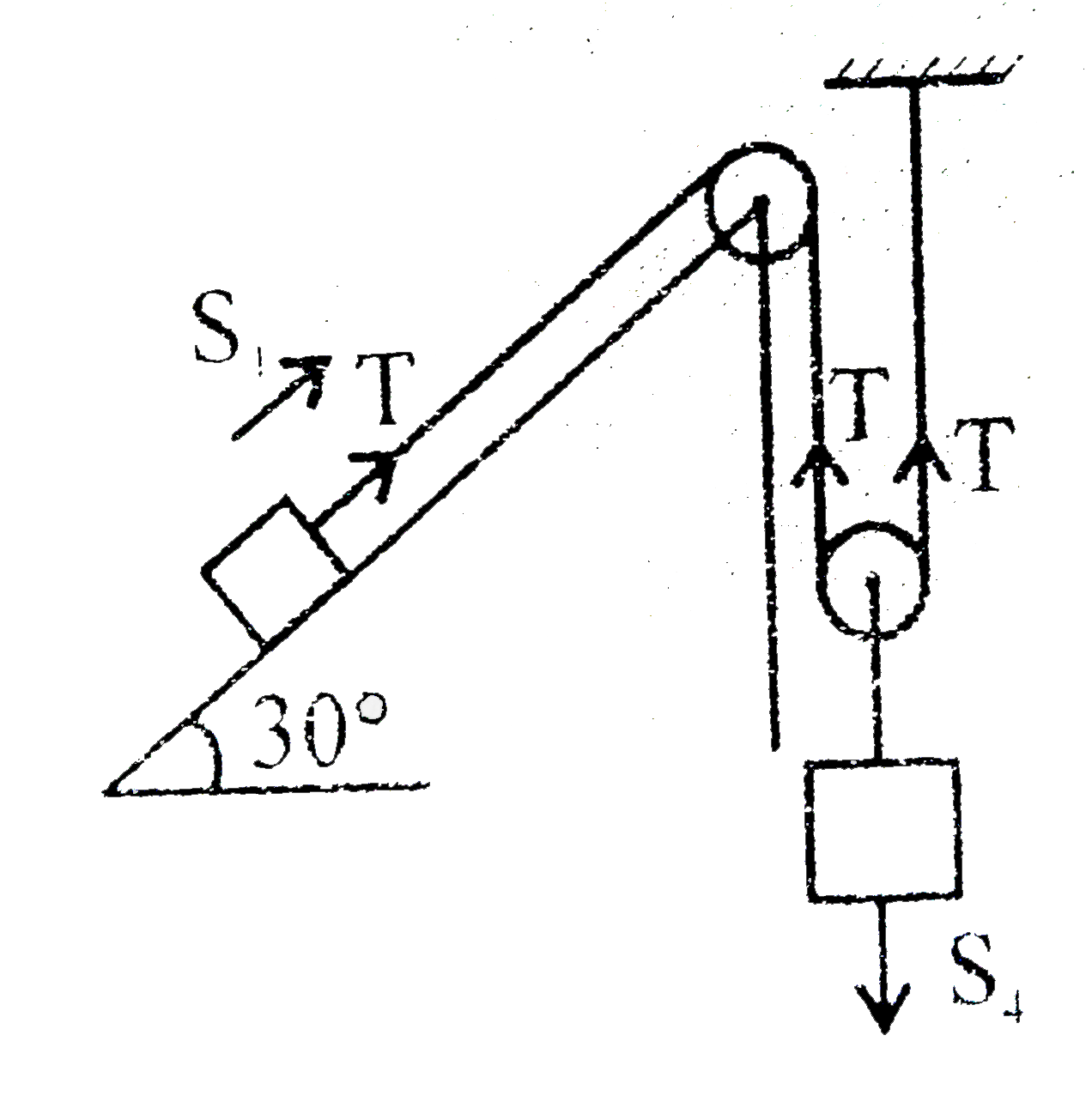
`-2T_S_(4) +TS_(1)=0`
`S_(1)=2S_(4)=0.4 m`
`40-2T=4a_(4)`
`T-mg sin 30=1a_(1)`
`a_(4)=10-T/2`
`a_(1)=2a_(4)`
`T-5 20 -T`
2T=25
`omega_(T)=Txx0.4=12.5/5=5J`
Promotional Banner

Topper's Solved these Questions

  • TEST PAPERS

    BANSAL|Exercise PHYSICS PART (A)|32 Videos
  • TEST PAPERS

    BANSAL|Exercise PHYSICS PART (B)|3 Videos
  • TEST PAPERS

    BANSAL|Exercise PHYSICS PART- C|4 Videos
  • SEMICONDUCTORS

    BANSAL|Exercise CBSE Question|32 Videos

Similar Questions

Explore conceptually related problems

A block of mass m is placed on the inclined sufrace of a wedge as shown in fig. Calculate the acceleration of the wedge and the block when the block is released. Assume all surfaces are frictionless.

In figure m_(1)= 1 kg and m_(2)= 4 kg Find the mass m of the hanging block which will provent the smaller block from slipping over the triangular block .All the surface are frictionless and the string and the pulleys are light

Find the mass (in kg) of the hanging block which will prevent the smaller block from slipping over the triangular block. All the surfaces are frictionless and the strings and the pulleys are light. Given m=M=1kg,cottheta=2 ,

The two blocks in an Atwood machine have masses 2.0 kg and 3.0 kg. Find the work done by gravity during the fourth second after the system is released from rest.

A 20 kg block placed on a level frictionless surface is attached to a cord which passes over two small frictionless pulleys,as shown in figure-2.167,to a hanging block originally at rest 1m above the floor. If the hanging block strikes the floor 2 s after the system is released, the weight of the hanging block is :

A block A (mass 4M) is placed on the top of a wedge block B of base length l (mass=20M) as shown in figure. When the system is released from rest. Find the distance moved by the block B till the block A reaches ground Assume all surfaces are frictionless.

A block of mass 10 kg slides down on an incline 5 m long and 3 m high. A man pushes up on the ice block parallel to the incline so that it slides down at constant speed. The coefficient of friction between the ice and the incline is 0.1. Find : (a) the work done by the man on the block. (b) the work done by gravity on the block. (c) the work done by the surface on the block. (d) the work done by the resultant forces on the block. (e) the change in K.E. of the block.

Consider the system shown in the figure. Coefficient of friction between the block and table is mu=0.5. The system is released from rest. Find the work done by friction, when the speed of block is 10 m/s (m=1kg)

A block of mass 1 kg is released from the top of a wedge of mass 2 kg. Height of wedge is 10 meter and all the surfaces are frictionless. Then

BANSAL-TEST PAPERS-PHYSICS
  1. Match the column

    Text Solution

    |

  2. An atheletic completes a circular loop moving with maximum constant sp...

    Text Solution

    |

  3. Find the work done by tension (in J) on 1 kg block when 4 kg block mov...

    Text Solution

    |

  4. A projectile is projected in xy-plane with a speed of 10 m/s at an ang...

    Text Solution

    |

  5. A scientist measure the initial velocity of an object to be 12.376 m/s...

    Text Solution

    |

  6. On an ice rink, two skaters of mass 60 kg each grab hands and spin in ...

    Text Solution

    |

  7. A smooth inclined plane is inclined at an angle theta with the horizon...

    Text Solution

    |

  8. The displacement x of a particle of mass 1.0 kg moving the one dimensi...

    Text Solution

    |

  9. three point masses A ,B and C are 66 grm each are connected as shown. ...

    Text Solution

    |

  10. If the speed of light c, acceleration due to gravity (g) and pressure ...

    Text Solution

    |

  11. The following sets of three vectors act on a body. Whose resultant can...

    Text Solution

    |

  12. Which of the the following statements is false regarding a ball trhown...

    Text Solution

    |

  13. Two particles of mass m(1) and m(2)(m(1) gt m(2)) are attached to the ...

    Text Solution

    |

  14. Power delivered to a body varies as P=3t^(2). Find out the chang ein k...

    Text Solution

    |

  15. A block of mass 10 kg is placed in a car going down an incline of incl...

    Text Solution

    |

  16. A particle at a height h from the ground is projected with an angle 30...

    Text Solution

    |

  17. Raindrops are falling vertically with a velocity 10 m//s. To a cyclist...

    Text Solution

    |

  18. Two balls are thrown simultaneously at two different angles so that bo...

    Text Solution

    |

  19. Two masses A and B are connected with two an inextesible string to wri...

    Text Solution

    |

  20. The potential energy of a particle varies with x according to the relt...

    Text Solution

    |

