

Home
Class 12
PHYSICS
A uniform circular disc of mass 'm' and ...

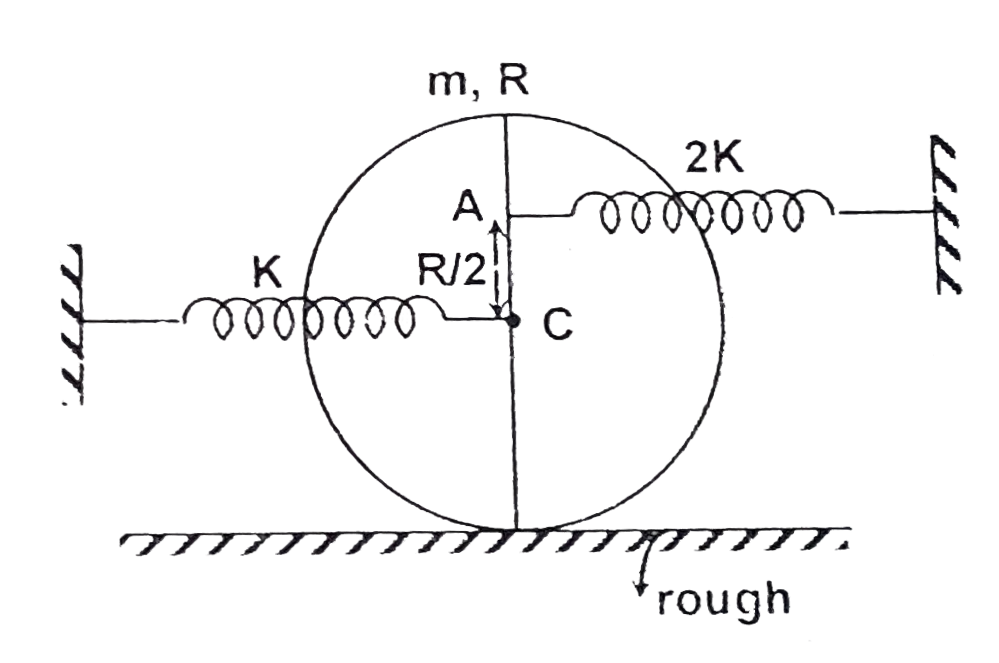
A uniform circular disc of mass 'm' and radius 'R' is placed on a rough horizontal surface and connected to the two ideal non-deformed spring of stiffness k and `2k` at the centre 'C' and point 'A' as shown . The centre of the disc is slighty displaced horizontally from equilibrium positon and then released, then the time period of small oscillation of the disc is (there is no slipping between the disc and the surface).

Promotional Banner

Similar Questions

Explore conceptually related problems

A uniform circular disc of radius R is rolling on a horizontal surface. Determine the tangential velocity : the centre of mass

Two springs of spring constant k_(1)and k_(2) are connected by a mass m as shown in the figure. Under negligible friction, if the mass is displaced by small amount x from its equilibrium position and released, the period of oscillation is

A disc of mass m and radius r placed on a routh horizontal surface. A cue of mass m hits the disc at a height h from the axis passing through centre and parallel to the surface. The disc will start pure rolling for.

A uniform circular disc of radius r is placed on a rough horizontal surface and given a linear velocity v_(0) and angular velocity omega_(0) as shown. The disc comes to rest after moving some distance to the right. It follows that

A uniform circular disc of radius r is placed on a rough horizontal surface and given a linear velocity v_(0) and angular velocity omega_(0) as shown. The disc comes to rest after moving some distance to the right. It follows that

A uniform circular disc of mass M and radius R is pivoted at distance x above the centre of mass of the disc, such that the time period of the disc in the vertical plane is infinite. What is the distance between the pivoted point and centre of mass of the disc ?

A uniform disc of mass m and radius R is released gentiy on a horizontal rough surface. Such that centre of the disc has velocity V_(0) towards right and angular velocity omega_(0) (anticlockwise) as shown. Disc will certainly come back to its intial position if

A uniform disc of mass m and radius R is released gentiy on a horizontal rough surface. Such that centre of the disc has velocity V_(0) towards right and angular velocity omega_(0) (anticlockwise) as shown. Disc will certainly come back to its intial position if