Home
Class 12
PHYSICS
A different force is applied to each of ...

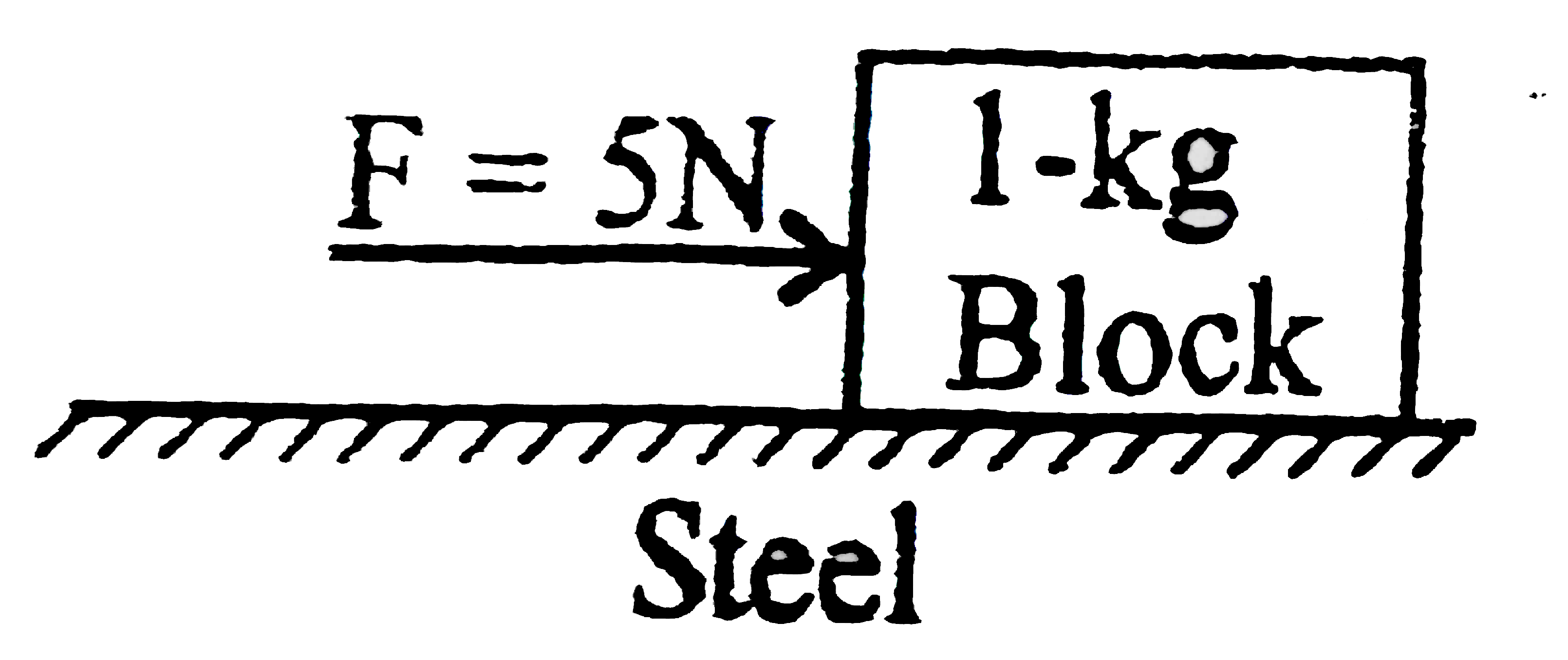
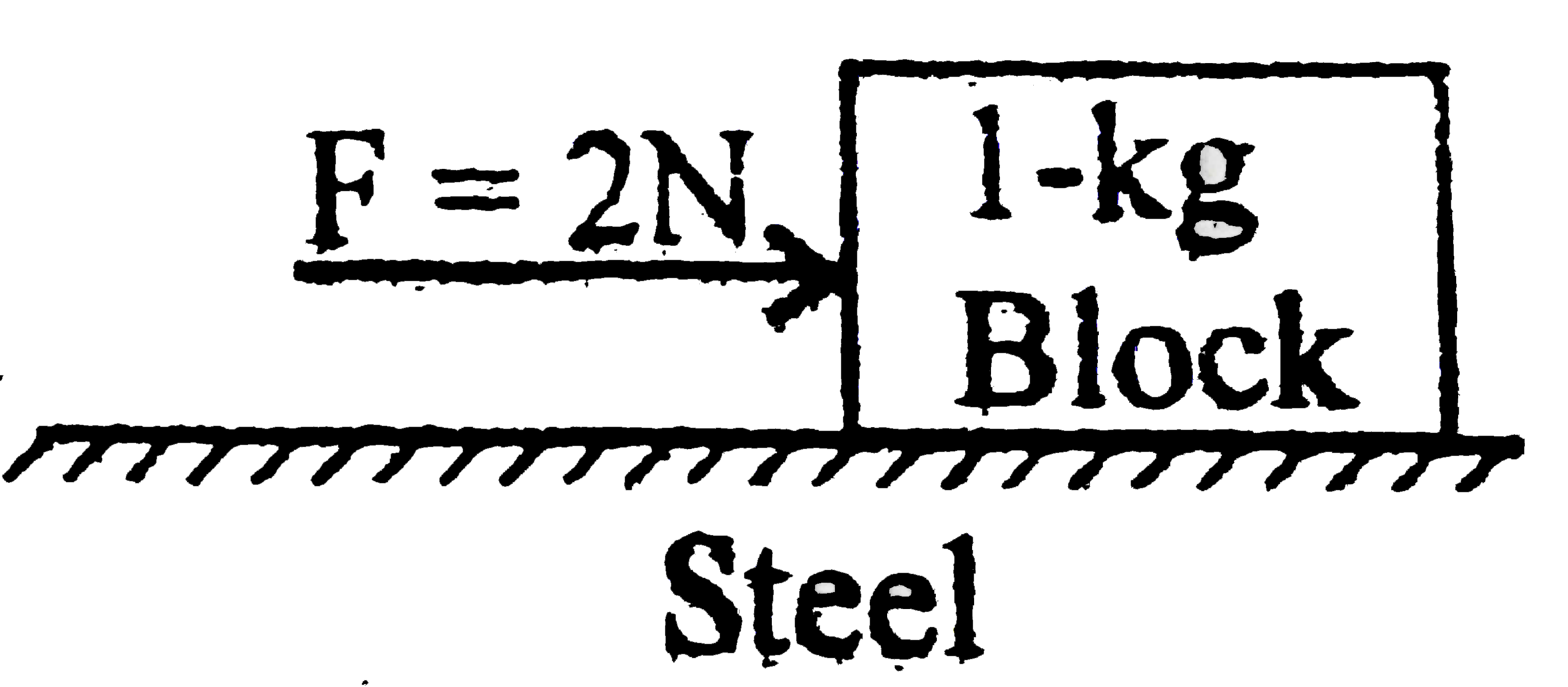
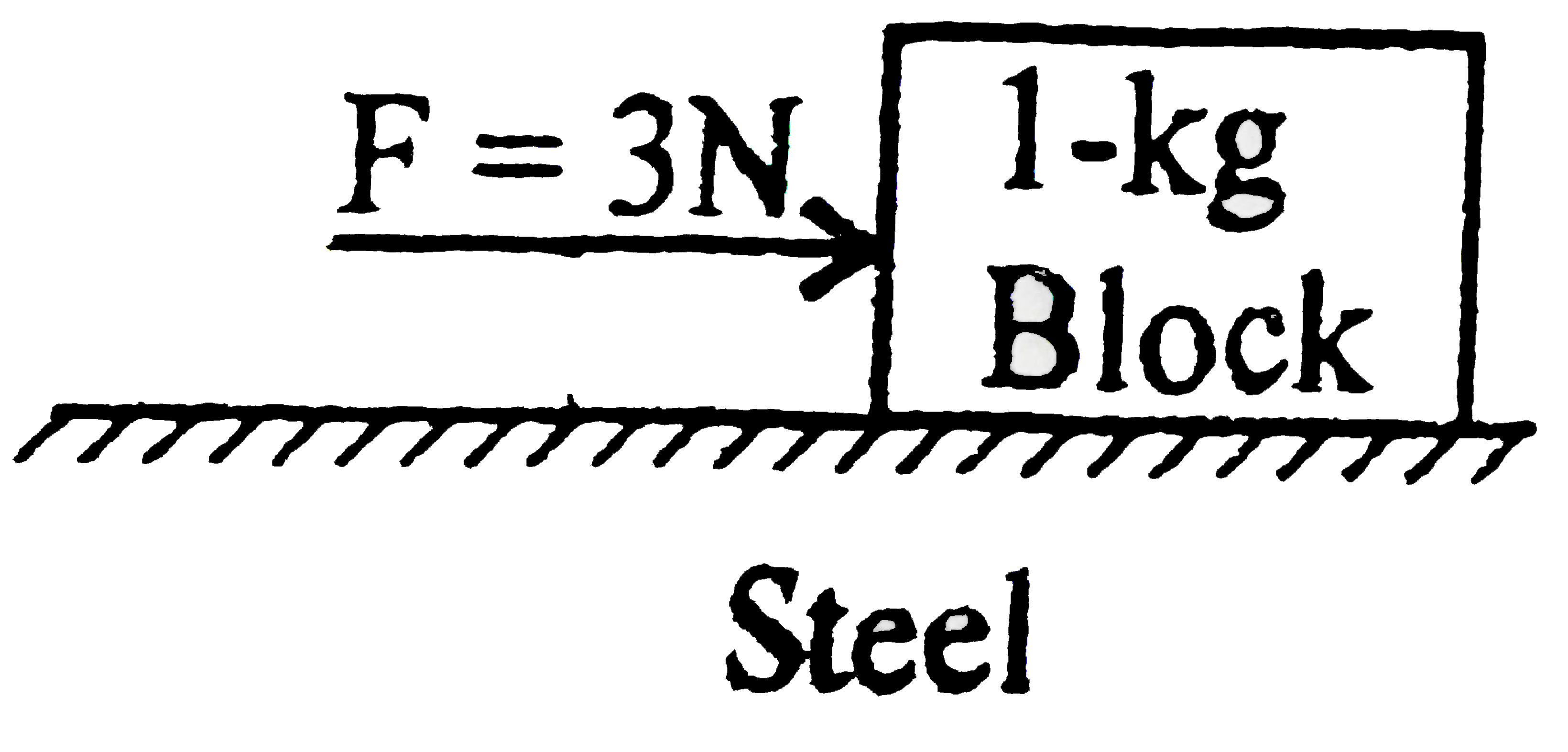
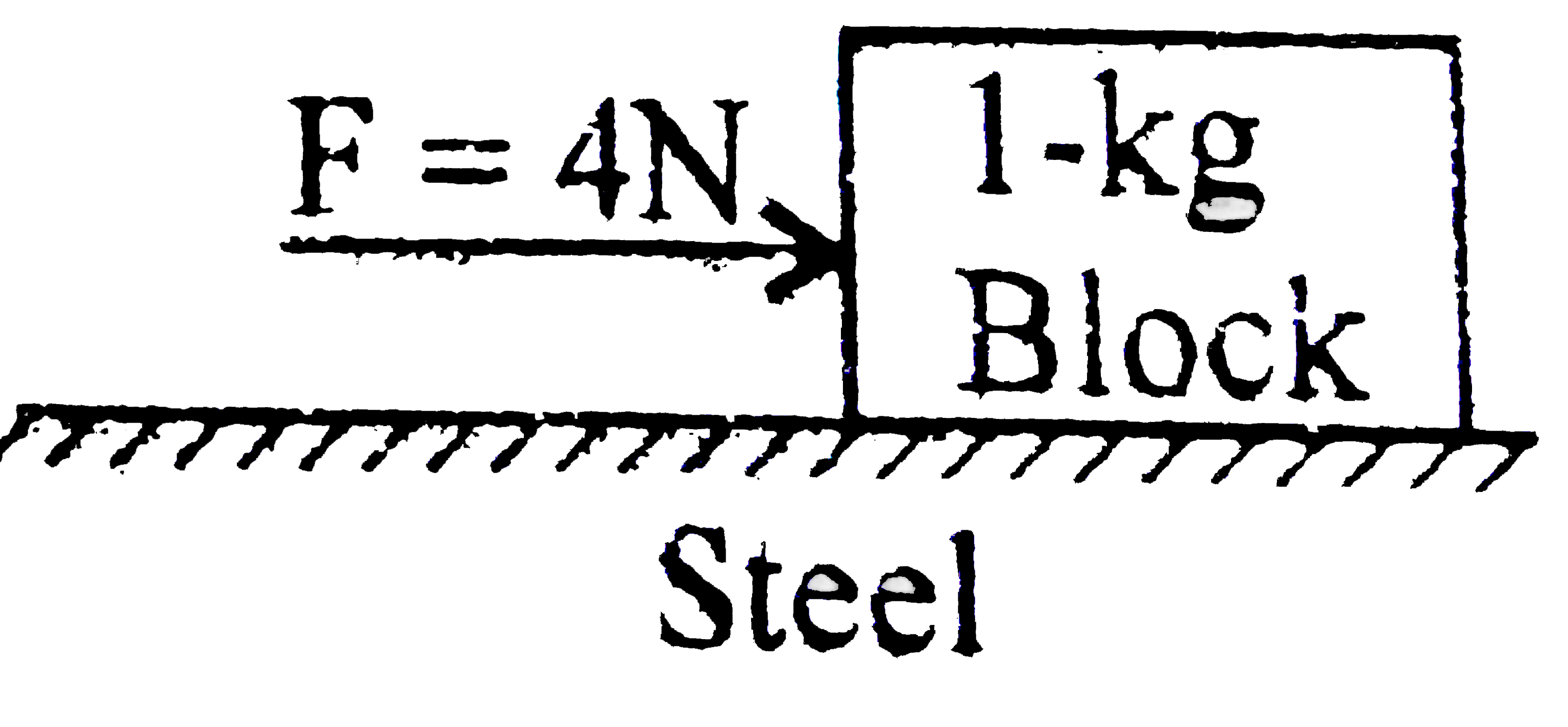
A different force is applied to each of four 1-kilogram blocks to slide them across a uniform steel surface at constant speed as shown below. In which diagram is the coefficient of frictin between the block and steel smallest ?

A

B

C

D

Text Solution

Verified by Experts

The correct Answer is:

B

Force constant speed `rArr ` ext. force =frictional
force (max).
`F_(ext)=F_(max) muR`
Promotional Banner

Topper's Solved these Questions

  • TEST PAPERS

    BANSAL|Exercise PHYSICS PART (A)|32 Videos
  • TEST PAPERS

    BANSAL|Exercise PHYSICS PART (B)|3 Videos
  • TEST PAPERS

    BANSAL|Exercise PHYSICS PART- C|4 Videos
  • SEMICONDUCTORS

    BANSAL|Exercise CBSE Question|32 Videos

Similar Questions

Explore conceptually related problems

A horizontal force of 20 N is applied to a block of 10 kg resting on a rough horizontal surface. How much additional force is required to just move the block, if the coefficient of static friction between the block and the surface is 0.4 ?

Block A of mass M in the system shown in the figure slides down the incline at a constant speed. The coefficient of friction between block A and the surface is 1 3 3 . The mass of block B is-

A block of mass m lying on a rough horizontal surface of friction coefficient mu is pulled by a force F as shown , the limiting friction between the block and surface will be

What is the value of applied force ‘F’ which is exerted at an angle theta with the horizontal on a block of mass ‘m’ placed on a horizontal rough surface, if the coefficient of static friction between the block and the surface is , such that the block is on the verge of moving horizontally?

In a figure shown mass of A and B is equal to M each. Friction between B and lowermost surface is negligible. Initially both the blocks are at rest. The dimensions of the block A are very small. A constant horizontal force F is applied on the blocks B and both the blocks start moving together without any relative motion. Suddenly, the block B encounters a fixed obstacle and comes to rest. The block A continues to slide on the block B . The block A just manages to reach the opposite end of the bolck B . What is the coefficient of friction between the two blocks? (Required length are shown in figure)

A block of mass m = 2kg is accelerating by a force F = 20N applied on a smooth light pulley as shown in the figure. If the coefficient of kinetic friction between the block and the surface is mu=0.3 , find its acceleration.

The system of two blocks is at rest an shown in the figure. A variable Horizontal force is applied to the upper block. The maximum possible constant force exerted by the horizontal ground surface on the lower block is ( coefficient of friction for both the contracts is mu )

Two blocks A and B of masses 10 kg and 15 kg are placed in contact with each other rest on a rough horizontal surface as shown in the figure. The coefficient of friction between the blocks and surface is 0.2. A horizontal force of 200 N is applied to block A. The acceleration of the system is ("Take g"=10ms^(-2))

A varying horizental force F = at act on a block of mass m kept on a smooth horizontal surface An identical block is kept on the first block.The coefficient of friction between the blocks is mu . The time after which the relative sliding between the blocks prevails is

BANSAL-TEST PAPERS-PHYSICS
  1. A small 1.0 kg mass is launched form the top of the cliff with speed V...

    Text Solution

    |

  2. A samll object of mass 10.0 g is at rest 30.0 cm from a horizontal dis...

    Text Solution

    |

  3. A different force is applied to each of four 1-kilogram blocks to slid...

    Text Solution

    |

  4. A small block of mass m(1) is released from rest at the top of a curve...

    Text Solution

    |

  5. A juggler tosses a ball up in the air with initial speed u. at the ins...

    Text Solution

    |

  6. A stone is projected from a horizontal plane. It attains maximum heigh...

    Text Solution

    |

  7. Find the radius of an equilateral triangular plate about its median. S...

    Text Solution

    |

  8. A rod of mass m and length l is hinged at 'its' end and released from ...

    Text Solution

    |

  9. A train crossesa a bridge of length 171 m in 27 second. It passed a pe...

    Text Solution

    |

  10. A uniform metal rod of length l I balanced at the mid point on a sharp...

    Text Solution

    |

  11. If the system is suspended by the mass m the length of the spring is l...

    Text Solution

    |

  12. A body of mass m has an initial speed v is acted by two forces vec(F)(...

    Text Solution

    |

  13. There 1.2 kg masses are located at the vertices of an equilateral tria...

    Text Solution

    |

  14. Humanity uses energy at the rate of about 10^(13) W. if we found a way...

    Text Solution

    |

  15. An object with kinetic energy K explodes into two pieces, each of whic...

    Text Solution

    |

  16. A cuboid of height 10 cm, width 5 cm and 8 kg is kept on a rough horiz...

    Text Solution

    |

  17. A cuboid of height 10 cm, width 5 cm and 8 kg is kept on a rough horiz...

    Text Solution

    |

  18. A cuboid of height 10 cm, width 5 cm and 8 kg is kept on a rough horiz...

    Text Solution

    |

  19. A small particle starts moving from point P along the smooth inclined ...

    Text Solution

    |

  20. A block of mass m is placed gently onto a long plank of mass M moving ...

    Text Solution

    |
