Home
Class 12
PHYSICS
An object is moving in x-y plane its vel...

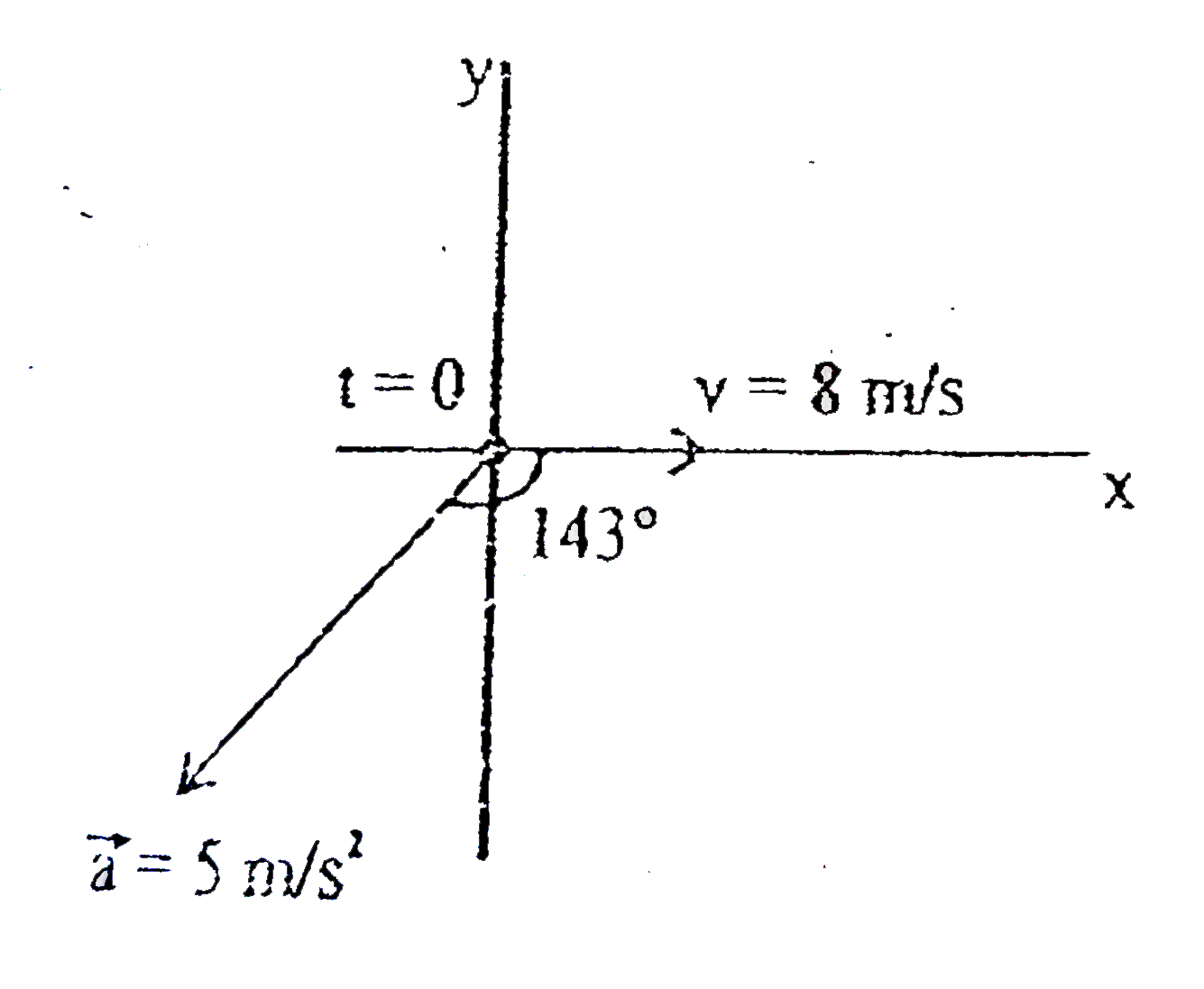
An object is moving in `x-y` plane its velocity and acceleration at `t=0` are represented in figure.

After how much time object crosses the `y-`axis:-

A

`4 sec`

B

`2 sec`

C

`3 sec`

D

None

Text Solution

Verified by Experts

The correct Answer is:
A

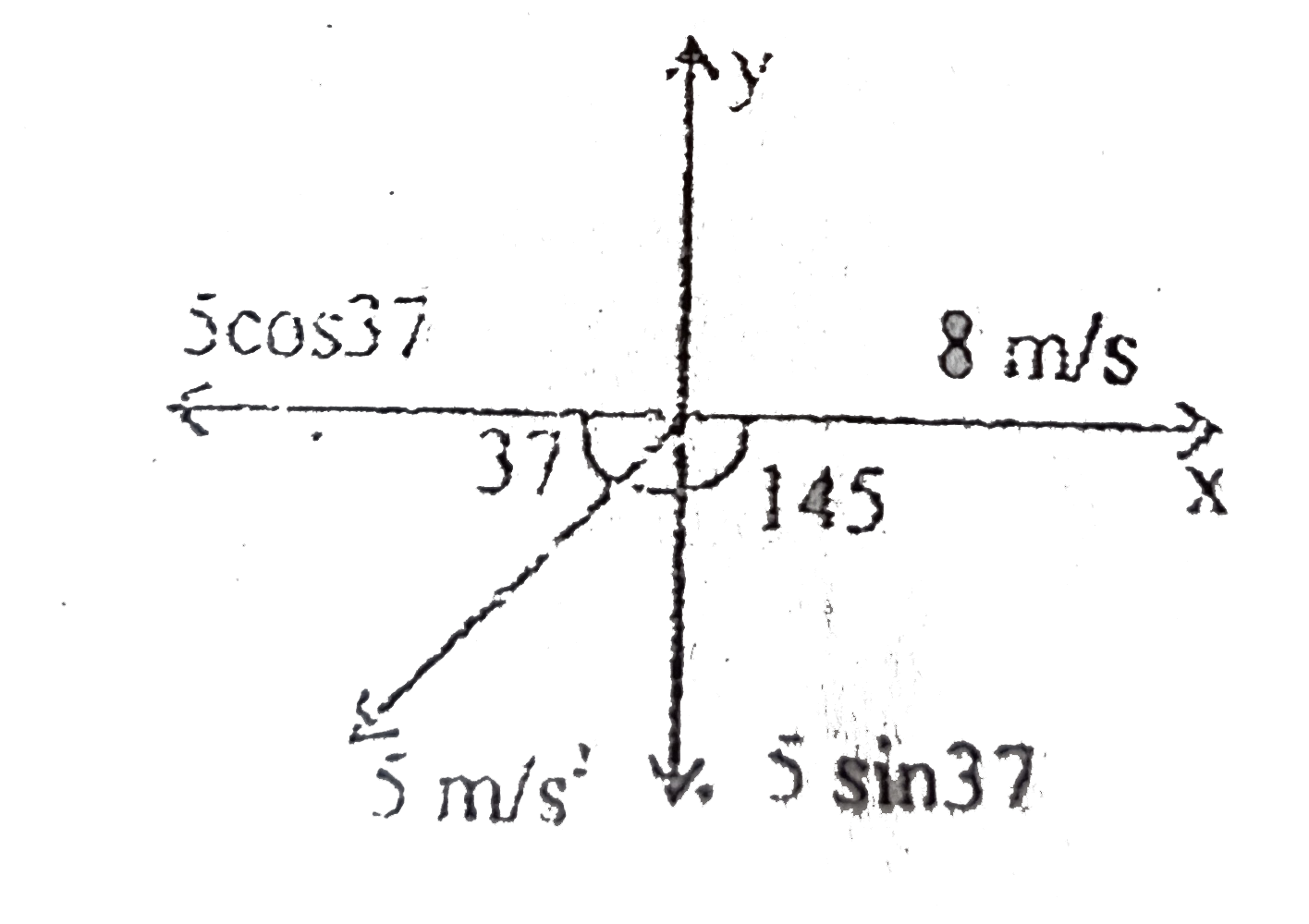
`vec(v)=8hat(i)` " "`vec(a)=-4hat(i)-3hat(j)`
when object crosses `y`-axis
`x=0`
`x=u_(x)t+(1)/(2)a_(x)t^(2)`

`0=8t+(1)/(2)(-4)t^(2)rArrt=4 sec`.
Promotional Banner

Topper's Solved these Questions

Similar Questions

Explore conceptually related problems

An object is moving in x-y plane its velocity and acceleration at t=0 are represented in figure. The ratio of magnitude of velocity to magnitude of component of acceleration along velocity at t=0 :-

When an object is moving with a uniform velocity, what is its acceleration?

A particle is moving in x–y plane. The x and y components of its acceleration change with time according to the graphs given in figure. At time t = 0 , its velocity is v_(0) directed along positive y direction. if a_(0) = (v_(0))/(t_(0)) , find the angle that the velocity of the particle makes with x axis at time t = 4t_(0) .

A point mass is moving in the x-y plane. Its acceleration is a constant vector perpendicular to the x-axis. Which of the following do/does not charge with time ?

An object of mass m is moving with a constant velocity upsilon How much work should be done on the object in order to bring the object to rest ?

Show that area under the velocity-time graph of an object moving with constant acceleration in a straight line in certain time interval is equal to the distance covered by the object in the interval.

A particle starts from the origin of coordinates at time t = 0 and moves in the xy plane with a constant acceleration alpha in the y-direction. Its equation of motion is y = beta x^(2) . Its velocity component in the x-directon is

A particle at origin (0,0) moving with initial velocity u = 5 m/s hatj and acceleration 10 hati + 4 hatj . After t time it reaches at position (20,y) then find t & y

Show that the area under the velocity-time graph of an object moving with constant acceleration in a straight line in certain time interval is equal to the distance covered by the object in that interval.

