Home
Class 12
PHYSICS
If acceleration of block B is 4 m//s^(2)...

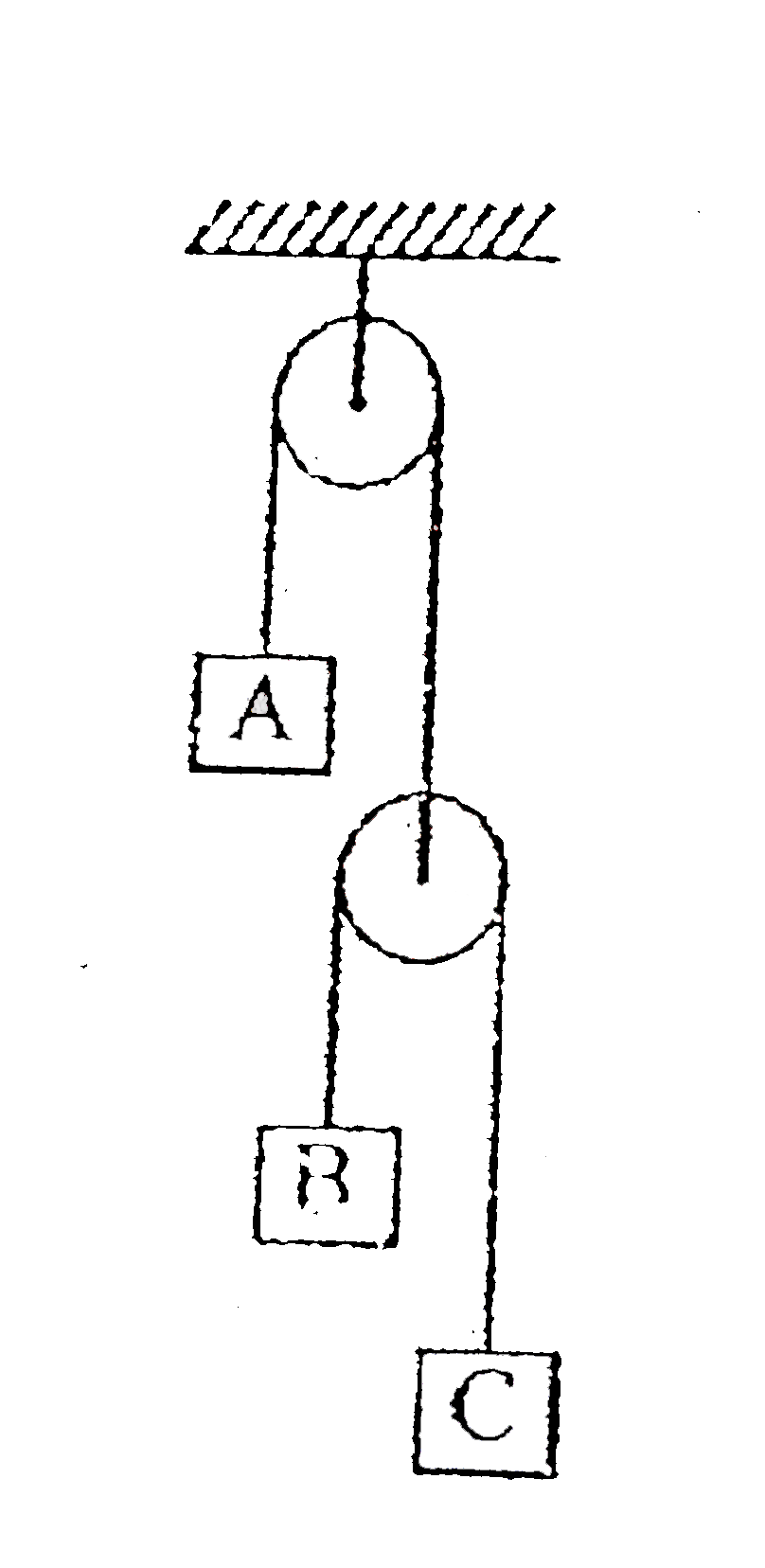
If acceleration of block `B` is `4 m//s^(2)` upward & that of C is `6 m//s^(2)` downward. Find acceleration of `A` `:-`

A

`2 m//s^(2)` upward

B

`1 m//s^(2)` upward

C

`1 m//s^(2)` downward

D

`2 m//s^(2)` downward

Text Solution

Verified by Experts

The correct Answer is:

B

`vec(-a_(A))=(vec(a_(B))+vec(a_(C)))/(2)`
`rArrvec(a_(A))=1m//s^(2)` upwards
Promotional Banner

Topper's Solved these Questions

Similar Questions

Explore conceptually related problems

At a certain moment of time, acceleration of the block A is 2 m//s^(2) . Upward and acceleration of block B is 3 m//s^(2) upward. The acceleration of block C is ( masses of pulleys and string are negligible )

In the figure acceleration of A is 1m//s^(2) upward, acceleration of B is 7m//s^(2) upward acceleration of C is 2m//s^(2) upward. The acceleration of D will be.

If acceleration of A is 2m//s^(2) to left and acceleration of B is 1m//s^(2) to left, then acceleration of C is-

Block A is kept on block B as shown in figure. It is known that acceleration of block A is 2 m//s^(2) towards right and acceleration of block B is 3 m//s^(2) towards right under the effect of unknown forces. Direction of friction force acting on A by B (mu_(AB) = 0.3)

The system shown in figure starts from rest, and each block moves with a constant acceleration. If the relative acceleration of block C with respect to block B is 6m//s^(2) upward and the relative acceleration of block D with respect to block C after 3s from starts.

In the pully system shown, if radii of the bigger and smaller pulley are 2m and 1m respectively and the acceleration of block A is 5 m//s^(2) in the downward direction, then the acceleration of block B will be

The magnitude of acceleration of a particle as seen by observer A is a m//s^(2) and that observed by Bis b m//s^(2) . If magnitude of acceleration of A with respect to B is x m//s^(2) then indicate the correct statements is :

In the arrangement shown in fig., all pulleys are smooth and massless. When the system is released from the rest, acceleration of block 2 and 3 relative to 1 are 1 ms^(-2) downwards and 5ms^(-2) downwards, respectively. Acceleration of block 3 relative to 4 is zero. Find the absoulte acceleration of block 4.

In the arrangement shown in fig., all pulleys are smooth and massless. When the system is released from the rest, acceleration of block 2 and 3 relative to 1 are 1 ms^(-2) downwards and 5ms^(-2) downwards, respectively. Acceleration of block 3 relative to 4 is zero. Find the absoulte acceleration of block 2.
