Home
Class 12
PHYSICS
Two masses m(1) and m(2). Which are con...

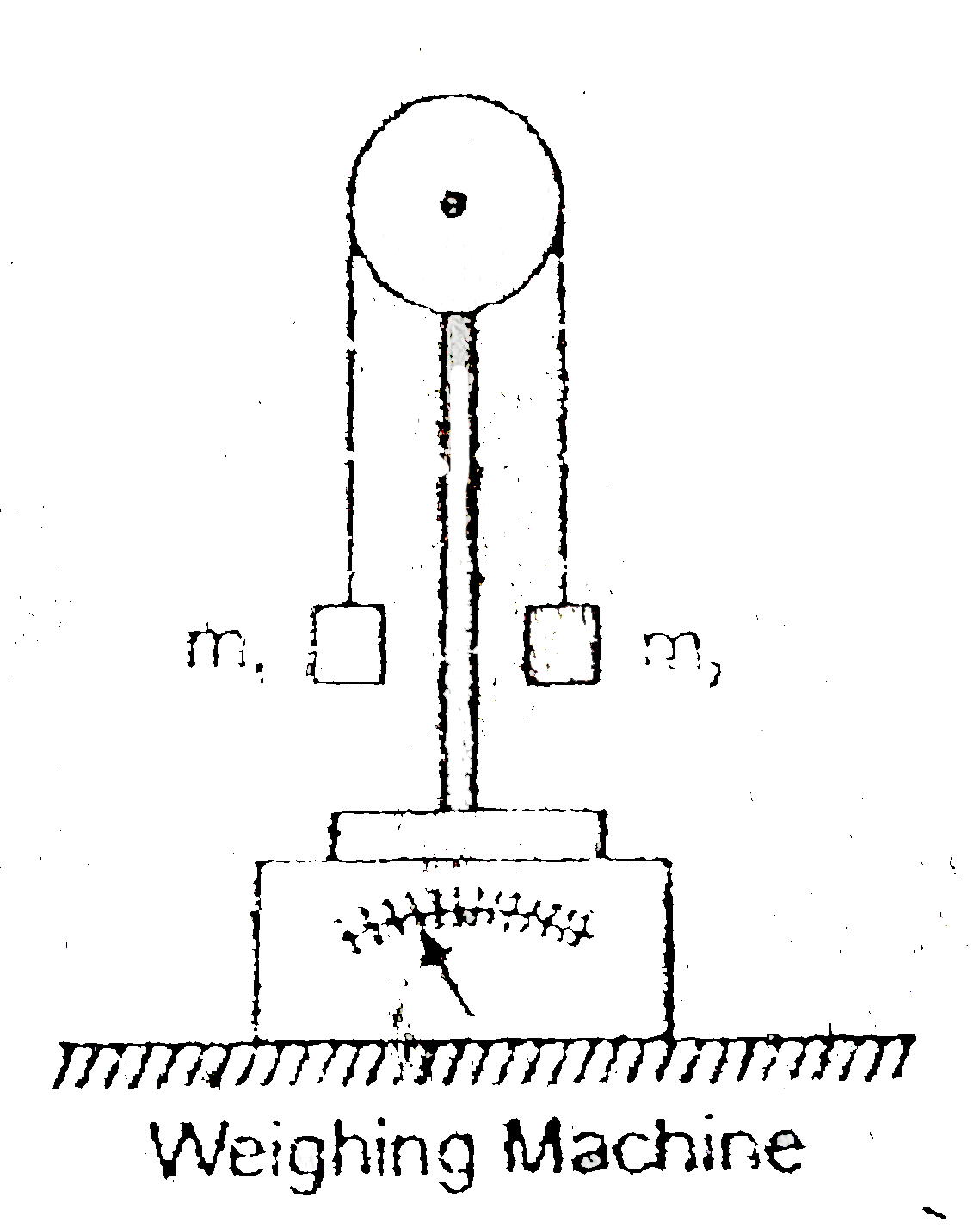
Two masses `m_(1)` and ` m_(2)`. Which are connected with a light string, are placed over a frictionless pulley. This set up is placed over a weighting machine, as shown. Three combination of masses `m_(1)` and `m_(2)` are used, in first case `m_(1)=6 kg` and `m_(2)=2kg` in second case `m_(1)=5kg` and `m_(2)=3kg` and in third case `m_(1)=4kg` and `m_(2)=4kg`.Masses are held stationary initiallly and then released. If the readings of the weighing machine after the release in three cases are `W_(1)`,`W_(2)` and `W_(3)` respectively then`:-`

A

`W_(1)gtW_(2)gtW_(3)`

B

`W_(1)ltW_(2)ltW_(3)`

C

`W_(1)=W_(2)=W_(3)`

D

`W_(1)=W_(2)ltW_(3)`

Text Solution

Verified by Experts

The correct Answer is:

B

`N//A`
Promotional Banner

Topper's Solved these Questions

Similar Questions

Explore conceptually related problems

Two masses m_(1) and m_(2) which are connected with a light string, are placed over a frictionless pulley. This set up is placed over a weighing machine, as shown. Three combination of mass m_(1) and m_(2) are used, in first case m_(1) =6kg and m_(2)=2 kg , in seconds case m_(1)=5 kg and m_(2)=3 kg and in third case m_(1)=4 kg and m_(2)= 4 kg . masses are held stationary initially and then released. if the reading of the weighing machine after the release in three cases are W_(1),W_(2) and W_(3) respectively then:

Two blocks of masses m_1 and m_2 , which are connected with a light string, are placed over a friction less pulley. This set up is placed over a weighing machine, as shown. Three combination of masses m_1 and m_2 are used, in first case m_1=6kg and m_2=2kg , in second case m_1=5kg and m_2=3kg and in third case m_1=4kg and m_2=4kg. masses are held stationary initially and then released if the readings of the weighing machine after the release in three cases are W_1 , W_2 and W_3 respectively then:

Two masses m_(1) and m_(2) are attached to a string which passes over a frictionless smooth pulley. When m_(1)=10kg,m_(2)=6kg , the acceleration of masses is

Two masses m_(1) and m_(2) ( m_(2) gt m_(1)) are hanging vertically over frictionless pulley. The acceleration of the two masses is :

Two masses m_1=5kg and m_2=4.8kg tied to a string are hanging over a light frictionless pulley. What is the acceleration of the masses when left free to move?

Two masses M_(1)=5kg,M_(2)=10 kg are connected at the ends of an inextensible string passing over a frictionless pulley as shown. When masses are released, then acceleration of masses will be

Two blocks of masses m_1 = 4 kg and m_2 = 2 kg are connected to the ends of a string which passes over a massless, frictionless pulley. The total downwards thrust on the pulley is nearly

Two masses m_(1)=4kg and m_(2)=2kg are connected with an nextansible , massless string that passes over a frictionless pulley and through a slit as, shown the string is vertical upon by a conatant friction force 10 N by the slit as it moves (use g=10m//s^(2)

Two block with masses m_(1) = 3kg and m_(2) = 5 kg are connected by a light string that slides over a frictionless pulley as shown in figure. Initially, m2 is held 5 m off the floor while m_(1) is on the floor. The system is then released. At what speed does m_(2) hit the floor?
