Home
Class 12
PHYSICS
Assertion:- The cord between A and B mor...

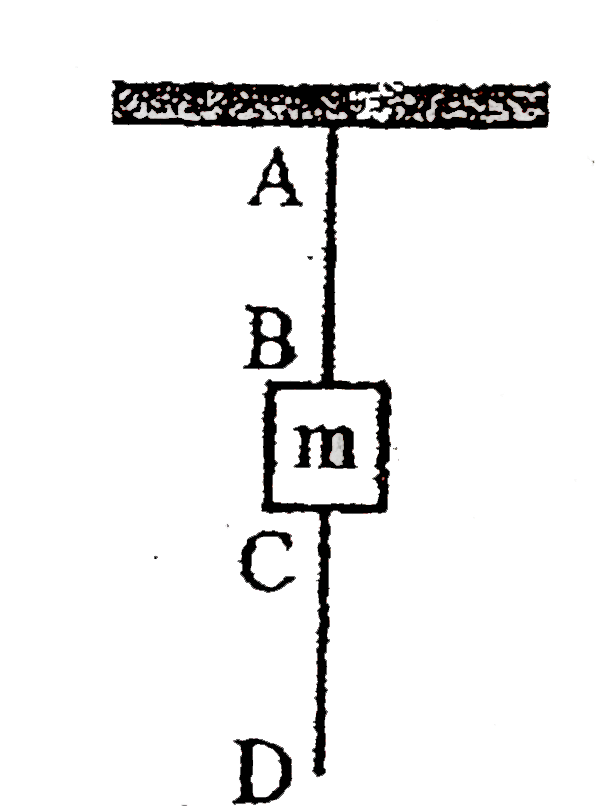
Assertion`:-` The cord between `A` and `B` more likely to snap with a gradual downward pull at `D`.

Reason`:-` When someone gives the lower cord a sudden downward pull, the tension in the lower cord inceaces suddenly.

A

If both Assertion & Reason are True & the Reason is a correct explanation of the Assertion.

B

If both Assertion & Reason are True but Reason is not a correct explanation of the Assertiion.

C

If Assertion is True but the Reason is False.

D

If both Assertion & Reason are False

Text Solution

Verified by Experts

The correct Answer is:

B

`N//A`
Promotional Banner

Topper's Solved these Questions

Similar Questions

Explore conceptually related problems

The circular current loop of radius b shown in Fig. is mounted rigidly on the axle, midway between the two supporting cords. In the absence of an external magnetic field, the tensions in the cords are equal and are T_0. a. What will be the tensions in the two cords when the vertical magnetic field B is present? b. Repeat if the field is parallel to the axis.

A cord is used to lower vertically a block of mass M , a distance d at a constant downward acceleration of (g)/(4) , then the work done by the cord on the block is

Figure shows a rod of length l resting on a wall and the floor. Its lower end A is pulled towards left with a constant velocity v. Find the velocity of the other end B downward when the rod makes an angle theta with the horizontal.

If two glass plates have water between them and are separated by very small distance (see figure). It is very difficult to pull them apart. It is because the water in between forms cylindrical surface on the side that gives rise ot lower pressure in the water in comparison to atmosphere. If the radius of the cylindrical surface is R and surface tension of water is T then the pressure in water between the plates is lowr by:

Figure shows a rod of length l resting on a wall and the floor. Its lower end A is pulled towards left with a constant velocity u. As a result of this, end A starts moving down along the wall. Find the velocity of the other end B downward when the rod makes an angle theta with the horizontal.

A small 0.500 kg object moves on a frictionless horizontal table in a circular path of radius 1.00 m. The angular speed is 6.28 "rad"//s . The object is attached to a string of negligible mass that passes through a small hole in the table at the center of the circle. Someone under the table begins to pull the string downward to make the circle smaller. If the string will toler ate a tension of no more than 105 N, what is the radius of the smallest possible circle on which the object can move?
