Home
Class 12
PHYSICS
In the figure, block A is released from ...

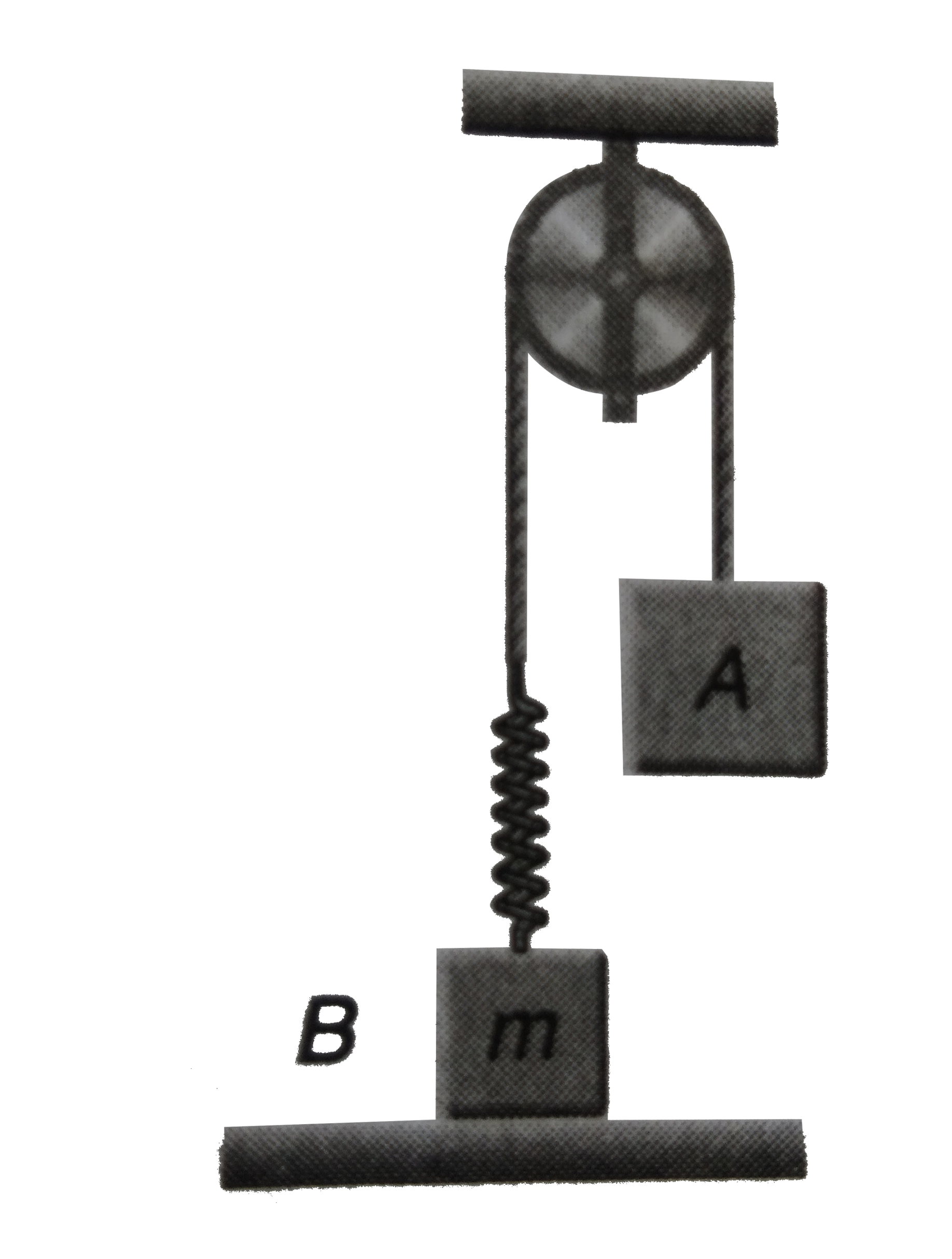
In the figure, block A is released from rest when the spring is its natural length for the block B of mass m to leave contact with the ground at some stage what should be the minimum mass of block A?
.

A

`2M`

B

`M`

C

`M//2`

D

A function of `M` and the force constant of the spring.

Text Solution

Verified by Experts

The correct Answer is:

C

The spring will exert the maximum force when the ball is at its lowest postion. If the ball has descended through a distance `x` to reach this position, `mgx=(1)/(2)kx^(2)`. Where `k` is the force constant of the spring. For the block `B` to leave contact, spring force `=kx=Mg`
Promotional Banner

Topper's Solved these Questions

Similar Questions

Explore conceptually related problems

In figure, block A is released from rest, when spring is at its natural unstretched length. For block B of mass M to leave contact with the ground at some stage, the minimum mass of A must be

In the adjoining diagram the ball A is released from rest when the spring is at its natural length (neither stretched nor compressed) For the block B of mass M to leave contact with the ground at some time, the minimum mass of A must be:

In the arrangement shown in the fig. string, springs and the pulley are mass less. Both the springs have a force constant of k and the mass of block B resting on the table is M. Ball A is released from rest when both the springs are in natural length and just taut. Find the minimum value of mass of A so that block B leaves contact with the table at some stage

In the arrangement shown in the figure, block B of mass M rests on a weighing scale. Ball A is released from a position where spring is in its natural length and the scale shows the correct weight of block B. Find the mass of ball A so that the minimum reading shown by the scale subsequently is half the true weight of B.

The block of mass m is released when the spring was in its natrual length. Spring constant is k. Find the maximum elongation of the spring.

Block m is released from rest when spring is in its natural length ( assume pulley is ideal and block does not strike on ground during it's motion in vertical plane ) than :

In the figure shown, the system is released from rest with both the springs in unstretched positions. Mass of each block is 1 kg and force constant of each spring is 10 N/m. Maximum speed of the block placed horizontally is:

The system is released from rest with spring intially in its natural length. If mass of the block m = 10 kg. and spring constant k = 100 N//m , then maximum extension in spring is :

ALLEN-TEST PAPER-Exercise (Physics)
  1. A constant force produces maximum velocity V on the block connected to...

    Text Solution

    |

  2. A particle with total energy E moves in one dimemsional region where t...

    Text Solution

    |

  3. In the figure, block A is released from rest when the spring is its na...

    Text Solution

    |

  4. A body of mass 2.0 kg, force to travel in the x-direction, is subjecte...

    Text Solution

    |

  5. The potential energy for a force filed vecF is given by U(x,y)=cos(x+y...

    Text Solution

    |

  6. A particle of mass 5kg moving in the X-Y plane has its potential energ...

    Text Solution

    |

  7. As a particle moves along the x-axis, it is acted upon by a conservati...

    Text Solution

    |

  8. Water is flowing in a river at 2 ms^(-1). The river is 50 m wide and h...

    Text Solution

    |

  9. Which of the following statemente is / are INCORRECT? (a) Mechanical...

    Text Solution

    |

  10. Consider the following sketch of potential energy for a particle as a ...

    Text Solution

    |

  11. The potential energy of a 1 kg particle free to move along the x- axis...

    Text Solution

    |

  12. The figure below shows a graph of potential energy U(s) verses positio...

    Text Solution

    |

  13. A force F acting on a body depends on its displacement x as Fpropx^(a)...

    Text Solution

    |

  14. If vec(A)=2hat(i)+hat(j)+hat(k) and vec(B)=hat(i)+2hat(j)+2hat(k), fi...

    Text Solution

    |

  15. An insect starts from (2,3,4) and travels along (hat(i)+2hat(j)+2hat(k...

    Text Solution

    |

  16. For the given vector vec(A)=3hat(i)-4hat(j)+10hat(k), the ratio of mag...

    Text Solution

    |

  17. In the arrangement shown in figure coefficient of friction between 5kg...

    Text Solution

    |

  18. A block is kept at the corner of two walls and force 3N is applied on ...

    Text Solution

    |

  19. A plank of mass 2 kg and length 1 m is placed on horizontal floor.A sm...

    Text Solution

    |

  20. A block is moving along y-axis with velocity vec(v)(A)=4hat(j) on a pl...

    Text Solution

    |
