Home
Class 12
PHYSICS
A plank of mass 2 kg and length 1 m is p...

A plank of mass `2 kg` and length `1 m` is placed on horizontal floor.A small block of mass `1 kg` is placed on top of the plank , at its right extreme end .The coefficient of friction between plank and floor is `0.5` and that between plank and block is `0.2` . If a horizontal force `= 30 N` starts acting on the plank to the right ,the time after which the block will fall off the plank is `(g = 10 ms^(-2))`

A

`(2//3)s`

B

`1.5 s`

C

`0.75 s`

D

`(4//3)s`

Text Solution

Verified by Experts

The correct Answer is:
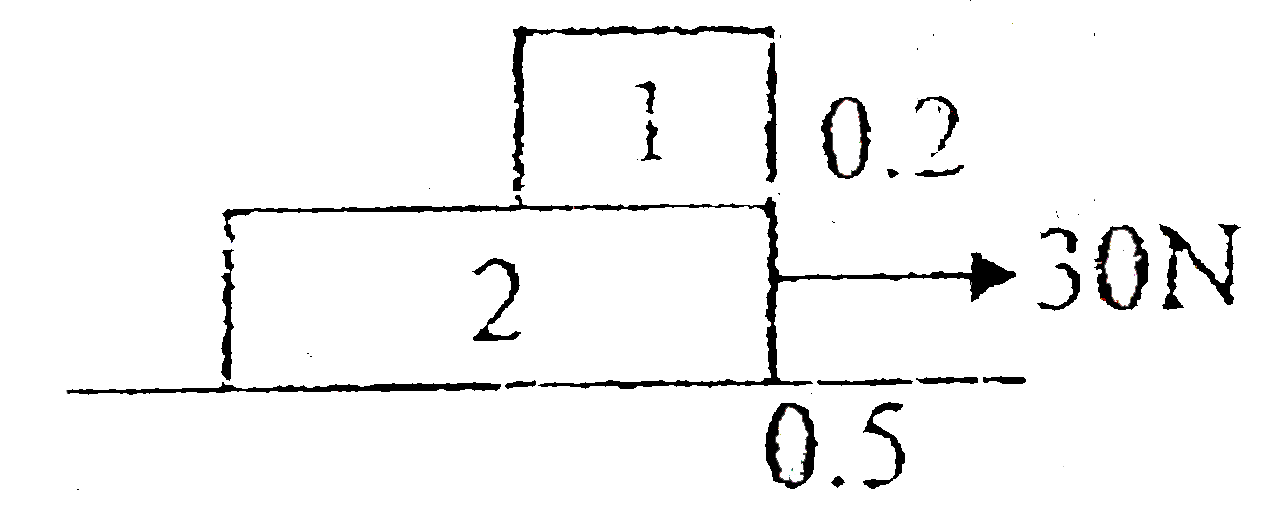
A

`a_(1//g)=2 m//s^(2)`
`a_(2//g)=(30-2-15)/(2)=(13)/(2)=6.5m//s^(2)rArra_(2n)=4.5`

`s_(2//1)=(1)/(2)a_(2//1)t^(2 )rArrt=(1)/(2)xx4.5xxt^(2)`
`rArrt=sqrt(4/9)=(2)/(3)` sec
Promotional Banner

Topper's Solved these Questions

Similar Questions

Explore conceptually related problems

A small block of mass 1kg is placed over a plank of mass 2kg. The length of the plank is 2 m. coefficient of friction between the block and the plnak is 0.5 and the ground over which plank in placed is smooth. A constant force F=30N is applied on the plank in horizontal direction. the time after which the block will separte from the plank is (g=10m//s^(2))

A bolck of mass m =2 kg is placed on a plank of mass M = 10 kg, which is placed on a smooth horizontal plane as shown in the figure. The coefficient of friction between the block and the plank is mu=(1)/(3) . If a horizontal force F is applied on the plank, then the maximum value of F for which the block and the plank move together is (g=10m//s^(2))

A block A of mass 2 kg rests on another block B of mass 8 kg which rests on a horizontal floor. The coefficient of friction between A and B is 0.2 while that between B and floor is 0.5 .When a horizontal floor F of 25 N is applied on the block B the force of friction between A and B is

A block of mass m=2kg is placed in equilibrium on a moving plank accelerating with a=1m//s^(2) . If coefficient of friction between plank and block mu=0.2 . The friction force acting on theblock is:

A block of mass m=2kg is placed in equilibrium on a moving plank accelerating with a=4m//s^(2) . If coefficient of friction between plank and block mu=0.2 . The friction force acting on theblock is:

A block of mass m=2kg of shown dimensions is placed on a plank of mass M = 6Kg which is placed on smooth horizontal plane. The coefficient of friction between the block and the plank is mu=1/3 . If a horizontal froce F is applied on the plank, then find the maximum value of F (in N) for which the block and the plank move together

A plank of mass 10 kg and a block of mass 2 kg are placed on a horizontal plane as shown in the figure. There is no friction between plane and plank. The coefficient of friction between block and plank is 0.5 .A force of 60 N is applied on plank horizontally. In first 2 s the work done by friction on the block is

A block of mass 2 kg, initially at rest on a horizontal floor, is now acted upon by a horizontal force of 10 N . The coefficient of friction between the block and the floor is 0.2. If g = 10 m//s^(2) , then :

A block of mass'm' it kept over the smooth surface of the plank of mass M. the plank of length l is kept over the smooth horizontal surface. A constant horizontal force F is applied onto the plank as shown in figure. Calculate the time after which the block falls off the plank?

A plank of mass M is placed on a rough horizontal force F is applied on it A man of mass m rens on the plank find the acceleration of the man so that the plank does not move on the surface . The coefficent of friction between the plank and the surface is mu Assume that the man does not slip on the plank

ALLEN-TEST PAPER-Exercise (Physics)
  1. In the arrangement shown in figure coefficient of friction between 5kg...

    Text Solution

    |

  2. A block is kept at the corner of two walls and force 3N is applied on ...

    Text Solution

    |

  3. A plank of mass 2 kg and length 1 m is placed on horizontal floor.A sm...

    Text Solution

    |

  4. A block is moving along y-axis with velocity vec(v)(A)=4hat(j) on a pl...

    Text Solution

    |

  5. A block is projected up along the line of greatest slope of an incline...

    Text Solution

    |

  6. A metal block is resting on a rough wooden surface. A horizontal force...

    Text Solution

    |

  7. A Body intially at rest, starts moving along x-axis in such a way so t...

    Text Solution

    |

  8. A particle is shifted from A to B and then from B to C where A,B and C...

    Text Solution

    |

  9. Velocity of a stone projected, 2 second before it reaches he maximum h...

    Text Solution

    |

  10. A particle is moving along x-axis whose position is given by x=4-9t+(t...

    Text Solution

    |

  11. A particle moves 21m along the vector 6hat(i)+2hat(j)+3hat(k) , then 1...

    Text Solution

    |

  12. A particle is falling freely under gravity. In frist t secnd it covers...

    Text Solution

    |

  13. For a particle moving along x-axis, speed must be increasing for the f...

    Text Solution

    |

  14. A car of mass 1000kg moves from point A to B. If kinetic energy of ca...

    Text Solution

    |

  15. Two bodies of masses m(1) and m(2) are acted upon by a constant force ...

    Text Solution

    |

  16. A body (intially at rest is falling under gravity. When it loses a gra...

    Text Solution

    |

  17. The graph given below shows how the force on a mass depends on the po...

    Text Solution

    |

  18. A particle with total energy E moves in one direction in a region wher...

    Text Solution

    |

  19. Consider the folllowing graph of potential energy (U) vs position (x) ...

    Text Solution

    |

  20. A chain of uniform mass m and length L is held on a frictionless table...

    Text Solution

    |

