Home
Class 12
PHYSICS
A car of mass 1000kg moves from point A...

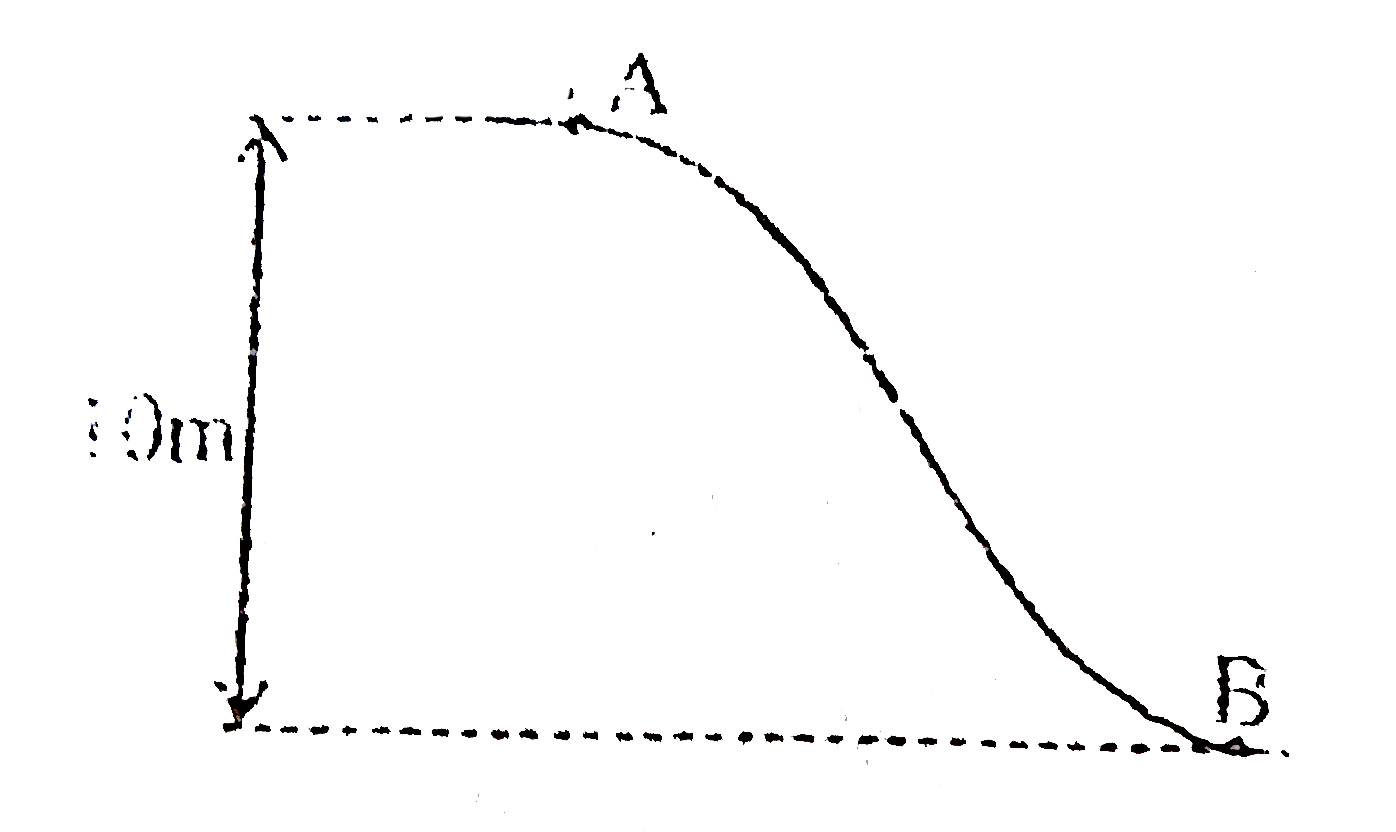
A car of mass `1000kg` moves from point `A` to `B`. If kinetic energy of car at point `A` is `100KJ` and at `B` is `220 Kj`. Then find work done by friction force on the car ?

A

`-100kJ`

B

`100kJ`

C

`-20kJ`

D

`20 kJ`

Text Solution

Verified by Experts

The correct Answer is:

D

By using work energy theorm,`W=DeltaKE`
`rArrW_(gravity)+W_(f riction)=DeltaKE`
`rArrmgh+W_(f riction)=120xx10^(3)rArrW_(f riction)=20kJ`
Promotional Banner

Topper's Solved these Questions

Similar Questions

Explore conceptually related problems

A body moves from point A to point B under the action of a force varying in magnitude as shown in the force displacement graph. Find total work done by the force :

A car, while moving, is facing a wind from the opposite direction. The work done by the wind on the car will be ______.

A car of mass 800 kg is moving with a constant velocity 40 km/h . Find the net force on it.

A car of mass 800 kg is moving with a constant velocity 40 km/h. Find the net force on it.

A block of mass 1 kg is placed at the point A of a rough track shown in the figure. If slightly pushed towards right, it stops at the point B of the track. The work done by the frictional force on the block during its transit from A to B is

A car of mass 1000kg moves on a circular path with constant speed of 12 m//s . It turned through 90^@ after travelling 471 m on the road . The centripetal force acting on the car is

A car of mass 1000 kg moves on a circular path with constant speed of 16 m/s. It is turned by 90º after travelling 628 m on the road. The centripetal force acting on the car is-

A car of 500 kg mass has a kinetic energy of 64 kJ. Find is speed ( in m/s)

A car of mass 1000 kg is moving with a certain speed when a constant braking force 1000 N acts on it for 5s and the speed of the car reduces to half its original speed. Find the further time required to stop the car if the same constant force acts.

ALLEN-TEST PAPER-Exercise (Physics)
  1. A particle is falling freely under gravity. In frist t secnd it covers...

    Text Solution

    |

  2. For a particle moving along x-axis, speed must be increasing for the f...

    Text Solution

    |

  3. A car of mass 1000kg moves from point A to B. If kinetic energy of ca...

    Text Solution

    |

  4. Two bodies of masses m(1) and m(2) are acted upon by a constant force ...

    Text Solution

    |

  5. A body (intially at rest is falling under gravity. When it loses a gra...

    Text Solution

    |

  6. The graph given below shows how the force on a mass depends on the po...

    Text Solution

    |

  7. A particle with total energy E moves in one direction in a region wher...

    Text Solution

    |

  8. Consider the folllowing graph of potential energy (U) vs position (x) ...

    Text Solution

    |

  9. A chain of uniform mass m and length L is held on a frictionless table...

    Text Solution

    |

  10. A force of magnitude of 30N acting along hat(i)+hat(j)+hat(k), displac...

    Text Solution

    |

  11. A spring of force constant K is cut in two parts at its one third leng...

    Text Solution

    |

  12. A ball of mass m is attached to a string whose other end is fixed. The...

    Text Solution

    |

  13. A block of mass m lies on a horizontal frictionless surface and is att...

    Text Solution

    |

  14. Two bars of masses m(1) and m(2) connected by a non-deformed light spr...

    Text Solution

    |

  15. Power due to a force actoing on a block varies with time t as shown in...

    Text Solution

    |

  16. Two inclined frictionless tracks , one gradual and the other sleep mee...

    Text Solution

    |

  17. A particle A is projected verically upwards. Another indentical partic...

    Text Solution

    |

  18. Track OABCD (as shown is figure) is smooth and fixed in vertical plane...

    Text Solution

    |

  19. In the ideal atwood machine arrangement shown, what is the change in k...

    Text Solution

    |

  20. A partical of mass 2kg is moving on the x-axis with a constant mechani...

    Text Solution

    |
