Home
Class 12
PHYSICS
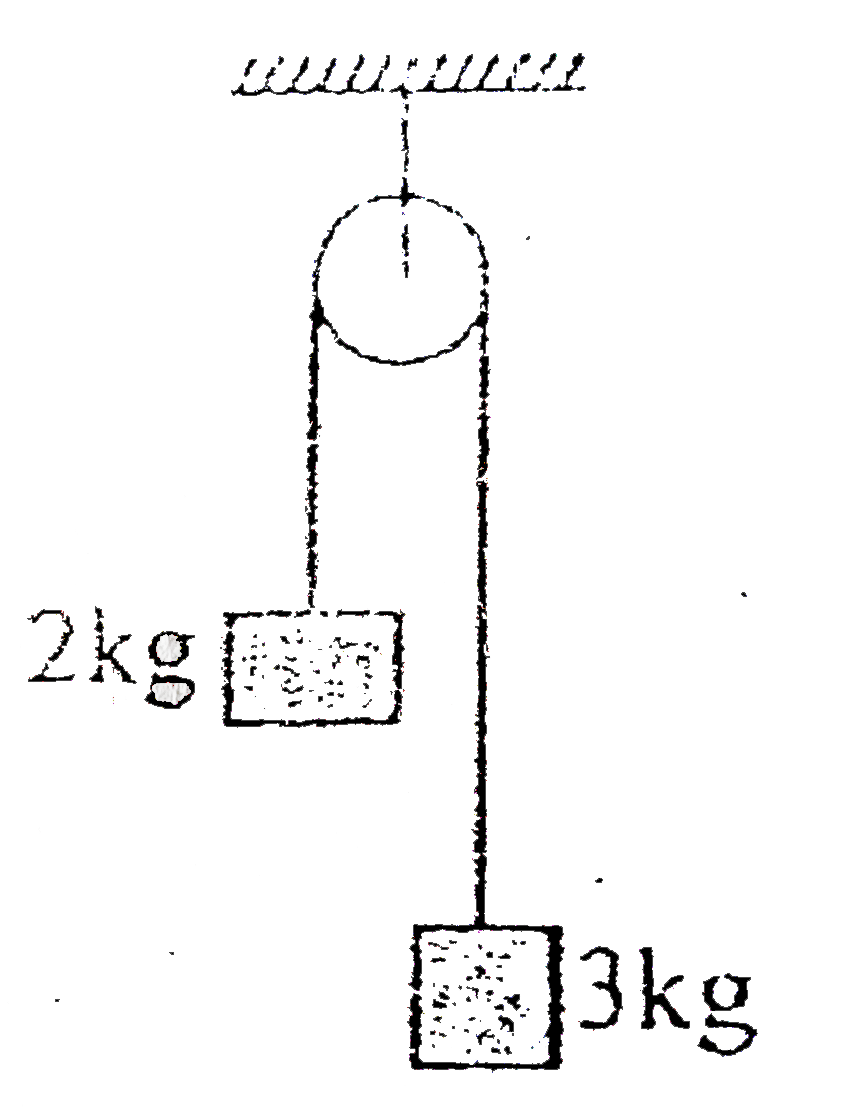
In the ideal atwood machine arrangement ...

In the ideal atwood machine arrangement shown, what is the change in kinetic energy of the system in `(1)/(sqrt2)`second of their motion starting from rest ?

A

`1J`

B

`2J`

C

`4J`

D

`5J`

Text Solution

Verified by Experts

The correct Answer is:

D

Acceleration`=(3g-2g)/(5)=2m//s^(2)` so
`v=2xx(1)/(sqrt2)=sqrt2m//s`
`:.DeltaE=(1)/(2)(2)(sqrt2)^(2)+(1)/(2)(3)(sqrt2)^(2)=5`
Promotional Banner

Topper's Solved these Questions

Similar Questions

Explore conceptually related problems

An electron is either released from rest or projected with some initial velocity in a uniform electric field. Neglect any other force on the electron apart from electrostatic force. Which of the graphs shown in fig could possibly represent the change in kinetic energy of the electron during its course of motion? Explain the situation in each case.

The acceleration of 3 kg block in the arrangement shown in the diagram ,when the given system is released from rest is

The speed of rolling of a ring of mass m changes from V to 3V . What is the change in its kinetic energy

The heavier bock in an atwood machine has a mass twice that of the lighter one. The tension in the stirng is 16.0 N when the sytem is set into motion. Find the decrease in the gravitational potential energy during the first second after the system is releaed from rest.

In the balance machine shown in the figures. Which arm will move downward after the system is released from rest (assuming stiring, arm of balance machie and the pulley to be light)

In the arrangement shown in figure what should be the mass of block A , so that the system remains at rest ? Neglect friction and mass of string.

A small steel sphere of mass m and radius r rolls without slipping on the fiictionless surface of a large hemisphere of radius R{R gt gt r) whose axis of symmetry is vertical. It starts at the top from the rest, (a) What is the kinetic energy at the bottom ? (b) What fraction is the rotational kinetic energy of the total kinetic energy at the bottom? (b) What fraction is the rotational kinetic energy of the total kinetic energy? (c) What fraction is the translational kinetic energy of the total kinetic energy? (d) Calculate the normal force that the small sphere will exerton.the hemisphere at its bottom. Howthe results will be affected if r is not very sjnall as compared to R.

ALLEN-TEST PAPER-Exercise (Physics)
  1. A particle A is projected verically upwards. Another indentical partic...

    Text Solution

    |

  2. Track OABCD (as shown is figure) is smooth and fixed in vertical plane...

    Text Solution

    |

  3. In the ideal atwood machine arrangement shown, what is the change in k...

    Text Solution

    |

  4. A partical of mass 2kg is moving on the x-axis with a constant mechani...

    Text Solution

    |

  5. A chain of length L and mass m is placed upon a smooth surface. The le...

    Text Solution

    |

  6. Potential energy function along x-axis in a certain force field is giv...

    Text Solution

    |

  7. A pigeon in flight experience a force of air resistance given by F=bv^...

    Text Solution

    |

  8. A potential energy curve U(x) is shown in the figure. What value must ...

    Text Solution

    |

  9. The left end of the spring tied to a wall and at the right end is atta...

    Text Solution

    |

  10. A block weighing 40N travels down a smooth fixed curved track AB joine...

    Text Solution

    |

  11. Two atoms interact with each other according to the following force F ...

    Text Solution

    |

  12. The potential energy U(x) of a particle moving along x-axis is shown i...

    Text Solution

    |

  13. A particle is to move along the x-axis from x=0 to x=x(1) while a cons...

    Text Solution

    |

  14. A body with mass 2kg moves in one direction in the presence of a force...

    Text Solution

    |

  15. An escalator is used to move 5 people (60kg each) per minute from the ...

    Text Solution

    |

  16. A stone is dropped into a quiet lake and waves move in circles at the ...

    Text Solution

    |

  17. For conservative force field, vec(F)=-(delU)/(delx)hat(i)-(delU)/(dy)...

    Text Solution

    |

  18. Find the value of x(1), so that int(0)^(x(1))ydx=5

    Text Solution

    |

  19. A rocket rises vertically up from the surface of earth so that it is d...

    Text Solution

    |

  20. Find the rate of change of radius of a sphere when its radius is 4 cm ...

    Text Solution

    |
