Home
Class 12
PHYSICS
Two identical balls moving in opposite d...

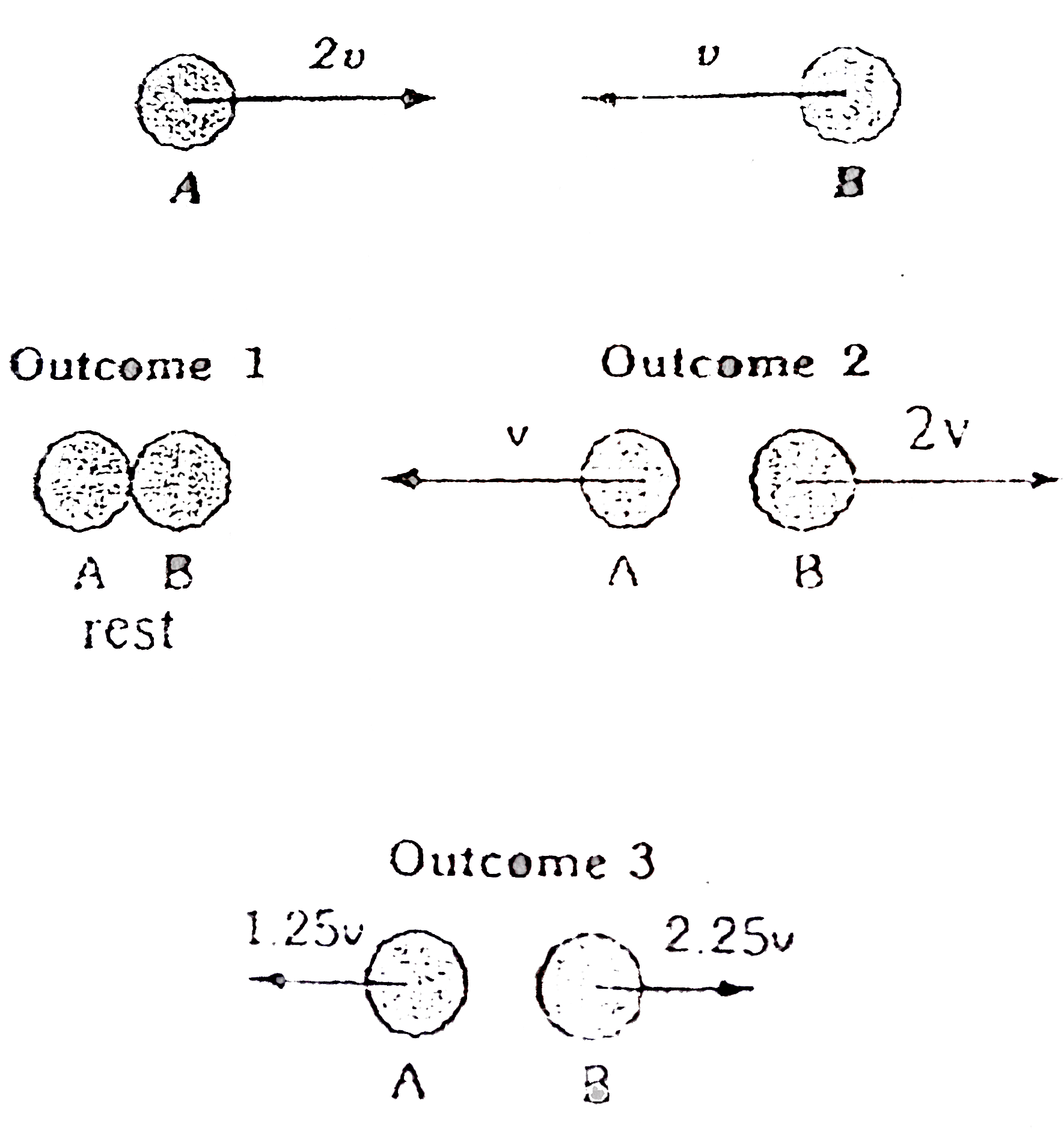
Two identical balls moving in opposite directions in free space collide head on. How they will move after the impact, is decided by coefficient of restitution. For different coeffecients of restiution, few possible outcomes are shown in the following figures. Which of the above outcomes are physically possible for a collision?

A

Only `1`

B

Only `2`

C

`1` and `2` but not `3`

D

`1` `2` and `3` all

Text Solution

Verified by Experts

The correct Answer is:

B

Ans.(2) (Linear momentum should be conserved)
Promotional Banner

Topper's Solved these Questions

Similar Questions

Explore conceptually related problems

A 1 kg ball moving at 12 m//s collides head on with a 2g ball moving in the opposite direction at 24 m//s . The velocity of each ball after the impact, if the coefficient of restitution is 2//3 is

Two identical balls moving in opposite direction with speed 20 m/s and 25 m/s undergo head on perfectly inelastic collision. The spped of combined mass after collision is

Two identical balls moving in opposite directions with speed 20 m/s and 25 m/s undergo head on perfectly inelastic collision. The speed of combined mass after collision is

When two identical balls are moving with equal speed in opposite direction, which of the following is true ? For the system of two bodies.

Two ball bearings of mass m each moving in opposite directions with same speed v collide head on with each other. If the collision is perfectly elastic, what will be the outcome of the collision ?

Two ball bearings of mass m each moving in opposite directions with each speeds v collide head on with each other . Predict the outcome of the collision , assuming it to the perfectly elastic.

A ball P is moving with a certain velocity , collides head-on with another ball Q of same mass is rest. The coefficient of restitution is 1/4, then ratio of velocity of P and Q just after the collision is

2kg ball moving at 6ms^(-1) collides head on with a 3kg ball moving in the opposite direction at 12m/s .The velocity of each ball after the impact, if the coefficient of restitution is 1/2, is ?

ALLEN-TEST PAPER-Exercise (Physics)
  1. Two forces F(1) and F(2) are applied simultaneously on a 2kg block res...

    Text Solution

    |

  2. A 6.0kg mass is moving to the right at 10 m//s. A 0.25kg mass is fired...

    Text Solution

    |

  3. Two identical balls moving in opposite directions in free space collid...

    Text Solution

    |

  4. In figure, determine the character of the collision. The masses of the...

    Text Solution

    |

  5. A rod has non uniform mass distribution. The mass increases uniformly ...

    Text Solution

    |

  6. A solid hemisphere and a hemisphereical shell are joined as shown. Bot...

    Text Solution

    |

  7. In a system of four thin uniform rods are each of mass inas shown. If ...

    Text Solution

    |

  8. A vertical rectangular door with its centre of gravity at O (see figur...

    Text Solution

    |

  9. A rectangular metal plate ABCD is supported by two hinges P(1) and P(2...

    Text Solution

    |

  10. A uniform beam of weight W is attached to a verical wall by a hings H....

    Text Solution

    |

  11. A body is free to rotate about an axis parallel to y-axis. A force of ...

    Text Solution

    |

  12. A disc of radius R=2m starts rotating wth constant angular acceleratio...

    Text Solution

    |

  13. In the balance machine shown in the figures. Which arm will move downw...

    Text Solution

    |

  14. A uniform disc of mass M =2.50 kg and radius R = 0.20 m is mounted on ...

    Text Solution

    |

  15. A car runs at constant speed around the horizontal race track shown in...

    Text Solution

    |

  16. A man M slides down a curved frictionless track, starting from rest. ...

    Text Solution

    |

  17. An object moves counter-clockwise along the circular path shown below....

    Text Solution

    |

  18. A girl finds herself stuck with her back to the wall of a cylinder rot...

    Text Solution

    |

  19. A puck of mass m is moving in a circle at constant speed on a friction...

    Text Solution

    |

  20. A simple pendulum of bob of mass m and length L has one of its ends fi...

    Text Solution

    |
