Home
Class 12
PHYSICS
A particle is moving with a velocity of ...

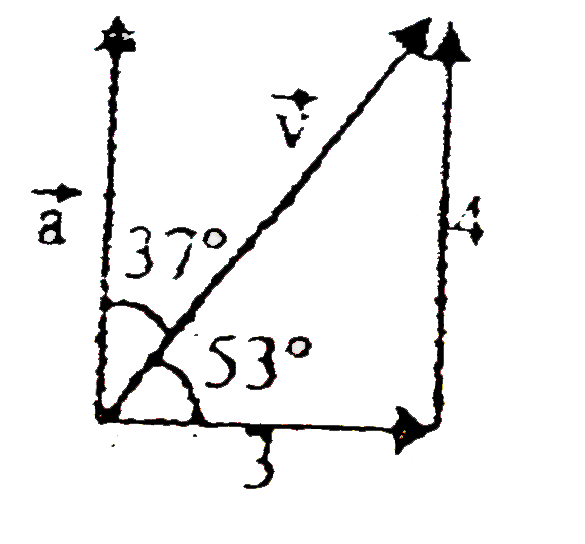
A particle is moving with a velocity of `vec(v)=(3hat(i)+4that(j))m//s`. Find the ratio of rangential acceleration to that of total acceleration at `t=1sec`

A

`(4)//(5)`

B

`(3)//(5)`

C

`(5)//(4)`

D

`(3)//(4)`

Text Solution

Verified by Experts

The correct Answer is:
A


At `t=1s, v=sqrt(3^(2)+4^(2))=5,vec(a)=(vec(dv))/(dt)=4hat(j)`
`a_(t)=4cos37^(2)=(16)/(5)rArr(a_(t))/(a)=(16//5)/(4)=(4)/(5)`
Promotional Banner

Topper's Solved these Questions

Similar Questions

Explore conceptually related problems

A particle is moving with initial velocity 1m/s and acceleration a=(4t+3)m/s^(2) . Find velocity of particle at t=2sec .

A particle has initial velocity vec(v)=3hat(i)+4hat(j) and a constant force vec(F)=4hat(i)-3hat(j) acts on the particle. The path of the particle is :

A particle is moving with speed 6m//s along the direction of vec(A)=2hat(i)+2hat(j)-hat(k) , then its velocity is :

A particle has initial velocity of (3hat(i)+4hat(j)) m//s and a acceleration of (4hat(i)-3hat(j)) m//s^(2) . Its speed after one second will be equal to :-

A particle of mass 2 kg is moving with velocity vec(v)_(0) = (2hat(i)-3hat(j))m//s in free space. Find its velocity 3s after a constant force vec(F)= (3hat(i) + 4hat(j))N starts acting on it.

A particle leaves the origin with initial velocity vec(v)_(0)=11hat(i)+14 hat(j) m//s . It undergoes a constant acceleration given by vec(a)=-22/5 hat(i)+2/15 hat(j) m//s^(2) . When does the particle cross the y-axis ?

A particle has an initial velocity of 3hat(i) + 4 hat(j) and an acceleration of 0.4 hat(i) + 0.3 hat(j) . Its speed after 10s is :

A particle starts moving with velocity "vecV=hat i(m/s)", and acceleration "vec a=(hat i+hat j)(m/s^(2))".Find the radius of curvature of the particle at "t=1sec".

A particle of mass 'm' moving with a velocity of (4hat(i)-hat(j))m//s strikes a fixed wall and finally moves with a velocity of (3hat(i)+2hat(j))m//s . Find (a) the impulse received by the particle. (b) the coefficient of restitution between them in the collision.

A particle has an initial velocity of 4hat(i)+4hat(j) m//s and an acceleration of -0.4 hat(i) m//s^(2) at what time will its speed be 5 m//s?

ALLEN-TEST PAPER-Exercise (Physics)
  1. A small disc can slide in a circular path on a frictionless inclined p...

    Text Solution

    |

  2. Two very small balls A and B of masses 4.0kg and 5.0kg are affixed to ...

    Text Solution

    |

  3. A particle is moving with a velocity of vec(v)=(3hat(i)+4that(j))m//s....

    Text Solution

    |

  4. A particle of mass m oscillates inside a smooth spherical shell of rad...

    Text Solution

    |

  5. An object of mass m is released from rest at a height h above the surf...

    Text Solution

    |

  6. As shown in figure, the left block rests on a table at distance l from...

    Text Solution

    |

  7. The following curve represents a function y=f(x). Find average value o...

    Text Solution

    |

  8. Two students A & B carried out an experiment to measure the time perio...

    Text Solution

    |

  9. A car leaves Kota for Bundi every 12 minutes The distance between Kota...

    Text Solution

    |

  10. Consider following speed time graphs describing motion of two bodies A...

    Text Solution

    |

  11. A projectile takes off with an initial velocity of 50m//s at an angle ...

    Text Solution

    |

  12. A ball is thrown from the top of a 60m high tower with velocity 20sqrt...

    Text Solution

    |

  13. Two particle are moing along X and Y axes towards the origin with cons...

    Text Solution

    |

  14. If system is in equilibrium then find relation between m(1) and m(2)

    Text Solution

    |

  15. The childern are trying to shoot a marble into a marble into a small b...

    Text Solution

    |

  16. A bead slides on a frictoinless strainght rod fixed between points A a...

    Text Solution

    |

  17. The hour hand of a clock is 6 cm long. The magnitude of the displaceme...

    Text Solution

    |

  18. A particle (bob) of mass 1 kg is performing vertical cicular motion. T...

    Text Solution

    |

  19. In case of an ideal spring, we take the reference point (where potenti...

    Text Solution

    |

  20. A machinist starts with three identical square plates but cuts one cor...

    Text Solution

    |

