Home
Class 12
PHYSICS
Two particle are moing along X and Y axe...

Two particle are moing along `X` and `Y` axes towards the origin with constant speeds `u` and `v` respectively. At time `t=0`, their repective distance from the origin are `x` and `y`. The time instant at which the particles will be closest to each other is

A

`sqrt(x^(2)+y^(2))/sqrt(u^(2)+v^(2))`

B

`(vx+uy)/(u^(2)+v^(2))`

C

`(ux+vy)/(u^(2)+v^(2))`

D

`(2sqrt(x^(2)+y^(2)))/(u+v)`

Text Solution

Verified by Experts

The correct Answer is:
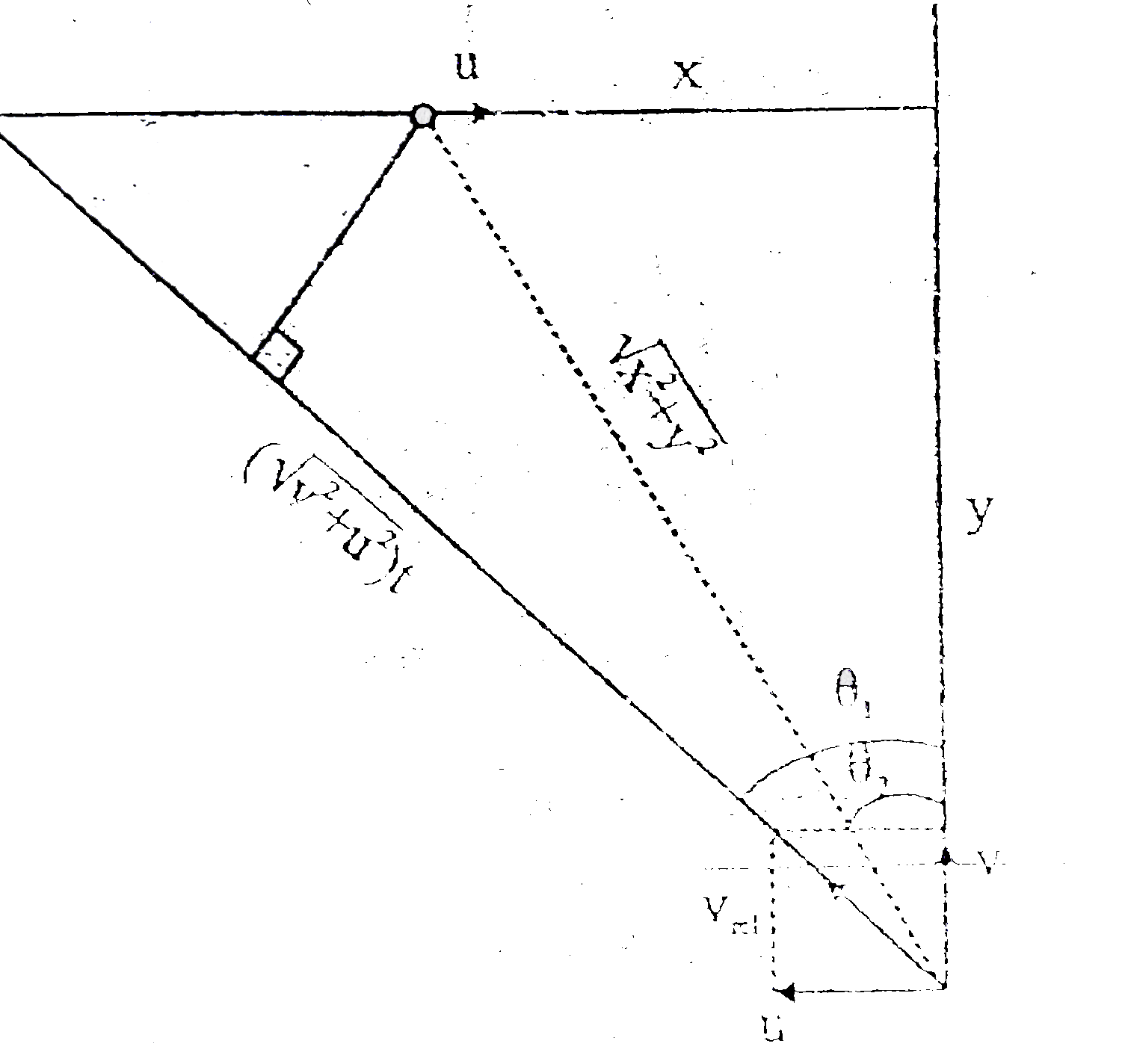
C


`sqrt(x^(2)+y^(2))cos(theta_(1)-theta_(2))=(sqrt(v^(2)+u^(2)))t`
`rArrt=(sqrt(x^(2)+y^(2)))/(sqrt(v^(2)+u^(2)))[(vy+ux)/(sqrt(x^(2)+y^(2'))sqrt(v^(2)+u^(2)))]=(ux+vy)/(u^(2)+v^(2))`
Promotional Banner

Topper's Solved these Questions

Similar Questions

Explore conceptually related problems

A particle is projected with velocity v_(0) along x - axis. The deceleration on the particle is proportional to the square of the distance from the origin i.e. a=-x^(2) . The distance at which particle stops is -

There is one tower of height h. one particle A is projected upward from top of the tower with a speed u_(1) at time t=0 . At time t= t_(0) another particle B is projected upward from the bottom of the tower with a speed u_(2) . When will the particles cross each other?

A particle executes SHM along x-axis with an amplitude A, time period T with origin as the mean position. At t = 0, if the particle starts in the +ve x-direction from the origin the minimum time in which it will be at x=-A//2 will be

A particle is projected with velocity V_(0) along axis x . The deceleration on the particle is proportional to the square of the distance from the origin i.e., a=omegax^(2). distance at which the particle stops is

The acceleration of a particle is increasing linearly with time t as bt .The particle starts from the origin with an initial velocity v_(0) The distance travelled by the particle in time t will be

The acceleration of a particle is increasing linearly with time t as bt. The particle starts from the origin with an initial velocity v_0 . The distance travelled by the particle in time t will be

The acceleration of particle is increasing linearly with time t as bt . The particle starts from the origin with an initial velocity v_0 . The distance travelled by the particle in time t will be.

A particle constrained to move along the x-axis in a potential V=k"x"^(2) is subjected to an external time dependent force vec(f)(t) here k is a constant, x the distance from the origin, and t the time. At some time T, when the particle has zero velocity at x = 0, the external force is removed. Choose the incorrect options – (1) Particle executes SHM (2) Particle moves along +x direction (3) Particle moves along – x direction (4) Particle remains at rest

A point particle travels in a straight line at constant speed. The closest it comes to the origin of coordinatesisa distance l With respect to this origin, does the particle have nonzero angular momentum ? As the particle moves along its straight line path, does its angular momentum with respect to origin change.

ALLEN-TEST PAPER-Exercise (Physics)
  1. A projectile takes off with an initial velocity of 50m//s at an angle ...

    Text Solution

    |

  2. A ball is thrown from the top of a 60m high tower with velocity 20sqrt...

    Text Solution

    |

  3. Two particle are moing along X and Y axes towards the origin with cons...

    Text Solution

    |

  4. If system is in equilibrium then find relation between m(1) and m(2)

    Text Solution

    |

  5. The childern are trying to shoot a marble into a marble into a small b...

    Text Solution

    |

  6. A bead slides on a frictoinless strainght rod fixed between points A a...

    Text Solution

    |

  7. The hour hand of a clock is 6 cm long. The magnitude of the displaceme...

    Text Solution

    |

  8. A particle (bob) of mass 1 kg is performing vertical cicular motion. T...

    Text Solution

    |

  9. In case of an ideal spring, we take the reference point (where potenti...

    Text Solution

    |

  10. A machinist starts with three identical square plates but cuts one cor...

    Text Solution

    |

  11. A block of mass m lies on a horizontal frictionless surface and is att...

    Text Solution

    |

  12. Two pucks are initially moving along a frictionless surface as shown i...

    Text Solution

    |

  13. Three particles with equal mass move with equal speed v along the medi...

    Text Solution

    |

  14. A canon shell moving along a straight line bursts into two parts. Just...

    Text Solution

    |

  15. Assertion :- velocity time graph of two paticles undergoing head-on co...

    Text Solution

    |

  16. Statement-1 : For any collision, coefficient of restitution (e0 lies ...

    Text Solution

    |

  17. Assertion :- To observe the motion of planets, the sun may be assumed ...

    Text Solution

    |

  18. Assertion :- The mechanical energy of earth-moon system remains same w...

    Text Solution

    |

  19. The average velocity of a particle moving on a straight line is zero i...

    Text Solution

    |

  20. Assertion:- A body may gain kinetic energy and potential energy simult...

    Text Solution

    |

