Home
Class 12
CHEMISTRY
In a photoelectric experiment, kinetic e...

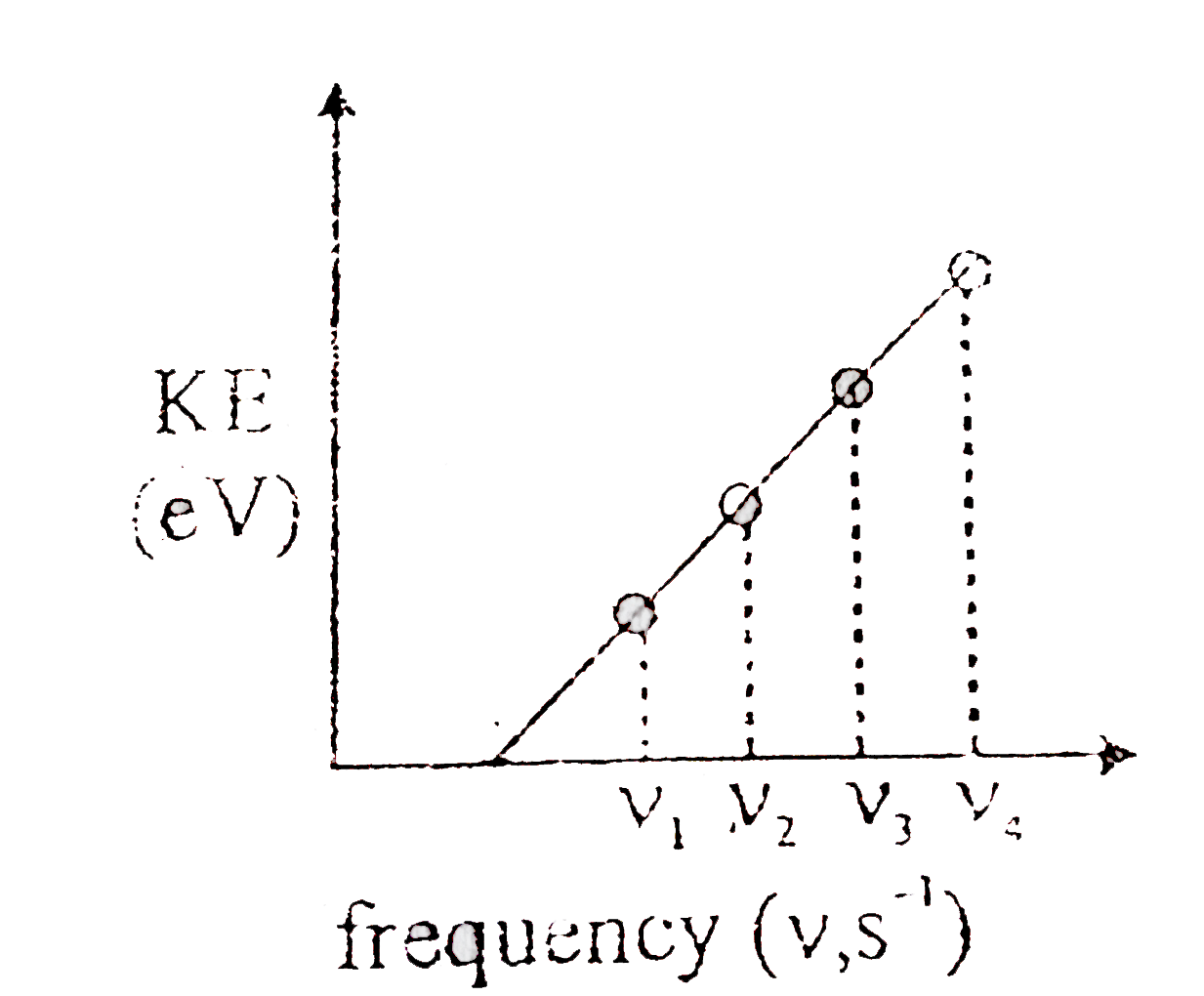
In a photoelectric experiment, kinetic energy of photoelectrons was plotted against the frequency of incident radition `(v)`, as show in figure. Which of the following statements is correct ?

A

The thershold frequency is `v_(1)`.

B

The slope of this line is equal to Plank's constant

C

As the frequency of incident wavelength in creases beyond thrshold frequency Kinetic energy of photoelectrons decreases

D

It is impossible to obtain such a graph.

Text Solution

Verified by Experts

The correct Answer is:

B

`K.E.=hv-hv_(0)`
y=mx-C
Slope = h
Promotional Banner

Similar Questions

Explore conceptually related problems

How does kinetic energy of ejected photoelectrons depend upon the frequency of incident radiation?

Maximum kinetic energy (E_(k)) of a photoelectron varies with the frequency (v) of the incident radiation as

The kinetic energy (E_(k)) of a photoelectron varies with the frequency (v) of the incident radiation as which of the following graph ?

For the photoelectric effect, the maximum kinetic energy E_(k) of the emitted photoelectrons is plotted against the frequency ν of the incident photons as shown in the figure. The slope of the curve gives

According to Einstein's photoelectric equation , the graph between the kinetic energy of photoelectrons ejected and the frequency of incident radiation is

According to Einstein's photoelectric equation, the graph between kinetic energy of photoelectrons ejected and the frequency of the incident radiation is :

The intensity of X-rays firom a coollidge tube is plotted against wavelength lambda as shown in the figure-3.12. Which ofthe following statements is/are correct:

The maximu kinetic energy (E_(k)) of the photoelectron varies with frequency (v) of the incident light as shown by the curve:

In a photoelectric experiment, a student plotted the graph of stopping potential (Vs) against the frequency of incident radiation (v). But he could not write the unit of the slope of the graph. What is the corrent unit ?
