(a) Velocity of a boat on still water is its capacity to move on water surface and aquals to its velocity relative to water.
`vec(v)_(b//w)=` Velocity of boat relative to water = Velocity of boat on still water
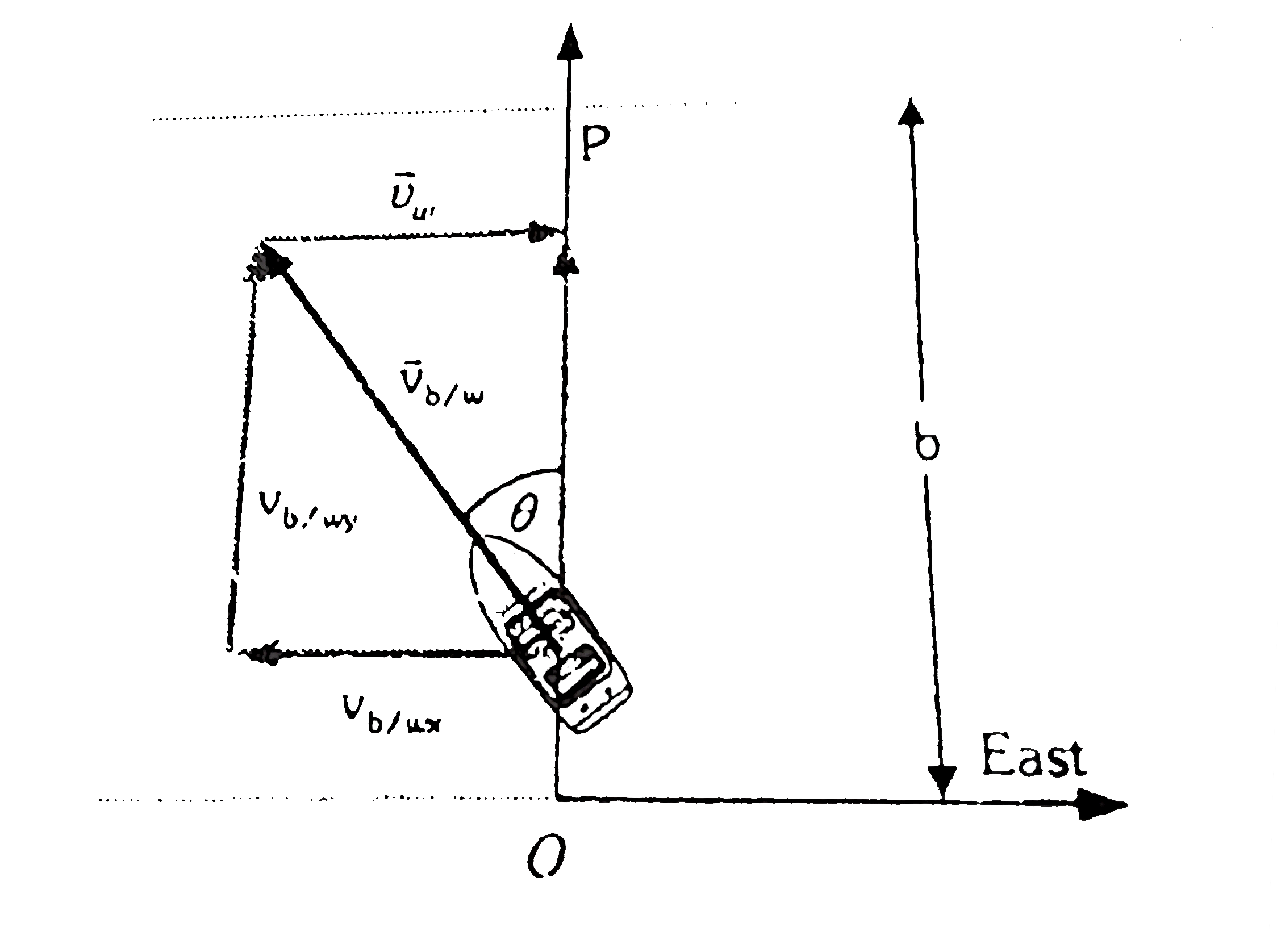
On flowing water, the water carries the boat along with it. Thus velocity `vec(v)_(b)` of the boat relative to the ground equals to vector sum of `vec(v)_(b//w)` and `vec(v)_(w)`. The boat crosses the river with the velocity `vec(v)_(b)`.
`vec(v)_(b)=vec(v)_(b//w)+vec(v)_(w)`
(b) To cross the river perpendicular to current the boat must be steered in a direction so that one of the components of its velocity `(vec(v)_(b//w))` relative to water becomes equal and opposite to water flow velocity `vec(v)_(w)` to neutralize its effect. It is possible only when velocity of boat relative to water is greater than water flow velocity. In the adjoining figure it is shown that the boat starts from the point O and moves along the line OP (y-axis) due north relative to ground with velocity `vec(v)_(b)`. To achieve this it is steered at an anglr `theta` with the y-axis.
`v_(b//w) sin theta=v_(w) rarr 5 sin theta=3 rArr theta=37^(@)`
(c) The boat will cover river width b with velocity
`v_(b)=v_(b//wy)=v_(b//w) sin 37^(@)=4 m//s` in time t, which is given by
`t=b//v_(b) rarr t=50 s`
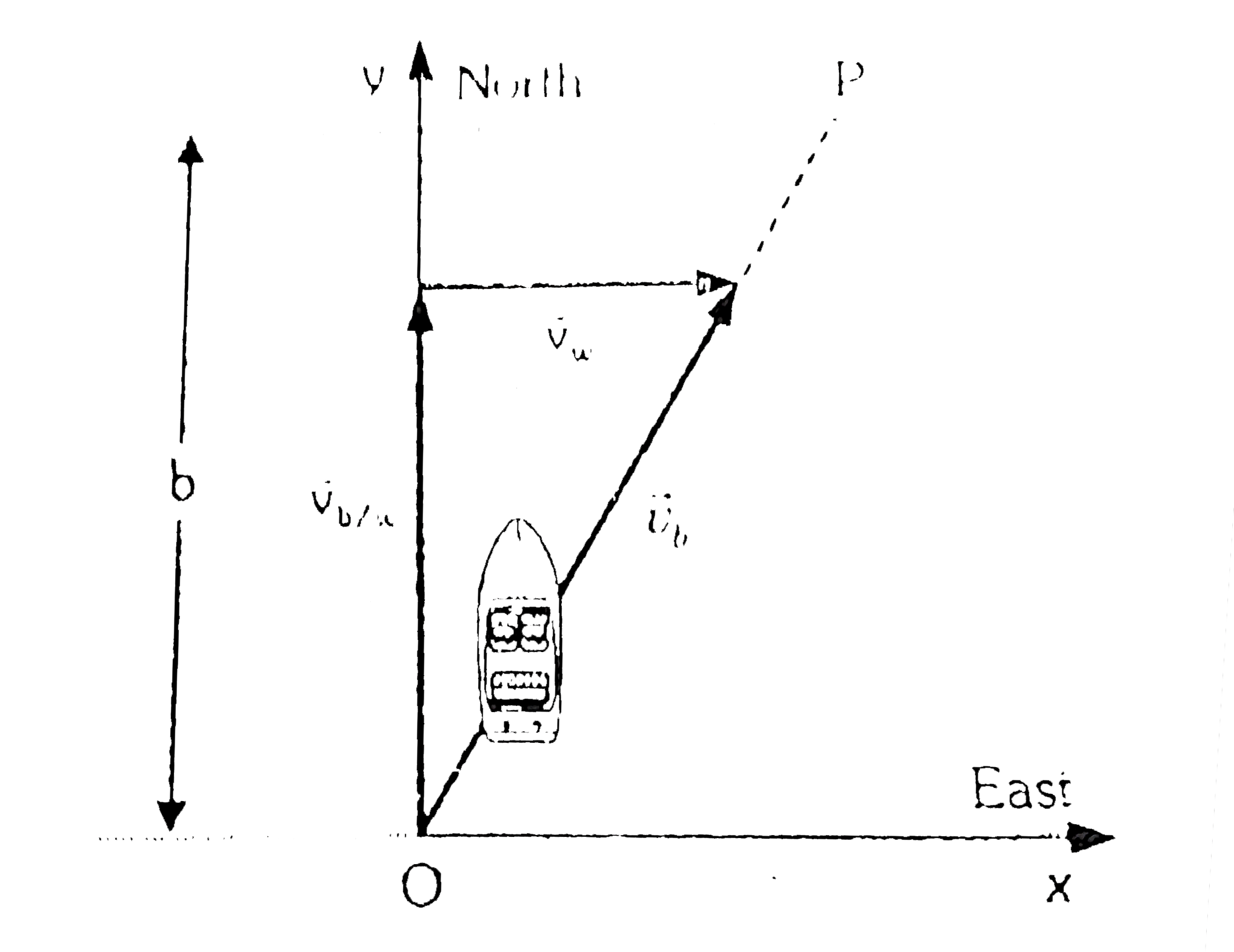
(d) To cross the river in minimum time, the component perpendicular to current of its velocity relative to ground must be kept to maximum value. It is achieved by steering the boat always perpendicular to current as shown in the adjoining figure. The boat starts from O at the south bank and reaches point P on the north bank. Time t taken by the boat is given by
`t=b//v_(b//w) rarr t=40 s`
Drift is the displacement along the river current measured from the starting point. Thus, it is given by the following equation. We denote it by `x_(d)`.
`x_(d)=v_(bx)t`
Substituting `v_(bx)=v_(w)=3 m//s`, from the figure, we have `x_(d)=120 m`


