

Home
Class 11
PHYSICS
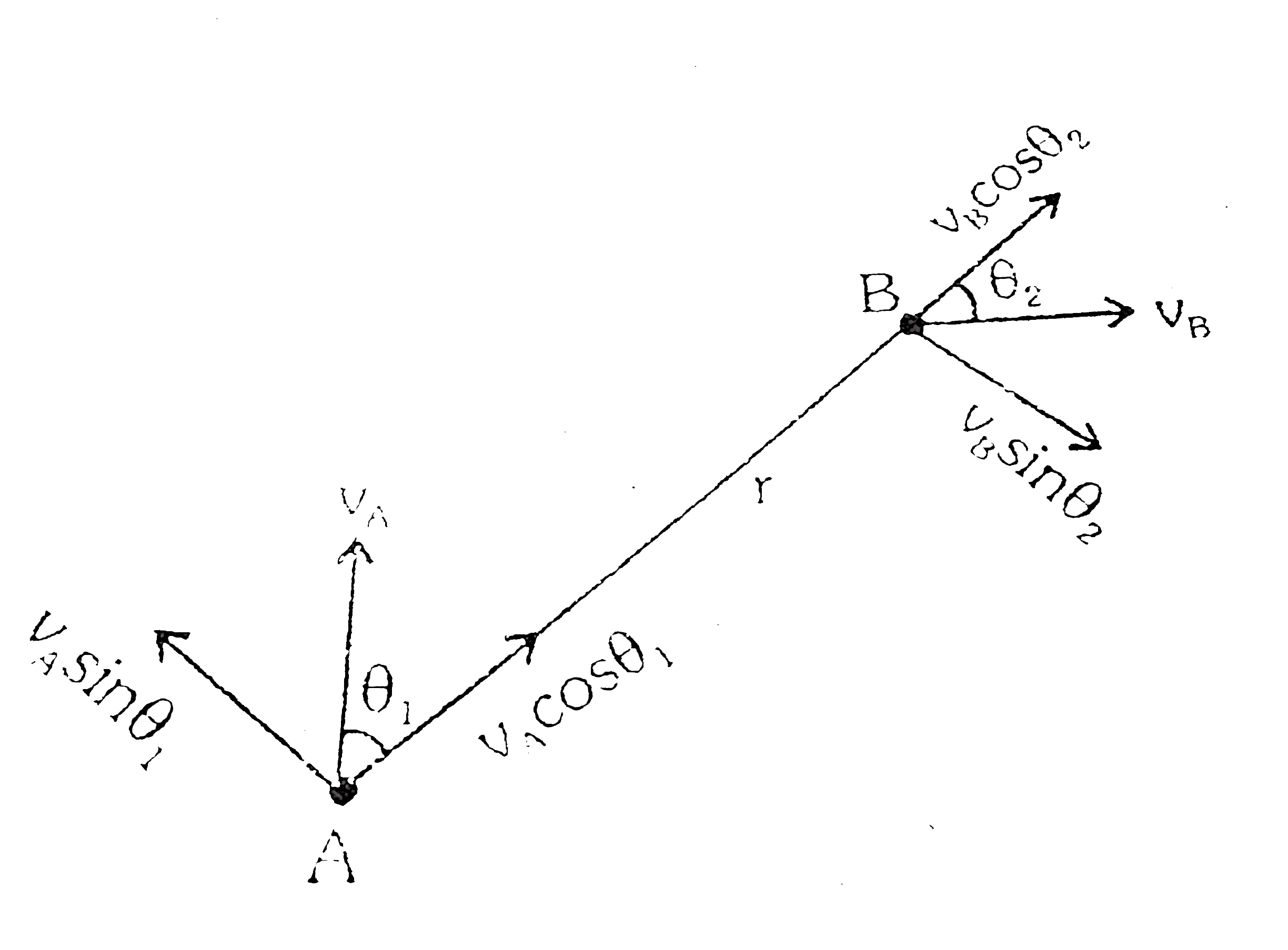
omega(AB)=("Relative velocity of A w.r.t...

`omega_(AB)=("Relative velocity of A w.r.t. B perpendicular to line AB")/("Sepration between a and B")`
`|(vec(v)_(AB))_(bot)|=v_(A) sin theta_(1)+v_(B) sin theta_(2)`
`r_(AB)=r`
`omega_(AB)=(v_(A) sin theta_(1)+v_(B) sin theta_(2))/(r)`
`(v_(AB))_(11)=v_(A) cos theta_(1)-v_(B) cos theta_(2)`
`(v_(AB))_(11) gt 0." "` Then A will approach B
`(v_(AB))_(11) lt 0. " "` Then B will separate from A

Promotional Banner

Topper's Solved these Questions

  • KINEMATICS

    ALLEN|Exercise EXERCISE-01|55 Videos
  • KINEMATICS

    ALLEN|Exercise EXERCISE-02|57 Videos
  • ERROR AND MEASUREMENT

    ALLEN|Exercise Part-2(Exercise-2)(B)|22 Videos
  • KINEMATICS (MOTION ALONG A STRAIGHT LINE AND MOTION IN A PLANE)

    ALLEN|Exercise BEGINNER S BOX-7|8 Videos

Similar Questions

Explore conceptually related problems

Two particles of equal mass in are projected from the ground with speeds v_(1) and v_(2) at angles theta_(1) , and theta_(2) as shown in the figure. Given theta_(2)gttheta_(1) and v_(1)costheta_(1)=v_(2)costheta_(2) Which statement/s is/are correct?

Two masses A and B are connected with two an inextesible string to write constraint relation between v_(A) & v_(B) Student A : v_(A) cos theta=v_(B) Student B : v_(B) cos theta=v_(A)

If (a^(2)-b^(2))sin theta+2ab cos theta=a^(2)+b^(2)tan theta=?

If u_(n)=sin(n theta)sec^(n)theta,v_(n)=cos(n theta)sec^(n)thetan in Nn!=1 then (v_(n)-v_(n-1))/(u_(n-1))+(1)/(n)((u_(n))/(v_(n)))=

int_ (0) ^ ((pi) / (2)) sin theta cos theta (a ^ (2) sin ^ (2) theta + b ^ (2) cos ^ (2) theta) ^ ((1) / ( 2)) d theta = ((1) / (3)) ((a ^ (2) + ab + b ^ (2)) / (a + b))

If ((a+b)^(2))/(4ab)=sin^(2)theta, then

Let A={ theta in R|cos^(2) (sin theta)+sin^(2) (cos theta)=1} and B={ theta in R| cos (sin theta) sin (cos theta)=0} . Then A nn B

If u_(n)=sin(n theta)sec^(n)theta,v_(n)=cos(n theta)sec^(n)thetan in N,n!=1, then (v_(n)-v_(n-1))/(v_(n-1))+(1)/(n)((u_(n))/(v_(n)))

A=[(cos theta, -sin theta),(sin theta, cos theta)] and AB=BA=l , then B is equal to