Home
Class 11
PHYSICS
A particle moves with a tangential accel...

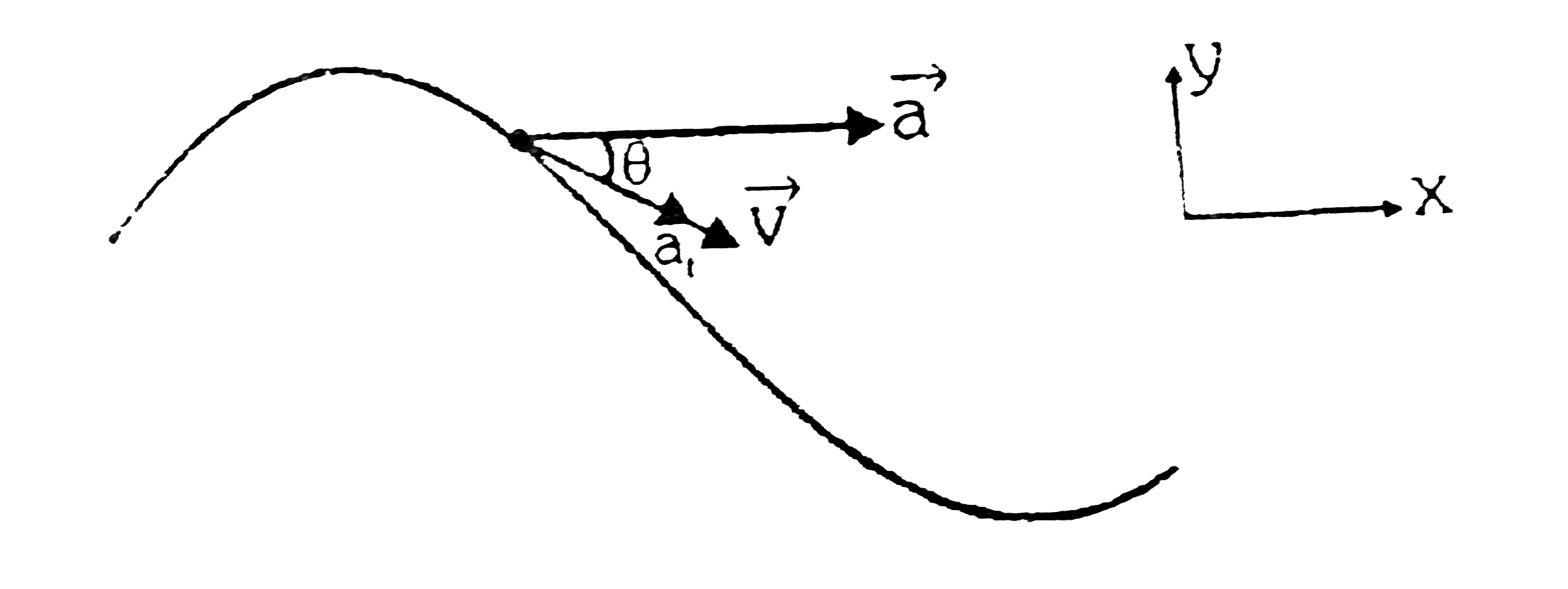
A particle moves with a tangential acceleration `a_(t)=vec(a).hat(v)` where `vec(a)=(5hat(i)) m//s^(2)`. If the speed of the particle is zero at `x=0`, then find v (in `m//s`) at `x=4.9 m`.

Text Solution

Verified by Experts

The correct Answer is:

7

As `dvd=vec(a).vec(d)r=adx=5dxrArr int_(0)^(v)vdv=5 int_(0)^(4.9)dxrArr v^(2)/2=5(4.9)rArr v^(2)=49rArrv=7 m//s`
Promotional Banner

Topper's Solved these Questions

  • KINEMATICS

    ALLEN|Exercise EXERCISE-01|55 Videos
  • KINEMATICS

    ALLEN|Exercise EXERCISE-02|57 Videos
  • ERROR AND MEASUREMENT

    ALLEN|Exercise Part-2(Exercise-2)(B)|22 Videos
  • KINEMATICS (MOTION ALONG A STRAIGHT LINE AND MOTION IN A PLANE)

    ALLEN|Exercise BEGINNER S BOX-7|8 Videos

Similar Questions

Explore conceptually related problems

A particle moves in the x-y plane under acceleration vec(a) = 3hat(i) + 4hat(j) m//s^(2) . If the initial velocities is vec(u) = 6hat(i) + 8hat(j) m//s . Find the velocity and the position vector of a particle after 2 s .

A particle has initial velocity vec(v)=3hat(i)+4hat(j) and a constant force vec(F)=4hat(i)-3hat(j) acts on the particle. The path of the particle is :

A particle starts moving with velocity "vecV=hat i(m/s)", and acceleration "vec a=(hat i+hat j)(m/s^(2))".Find the radius of curvature of the particle at "t=1sec".

A particle is moving with a constant acceleration vec(a) = hat(i) - 2 hat(j) m//s^(2) and instantaneous velocity vec(v) = hat(i) + 2 hat(j) + 2 hat(k) m//s then rate of change of speed of particle 1 second after this instant will be :

Two particles of equal masses have velocities vec v_1 = 4 hat i and vec v_2 = 4 hat j . First particle has an acceleration vec a_1 = (5 hat i + 5 hat j) ms^(-2) while the acceleration of the other particle is zero. The centre of mass of the two particles moves in a path of

Two particles of equal mass have velocities vec v_1 = 2 hat i= m//s^-1 and vec v_2 = 2hat j m//s^-1 . First particle has an acceleration vec a_1= (3 hat i+ 3 hat j) ms^-2 while the acceleration of the other particle is zero. The centre of mass of the two particles moves in a path of.

Velocity of a particle at some instant is v=(3hat i + 4hat j + 5hat k) m//s . Find speed of the particle at this instant.

A particle travels so that its acceleration is given by vec(a)=5 cos t hat(i)-3 sin t hat(j) . If the particle is located at (-3, 2) at time t=0 and is moving with a velocity given by (-3hat(i)+2hat(j)) . Find (i) The velocity [vec(v)=int vec(a).dt] at time t and (ii) The position vector [vec(r)=int vec(v).dt] of the particle at time t (t gt 0) .

A particle has initial velocity of (3hat(i)+4hat(j)) m//s and a acceleration of (4hat(i)-3hat(j)) m//s^(2) . Its speed after one second will be equal to :-
