

Home
Class 11
PHYSICS
A disk with moment of inertia I1 rotates...

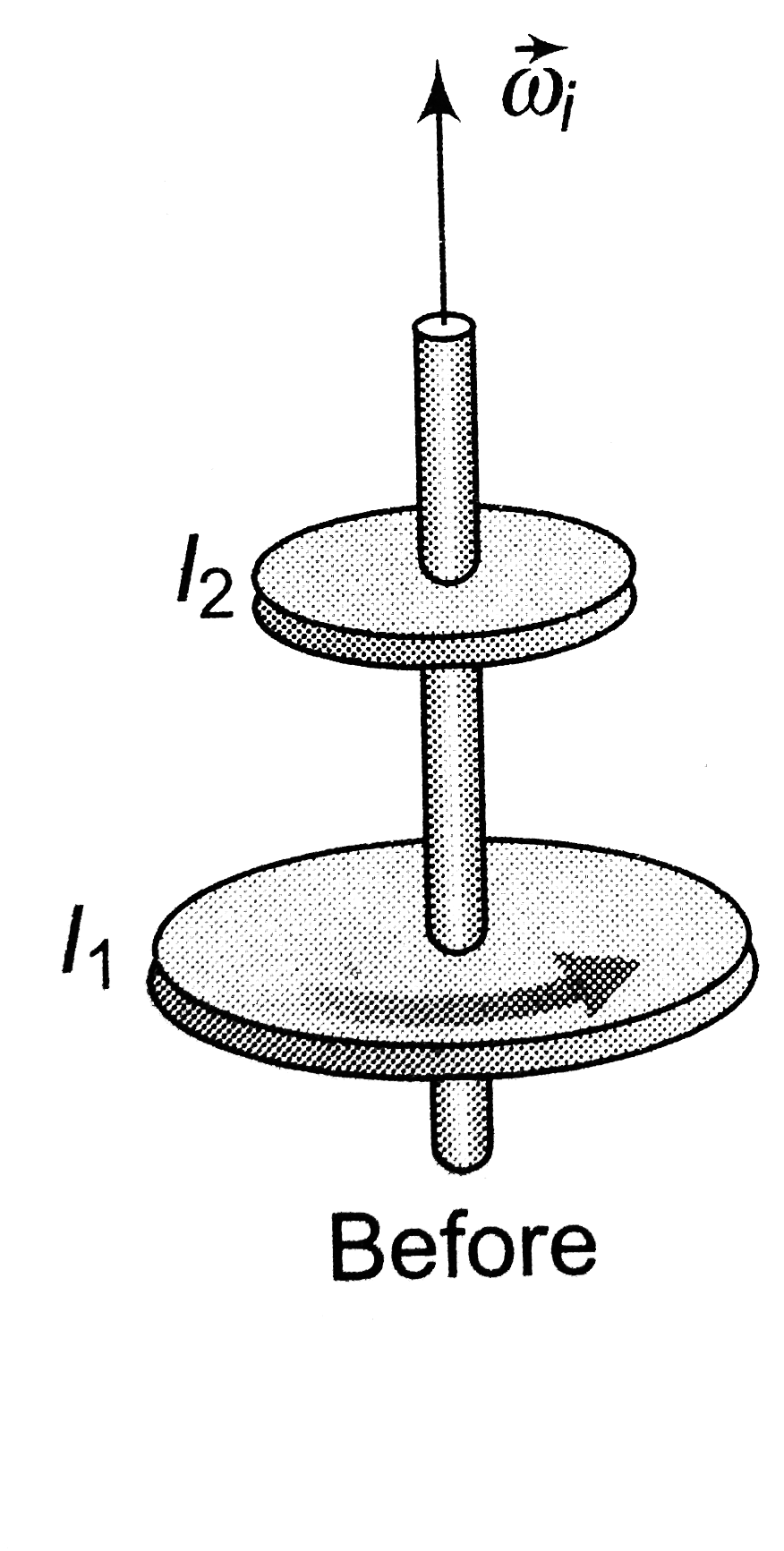
A disk with moment of inertia `I_1` rotates about frictionless, vertical axle with angular speed `omega_i` A second disk, this one having moment of inertia `I_2` and initial not rotating, drops onto the first disk (Fig.) Because of friction between the surfaces, the two eventually reach the same angular speed `omega_f`. The value of `omega_f` is.
.

Promotional Banner

Similar Questions

Explore conceptually related problems

A wheel of moment of inertia I_(1) rotates about a vertical frictionless axle with an angular velocity omega_(1) . A second wheel of moment of inertia I_2 and initially at rest drops onto the first wheel. The two wheels attain a common angular velocity of omega_(2) . (a) What is the value of omega_(2) ? (b) What is the ratio of the initial to the final rotational energy ?

A circular disk of moment of inertia I_t is rotating in a horizontal plane, about its symmetry axis,with a constant angular, speed omega_1 Another disk of moment of inertia I_b is dropped coaxially onto the rotating disk initially the second disk has zero angular speed.Eventually both the disks rotate with a constant angular speed omega_f The energy lost by the initially rotating disc to friction is :

A disc of moment of inertia I_(1) is rotating freely with angular speed omega_(1) when another non-rotating disc of moment of inertia I_(2) is dropped on it. The two discs then rotate as one unit. Find the final angular speed.

A circular disc of moment of inertia I_(1) is rotating in a horizontal plane, about its symmetry axis, with a constant angular speed omega_(1) . Another disc of moment of inertia I_(2) is placed coaxially on the rotating disc. Initially the second disc has zero angular speed. Eventually both the discs rotate with a constant angular speed omega_(2) . The energy lost by the initially rotating disc to friction is ............

A disc with moment of inertia I is rotating with some angular speed. Second disc is initially at rest. Now second disc with moment of inertia 3I is placed on first disc and starts rotating. Find loss of kinetic energy in fraction

A circular disc of moment of inertia I_(t) is rotating in a horizontal plane about its symmetry axis with a constant angular velocity omega_(i) . Another disc of moment of inertia I_(b) is dropped co-axially onto the rotating disc. Initially, the second disc has zero angular speed. Eventually, both the discs rotate with a constant angular speed omega_(f) . Calculate the energy lost by the initially rotating disc due to friction.

A circular disc of moment of inertia I_(t) is rotating in a horizontal plane about its symmetry axis with a constant angular velocity omega_(i) . Another disc of moment of inertia I_(b) is dropped co-axially onto the rotating disc. Initially, the second disc has zero angular speed. Eventually, both the discs rotate with a constant angular speed omega_(f) . Calculate the energy lost by the initially rotating disc due to friction.