

Home
Class 12
PHYSICS
Lower plate of a parallel plate capacito...

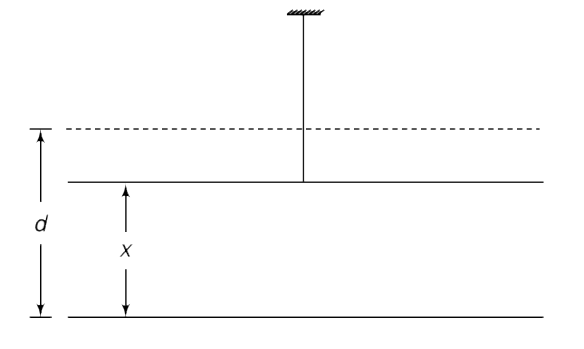
Lower plate of a parallel plate capacitor is fixed on a horizontal insulating surface. The upper plate is suspended above it using on elastic cord of force constant K. The upper plate has negligible mass and area of each plate is A. When there is no charge on the plates the equilibrium separation between them is d. When a potential difference = V is applied between the plates the equilibrium separation changes to x.
(a) Calculate V as a function of x.
(b) Find the value of x for which V is maximum. Calculate the maximum value of `V (= V_(max))`
(c) What will happen if `V gt V_(max)` ?
(d) Plot a rough graph showing variation of equilibrium separation (x) with V

Promotional Banner

Similar Questions

Explore conceptually related problems

A parallel plate air capacitor has capcity C distance of separtion between plates is d and potential difference V is applied between the plates force of attraction between the plates of the parallel plate air capacitor is

A parallel plate air capacitor has capcity C distance of separtion between plates is d and potential difference V is applied between the plates force of attraction between the plates of the parallel plate air capacitor is

A parallel plate air capacitor has capacity 'C' distance of separation between plates is 'd' and potential difference 'V' is applied between the plates force of attraction between the plates of the parallel plate air capacitor is :

A parallel plate air capacitor has capacity 'C' distance of separation between plates is ‘d’ and potential difference 'V' is applied between the plates. Force of attraction between the plates of the parallel plate air capacitor is

The force between the plates of a parallel plate capacitor of capacitance C and distance of separation of the plates d with a potential difference V between the plates, is.

The force between the plates of a parallel plate capacitor of capacitance C and distance of separation of the plates d with a potential difference V between the plates, is.

The lower plate of a parallel plate capacitor is fixed on an insulating plane as shown in figure. The upper plate is suspended from one end of a balance. Initially the capacitor is uncharged and balance is in equilibrium state. A voltage V is applied between the plates, what additional weight should be placed to maintain the balance? Consider the separation between the plates to be d and the area of each plate is A .