Home
Class 12
PHYSICS
A source of laser (S), a receiver (R) an...

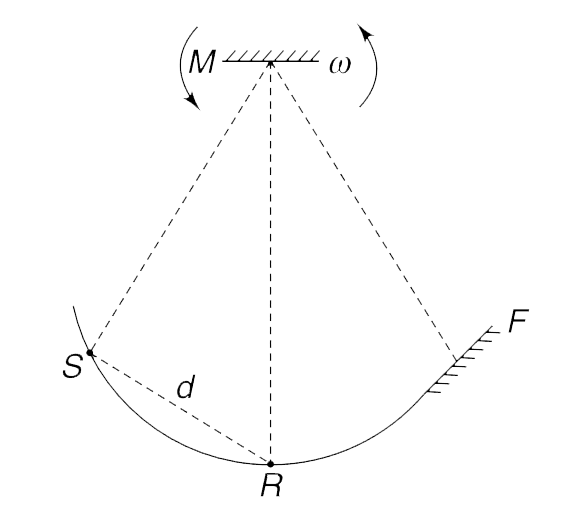
A source of laser (S), a receiver (R) and a fixed mir- ror (F) – all lie on an arc of a circle of radius `R = 0.5 km`. The distance between the source and the receiver is `d = 0.5 m`. At the centre of the circle there is a small mirror M which is rotating with angular speed `omega` (see figure). Find smallest value of `omega` is if it is seen that the source shoots a laser pulse which gets reflected at M, then gets reflected at F and finally gets reflected at M to be received by the receiver.

Text Solution

Verified by Experts

The correct Answer is:

`150 rad s^(-1)`
Promotional Banner

Topper's Solved these Questions

  • GEOMETRICAL OPTICS

    ARIHANT|Exercise Level 2|62 Videos
  • GEOMETRICAL OPTICS

    ARIHANT|Exercise Level 3|9 Videos
  • ELECTROSTATICS

    ARIHANT|Exercise Level 3|59 Videos
  • MAGNETIC EFFECT OF CURRENT

    ARIHANT|Exercise Magnetic effect of Current|45 Videos

Similar Questions

Explore conceptually related problems

A bead of mass m stays at point P (a,b) on a wire bent in the shape of a parabola y =4 Cx^(2) and rotating with angular speed omega (see figure ) . The value of omega is (neglect friction),

R and r are the radius of two circles (R gt r) . If the distance between the centre of the two circles be d , then length of common tangent of two circles is

Find the angular momentum of a particle of mass m describing a circle of radius r with angular speed omega .

A helium nucleus makes full rotation in a circle of radius 0.8 m in 2.5 seconds. The value of magnetic field B at the centre of the circle will be

A disc of mass m and radius R rotating with angular speed omega_(0) is placed on a rough surface (co-officient of friction =mu ). Then

A particle moves along a circle of radius R with a constant angular speed omega . Its displacement (only magnitude) in time t will be

A particle moves along a circle of radius R with a constant angular speed omega . Its displacement (only magnitude) in time t will be

A wheel of moment of inertial I and radius R is rotating about its axis at an angular speed omega . It picks up a stationary particle of mass m at its edge. Find the new angular speed of the wheel.

A circular disc of mass M and radius R is rotating with angular velocity omega . If two small spheres each of mass m are gently attached to two diametrically opposite points on the edge of the disc, then the new angular velocity of the disc will be
