Home
Class 12
PHYSICS
A glass cube is cut symmetrically into t...

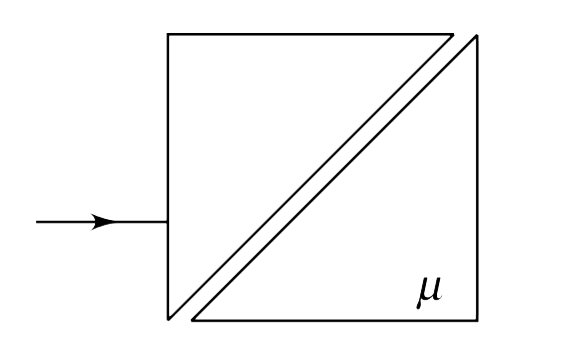
A glass cube is cut symmetrically into two halves and the two parts are kept at a small separation between them. Calculate the angular deviation suffered by a light ray incident normally on one of the faces of the cube.

Text Solution

Verified by Experts

The correct Answer is:

Zero
Promotional Banner

Topper's Solved these Questions

  • GEOMETRICAL OPTICS

    ARIHANT|Exercise Level 2|62 Videos
  • GEOMETRICAL OPTICS

    ARIHANT|Exercise Level 3|9 Videos
  • ELECTROSTATICS

    ARIHANT|Exercise Level 3|59 Videos
  • MAGNETIC EFFECT OF CURRENT

    ARIHANT|Exercise Magnetic effect of Current|45 Videos

Similar Questions

Explore conceptually related problems

If two prisms are combined , as shown in figure, find the total angular dispersion and angle of deviation suffered by a white ray of light incident on the combination.

An equilateral glass prism (mu - 1.6) is immersed in water (mu = 1.33) . Calculate the angle of deviation produced for a ray of light incident at 40^@ on one face of the prism.

Refractive index of a glass cube is sqrt(2) . A ray of light is incident on left face of the cube as shown. Right face of a glass cube is silvered. If the total deviation suffered by the ray when it comes out of the glass cube is 45n (in degree) then find n :

A ray of light travelling in air is incident on a composite transparent slab at an angle of incidence i = 45° . The composite slab consist of 100 parallel faced slices of equal thickness. The refractive index of the n^(th) slice (counting from the one on which light is incident) is given by mu_(n) = 1.0 + 0.01n . The medium on the other side of the slab has refractive index of sqrt(2) . Calculate the angular deviation suffered by the ray as it comes out of the slab.

State using a neat diagram, what happens to the path of light when light ray is incident normally at the boundary between two media.

An equilateral glass prism of refractive index 1.5 is immersed in water. Find the angle of deviation produced when a ray of light is incident at 42^(@) on one face of the prism. (Refractive index of water = 1.33)

An isosceles glass prism with base angles 40^(@) is champed over a tray of water in a position such that the base is just dipped in water. A ray of light incident normally on the inclined face suffers total internal reflection at the base. If the refractive index of water is 1.33 then the condition imposed on the refractive index mu of the glass is -

(a) Deduce the expression, by drawing a suitable ray diagram, for the refractive index of a triangular glass prisms in terms of the angle of minimum deviation (D) and the angle of prism (A). Draw a plot showing the variation of the angle of deviation with the angle of incidence. (b) Calculate the value of the angle of incidence when a ray of light incident on one face of an equilateral glass prism produces the emergent ray, which just grazes along the adjacent face. Refractive index of prism is sqrt2

Two pieces of glass plate one upon the other with a little water between them cannot be separated easily because of
