Home
Class 12
PHYSICS
A glass slab is placed between an object...

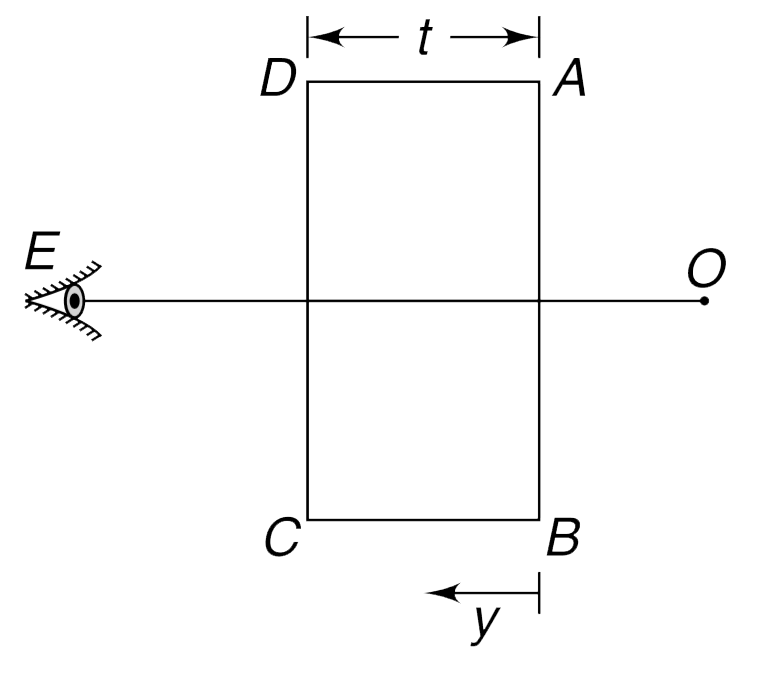
A glass slab is placed between an object (O) and an observer (E) with its refracting surfaces AB and CD perpendicular to the line OE. The refractive index of the glass slab changes with distance (y) from the face AB as `mu = mu_(0) (1 + y)`. Thickness of the slab is t. Find how much closer (compared to original distance) the object appears to the observer. Consider near normal incidence only.

Text Solution

Verified by Experts

The correct Answer is:

`t - (1)/(mu_(0)) ln (1+t)`
Promotional Banner

Topper's Solved these Questions

  • GEOMETRICAL OPTICS

    ARIHANT|Exercise Level 2|62 Videos
  • GEOMETRICAL OPTICS

    ARIHANT|Exercise Level 3|9 Videos
  • ELECTROSTATICS

    ARIHANT|Exercise Level 3|59 Videos
  • MAGNETIC EFFECT OF CURRENT

    ARIHANT|Exercise Magnetic effect of Current|45 Videos

Similar Questions

Explore conceptually related problems

If t is the real thickness mu is refractive index of a glass slab then the shift of the image with refernce to the object is given by

When a glass slab is placed on a dot on a paper.It apperas displaced by 4 cm viewed normally.What is the thickness of slab if the refractive index 1.5 .

A point object (A) is kept at a distance (L) from a convex mirror on its principal axis. A glass slab is inserted between the object and the mirror with its refracting surfaces perpendicular to the principal axis of the mirror. The thickness of the slab is 6 cm and its refractive index is (3)/(2) . The image formed after refraction through the slab, reflection from the mirror followed by refraction through the slab is a virtual image at a distance of 10 cm from the pole of the mirror (on its principal axis). Consider paraxial rays only and calculate the distance (L) of the object from the mirror. Focal length of the mirror is f = 20 cm .

A point object O is placed at a distance of 41 cm from a convex lens of focal length f = 20 cm on its principal axis. A glass slab of thickness 3 cm and refractive index mu = 1.5 is placed between the lens and the object with its faces perpendicular to the principal axis of the lens. Image of the object is formed at point I_(1) . Now the glass slab is tilted by an angle of theta = 1° (as shown in the Figure) and the final image is formed at I_(2) . Calculate the distance between points I_(1) and I_(2) . Consider only paraxial rays for the lens and near normal incidence for the glass slab.

An object 240 cm in front of a lens forms a sharp image on a screen 12 cm behind the lens. A glass slab 1 cm thick, having refractive index 1.50 is placed between the lens and the screen with its refracting faces perpendicular to the principal axis of the lens. (a) By how much distance the object must be moved so as to again cast a sharp image on the screen? (b) Another identical glass slab is interposed between the object and the lens. How much further the object shall be moved so as to form a sharp image on the screen.

Find the apparent depth of object O below surface AB , seen by an observer in mediumn of refractive index mu_(2)

A ray of light is incident on a glass slab at an angle of 45^(@) . If refractive index of glass be 1.6, what is the angle of refraction ?

A ray of light is incident on a glass slab of thickness t, at an angle i,r is the angle of refraction in the glass slab. Distance travelled in the glass slab is
