Home
Class 12
PHYSICS
OP is the principal axis of a concave mi...

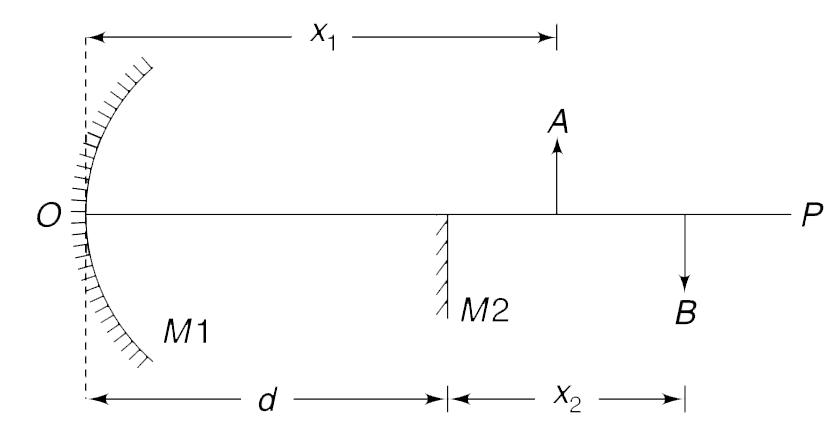
OP is the principal axis of a concave mirror M1. Just below the axis a plane mirror M2 is placed at a distance d from the concave mirror. Two small pins A and B are placed on the principal axis as shown. By moving M2 and changing d, the virtual image of A formed in mirror M1 and the virtual image of B formed in mirror M2 were made to coincide.
(a) Calculate the focal length of the concave mirror if it was found that the images coincide when separation between the mirrors was `d_(0)`.
(b) Can the two virtual images be observed by the eye simultaneously?

Text Solution

Verified by Experts

The correct Answer is:

(a) `|f| = ((x_(2) -d_(0))x_(1))/(x_(2) - (d_(0)+x_(1)))` (b) No.
Promotional Banner

Topper's Solved these Questions

  • GEOMETRICAL OPTICS

    ARIHANT|Exercise Level 3|9 Videos
  • GEOMETRICAL OPTICS

    ARIHANT|Exercise Level 3|9 Videos
  • ELECTROSTATICS

    ARIHANT|Exercise Level 3|59 Videos
  • MAGNETIC EFFECT OF CURRENT

    ARIHANT|Exercise Magnetic effect of Current|45 Videos

Similar Questions

Explore conceptually related problems

Is the virtual image formed by a concave mirror always magnified ?

When does a concave mirror form a virtual image ?

A plane mirror is placed at a distance of 50 cm from a concave mirror of focal length 16 cm. Where should a short object be placed between the mirrors and facing both the mirrors so that its virtual image in the plane mirror coincides with the real image in concave mirror? What is the ratio of the sizes of the two images?

An object is placed at a distance of 30 cm from a concave mirror and its real image is formed at a distance of 30 cm from the mirror. The focal length of the mirror is

The image formed by a spherical mirror is virtual. The mirror will be.

A particle is moving at a constant speed V from a large distance towards a concave mirror of radius R along its principal axis. Find the speed of the image formed by the mirror as a function of the distance x of the particle from the mirror.

Can a concave mirror form a virtual image of same size as the object?

ARIHANT-GEOMETRICAL OPTICS-Level 2
  1. Two plane mirrors M1 and M2 are inclined at 30° to the vertical. A poi...

    Text Solution

    |

  2. The distance between the eye and the feet of a boy is 1.5 m. He is sta...

    Text Solution

    |

  3. OP is the principal axis of a concave mirror M1. Just below the axis a...

    Text Solution

    |

  4. A real object AB has its image as IM when placed in front of a spheric...

    Text Solution

    |

  5. Two spherical concave mirrors of equal focal length are put against ea...

    Text Solution

    |

  6. A long rectangular strip is placed on the principal axis of a concave ...

    Text Solution

    |

  7. A pencil (AB) of length 20 cm is moving along the principal axis of a ...

    Text Solution

    |

  8. A small object of height h is placed perpendicular to the principal ax...

    Text Solution

    |

  9. Consider a large parabolic mirror whose section can be represented by ...

    Text Solution

    |

  10. Figure shows a glass (mu(g) = 1.5) vessel, partly filled with water (...

    Text Solution

    |

  11. Two plane mirrors M1 and M2, placed at right angles, form two sides of...

    Text Solution

    |

  12. When the sun appears to be just on horizon, it is in fact below the ho...

    Text Solution

    |

  13. Intensity of a light beam can be defined as amount of light energy inc...

    Text Solution

    |

  14. In the diagram shown, a light ray is incident on the lower medium boun...

    Text Solution

    |

  15. A fibre optic cable has a transparent core of refractive index 1.6 and...

    Text Solution

    |

  16. An optical fibre has diameter d and is made of material of refractive ...

    Text Solution

    |

  17. A glass cube has side length a and its refractive index is mu = (3)/(2...

    Text Solution

    |

  18. A single ray traverses a glass plate (thickness = t) with plane surfac...

    Text Solution

    |

  19. A transparent semicylinder has refractive index mu = sqrt(2) . A paral...

    Text Solution

    |

  20. A diver D is still under water ( mu = (4)/(3)) at a depth d = 10 m....

    Text Solution

    |
